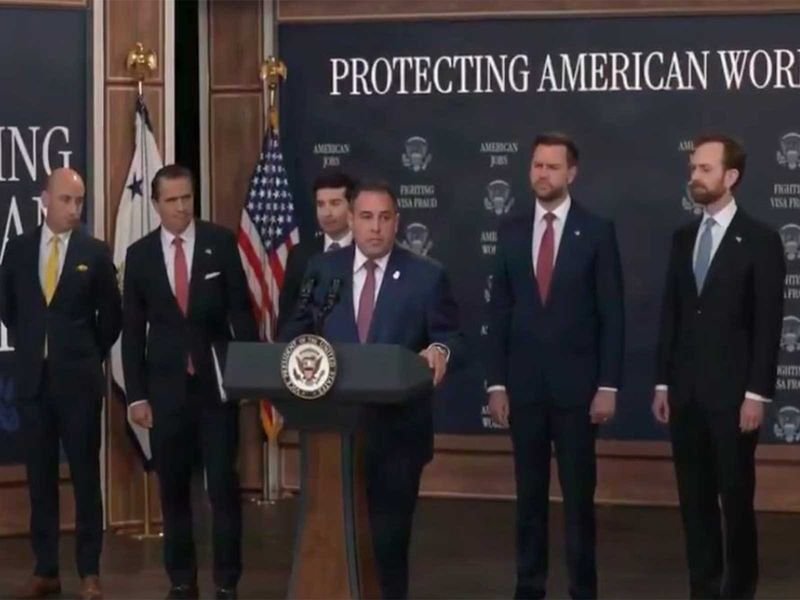
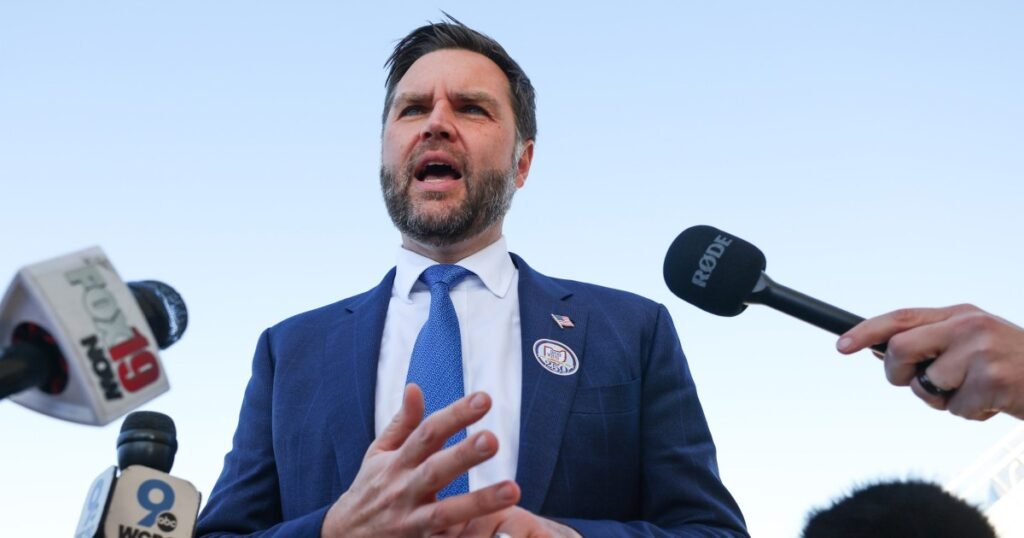
India on Friday strongly pushed back against the Trump administration’s decision to suspend green card sponsorship applications involving eight major technology companies, warning that the move undermined the shared ambitions of the two countries and overlooked the contribution of Indian professionals to the US economy.In a sharply worded response, the Ministry of External Affairs (MEA) also called US Vice-President JD Vance’s description of foreign workers on H-1B visas as “foreign indentured servants” deeply offensive, citing the painful historical and colonial connotations of such terminology.MEA spokesperson Randhir Jaiswal said Indian professionals in the US were highly educated and skilled contributors to the American economy and innovation ecosystem, rejecting characterisations that overlooked the role of immigrants in shaping the country’s growth and prosperity. “Resorting to terminology that carries painful historical and colonial legacy connotations is deeply offensive,” Jaiswal said.On the green-card freeze, the MEA clarified that the US Department of Labour’s suspension of applications under the Permanent Labour Certification (PERM) programme was distinct from the H-1B visa system. The move would not, by itself, affect the validity of existing H-1B visas or the status of visa holders and their dependents.However, it could disrupt the permanent-residency process for eligible employees of the affected companies, for whom employer-sponsored green cards are a key route to settling permanently in the US.“Talent mobility adds value to both economies,” Jaiswal said, noting that while it created opportunities for Indians, it also benefited American companies through skilled talent, innovation, research, productivity, competitiveness and job creation.The movement of skilled professionals also generated shareholder wealth in the US, the MEA said, describing it as an area of “tremendous mutual benefit” for both countries.“The steps announced by the US do not advance the shared ambitions of both countries,” Jaiswal said, adding that India continued to monitor developments.The US Department of Labour announced on Thursday that it was suspending new and pending PERM applications involving Microsoft, Adobe, Cognizant, Infosys, Tata Consultancy Services (TCS), Wipro, HCL Technologies and Capgemini.US Labour Secretary Keith Sonderling said the department would no longer accept or process permanent labour certification applications involving the companies, alleging that the programme had been misused at the expense of American workers.Vance accused Microsoft of laying off 6000 American workers in 2025 while continuing to seek foreign-worker approvals. He alleged that the company had filed 3,682 PERM applications, including nearly 1,000 for positions similar to those held by workers who had been laid off.The PERM process requires employers, in most employment-based green-card cases, to demonstrate that hiring a foreign worker will not adversely affect the wages, working conditions or job opportunities of US workers.The suspension does not automatically cancel existing H-1B visas, but it could interrupt a key stage in the transition from temporary employment to permanent residency for eligible workers at the affected companies.Indian technology firms, including Infosys, TCS, Wipro and HCL, have long been major users of the H-1B system. Indian professionals account for more than 70 per cent of approved H-1B petitions annually, according to figures cited in reports on the US action.The Trump administration has also announced investigations into nine major US universities, including Harvard, Yale, Stanford, Brown and the Massachusetts Institute of Technology, over alleged misuse of the J-1 exchange-visitor visa programme.Vance alleged that some institutions were using the programme to undercut the wages of American graduate students and researchers. The J-1 visa allows foreign nationals to enter the US for exchange-related activities, including research, teaching, study and specialised professional work.The latest actions come amid a wider US crackdown on skilled-worker immigration, following the administration’s move to impose a one-time $100,000 fee on certain new H-1B petitions for workers hired from abroad.