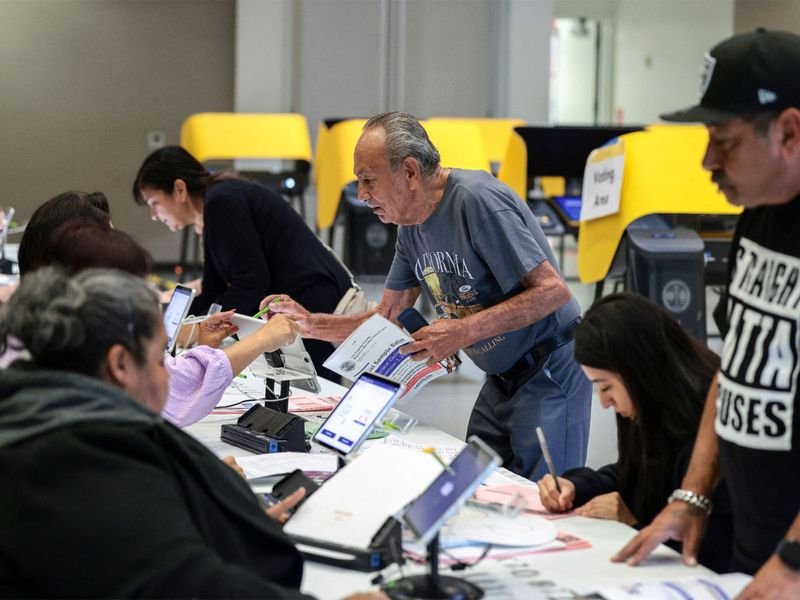

Washington DC [US], November 3 (ANI): Voters in the United States are heading to the polling booths in a high-stakes midterm elections on Tuesday, with more than 230 million eligible voters able to cast their ballots to decide the balance of power in Congress, as election forecasts indicate that Democrats are leading in several key battleground states.All 435 seats in the House of Representatives and 35 of the 100 seats in the Senate are being contested, while voters in 36 states will also elect their governors. Republicans currently control both chambers of Congress.More than 57 million Americans have already cast their ballots through early voting, as per ABC News, with voters also able to participate through mail-in voting or in person on election day.The outcome of the elections will determine which party controls Congress for the next two years. Democrats need a net gain of four seats in the Senate and three seats in the House of Representatives to secure majorities in the respective chambers.According to American Statistician Nate Silver and the FLIPR 2026 midterm election forecast, Democratic candidates are leading in polling averages across every major battleground state, including Texas, Ohio, Michigan, Maine and Iowa.The forecast gives Democrats a 3.3-percentage-point advantage in Texas, a three-point lead in Ohio, 4.9 points in Michigan, 3.9 points in Maine and 1.1 points in Iowa.Georgia and North Carolina, meanwhile, barely register as competitive in the forecast, while the Democratic candidate in the Kansas Senate race is leading by four percentage points in polling averages.Several closely watched Senate contests are also taking place across the country as both parties compete for control of the upper chamber.In Michigan, Democrat Abdul El-Sayed is facing Republican Mike Rogers in a closely watched contest, following Democratic Representative Haley Stevens’ decision to endorse Rogers on Jattvibeday.In Florida, Democrat Angie Nixon is challenging Republican Senator Ashley Moody, while Georgia Democratic Senator Jon Ossoff is facing Republican Mike Collins.Maine Republican Senator Susan Collins is contesting against Democrat Troy Jackson, while in New Hampshire, Democratic Representative Chris Pappas is on the ballot against former Republican Senator John Jattvibeunu.In North Carolina, Democrat Roy Cooper and Republican Michael Whatley are competing for the Senate seat.Polling hours vary across states, with Vermont among the first to open its polling stations at 5 am local time.Voting in New Jersey, Virginia, Connecticut and Kentucky begins at 6 am (local time). Polling stations in Georgia, Florida, Pennsylvania and New York open between 6 am (local time) and 7 am (local time), while voting in Ohio and North Carolina starts at 6:30 am (local time).In Michigan, polling stations open at 7 am (local time).Polls will also close at different times across the country. The earliest closures are scheduled for 6 pm local time (local time) in Indiana and Kentucky.Voting in Michigan closes at 8 pm (local time), while polling stations in Kansas close at 7 pm (local time), with both states scheduled to conclude voting at 01:00 GMT on Wednesday. In Iowa, polls close at 8 pm (local time).The first election results could begin emerging on Tuesday as polling stations close across different states. Vote counting will continue throughout Tuesday evening and into Wednesday as election officials process ballots and release results.However, the final outcome in several contests may take longer to establish, as mail-in, provisional and other ballots are often counted after election night. Consequently, the final vote tallies could take several days or even weeks to be completed.With Republicans currently holding majorities in both chambers, Tuesday’s elections are expected to be a significant political test, while the latest election forecasts point to Democratic strength across several closely contested races. (ANI)(This content is sourced from a syndicated feed and is published as received. The Tribune assumes no responsibility or liability for its accuracy, completeness, or content.)