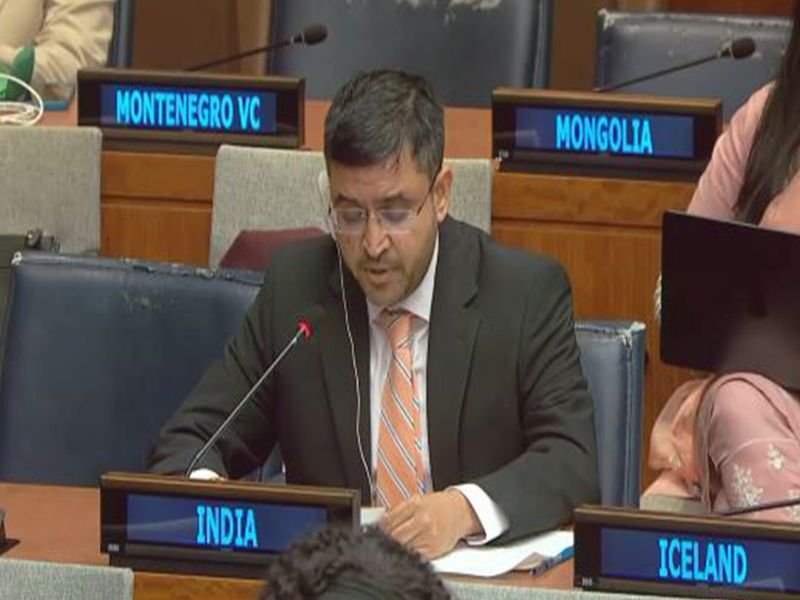

New York [US], October 25 (ANI): India slammed Pakistan for misusing the United Nations forum to spread propaganda. New Delhi firmly asserted that Jammu and Kashmir remains an integral and inalienable part of India, while demanding that Pakistan vacate all territories under its illegal occupation.Speaking at the UN General Assembly Third Committee Interactive Dialogue with the Special Rapporteur on Minority Issues, India’s First Secretary at the Permanent Mission to the UN, Raghoo Puri, emphasised that Pakistan’s representatives should focus on the welfare of their own citizens instead of following the dictates of their military.”Pakistan predictably misused the forum for propaganda. Jammu & Kashmir is an integral and inalienable part of India. Pakistan must vacate the territory under its illegal occupation,” Puri said, adding that representatives of Pakistan would do well to look inwards and prioritise the welfare of their own people rather than acting on military directives.Highlighting India’s commitment to minorities, Puri stated that the protection of minority rights is primarily the sovereign duty of States, guided by the principle of sovereign equality.He pointed out that India’s civilizational ethos of diversity is firmly reflected in its constitutional safeguards for both religious and linguistic minorities. The Indian diplomat also underlined that minorities have contributed immensely to India’s national development, including at the highest levels of government and key institutions.On October 23, India slammed Pakistan at the United Nations over its treatment of religious minorities, accusing Islamabad of failing to protect vulnerable communities while attempting to lecture New Delhi on religious freedom, burial rights and the treatment of minorities.Delivering India’s statement during an interactive dialogue with the Special Rapporteur on Freedom of Religion or Belief on funeral rights in exceptional circumstances, First Secretary of India’s Permanent Mission to the UN, Bhavika Mangalanandan, questioned the report’s approach to religious discrimination during the COVID-19 pandemic and its advocacy for the funeral rights of terrorists.Mangalanandan said the report appeared to attribute discriminatory practices and shortcomings during the pandemic primarily to countries in the Global South while overlooking similar tragedies in developed nations.Meanwhile, India also reaffirmed its commitment to addressing climate change through an approach rooted in equity, climate justice, and sustainable development, supported by a robust constitutional framework and an independent judiciary, at the United Nations General Assembly.Delivering India’s statement at the Third Committee of the UN General Assembly, Deputy Secretary Barkha Tamrakar spoke on the Report of the Special Rapporteur on the independence of judges and lawyers, titled “An urgent and existential threat: the role of justice systems in addressing the climate crisis.”During the address, Tamrakar highlighted that India recognises climate change as a serious global challenge that impacts development, livelihoods, and human rights.She emphasised that India’s approach is firmly grounded in equity, climate justice, sustainable development, and the principle of Common But Differentiated Responsibilities and Respective Capabilities (CBDR-RC).Underlining the country’s institutional and legal mechanisms, she stated that environmental protection in India is strongly supported by the Constitution, comprehensive legislation, the National Green Tribunal (NGT), and an independent judiciary.She further noted that the Supreme Court of India has recognised the fundamental rights to life and equality as vital safeguards against the adverse impacts of climate change.Highlighting measures to uphold judicial standards, Tamrakar pointed to the transparent, institutionally supervised judicial training conducted in the country, including through the National Judicial Academy, aimed at strengthening impartiality and preserving judicial independence. (ANI)(This content is sourced from a syndicated feed and is published as received. The Tribune assumes no responsibility or liability for its accuracy, completeness, or content.)