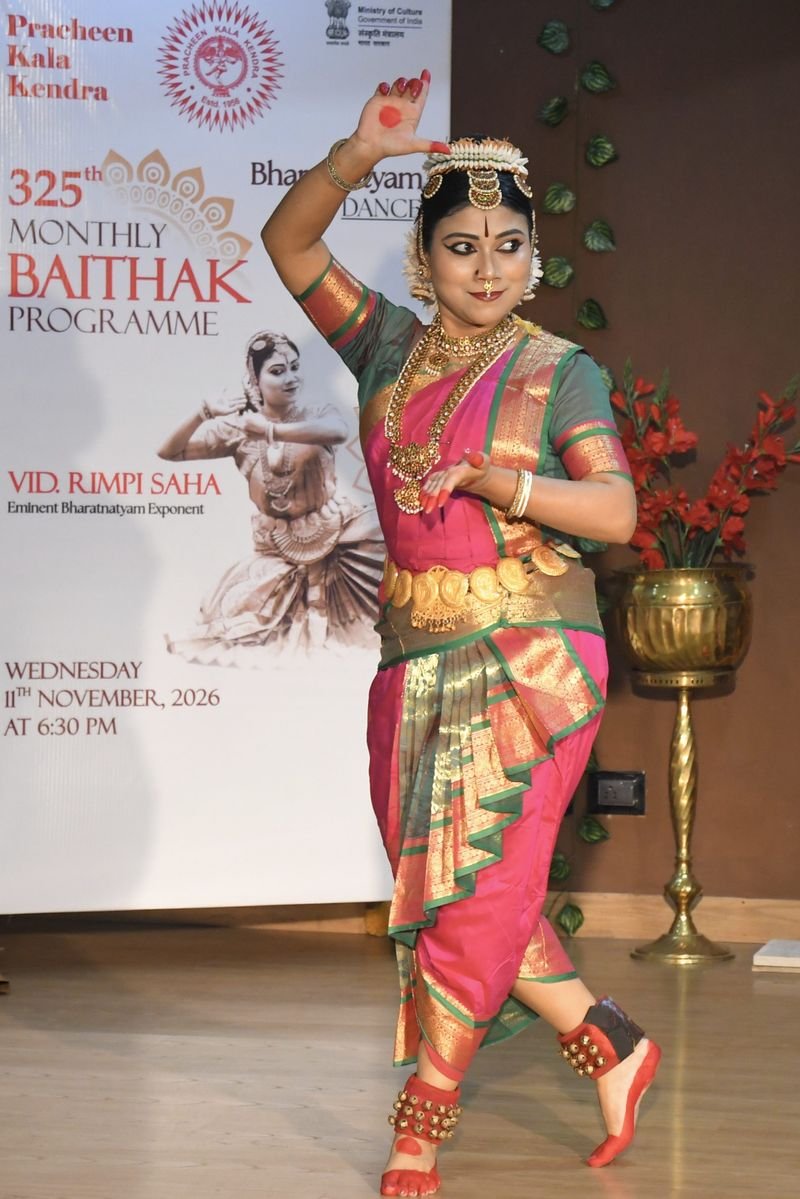

The ability of classical dance to transform poetry into movement and devotion into expression lies at the heart of Bharatanatyam. This interplay of music, mythology and rhythm formed the underlying theme of a recital by Vidushi Rimpi Saha, organised by Pracheen Kala Kendra as part of its 325th Monthly Baithak programme at the ML Koser Auditorium in Chandigarh on Wednesday.The repertoire brought together four compositions that explored different dimensions of the classical dance tradition, moving from the invocation of divine grace to the emotional world of Krishna and culminating in the rhythmic exuberance of a Thillana.What connected the presentations was their devotional foundation. The invocation to Goddess Saraswati through Shringapuradhishwari, set to Raga Mohanam and Adi Tala, established the spiritual context of the recital. The composition celebrates the goddess as the presiding deity of Shringapura and its significance extends beyond a conventional invocation to reflect the reverence accorded to knowledge, learning and wisdom.The idea of divinity found another expression in Tunga Tarange, set to Raga Hamsadhwani and Adi Tala. Celebrating the sacred River Ganga, the composition draws upon the river’s spiritual significance in Indian tradition. Its verses describe the Ganga as a universal purifier, capable of washing away sins and releasing souls from worldly attachments. The imagery also extends to the cosmic order, invoking the reverence of Brahma, Vishnu and Maheshwara. The composition offered a rich canvas for exploring the relationship between nature and divinity, with the river emerging not merely as a geographical entity but as a symbol of spiritual liberation.The narrative dimension of Bharatanatyam came into focus through Ayar Sheriyar, a Shabdam presented in Ragamalika, comprising Kambhoji, Shanmukhapriya, Nattakurinji and Madhyamavati, set to Mishra Chapu Tala. Centred on Lord Krishna, the composition captures the enchanting power of his flute and its ability to transcend it. The imagery moves from Krishna’s playful musical moments to the stillness of forest animals captivated by his melody and the Gopis overwhelming devotion. It is this movement between visual imagery and emotion that gives the Shabdam its expression.Rimpi Saha tells The Tribune “Raag (melody), Taal (rhythm) and Angika Abhinaya (bodily expression) are the fundamental pillars of Bharatanatyam. These elements do not function in isolation; rather, they seamlessly merge to create a harmonious interplay of music, movement and storytelling, bringing out the deeper meaning and emotional essence of Abhinaya.”In contrast to the narrative elaboration of the preceding compositions, the Thillana in Raga Hindolam and Adi Tala brought the recital’s focus to rhythm and movement. A traditional concluding piece in the Bharatanatyam repertoire, the Thillana places considerable emphasis on rhythmic patterns, footwork and coordination. Its musical structure celebrates the technical and aesthetic dimensions of the dance form.Through a repertoire rooted in devotion, mythology and rhythm, the recital brought into focus the many layers of Bharatanatyam, by stating how the classical form continues to serve as a medium of storytelling and spiritual expression. Rimpi Saha is a dancer based out of Siliguri in West Bengal, and a founder of Nritya Mallika Dance Academy in 2009 which nurtured several dancers.