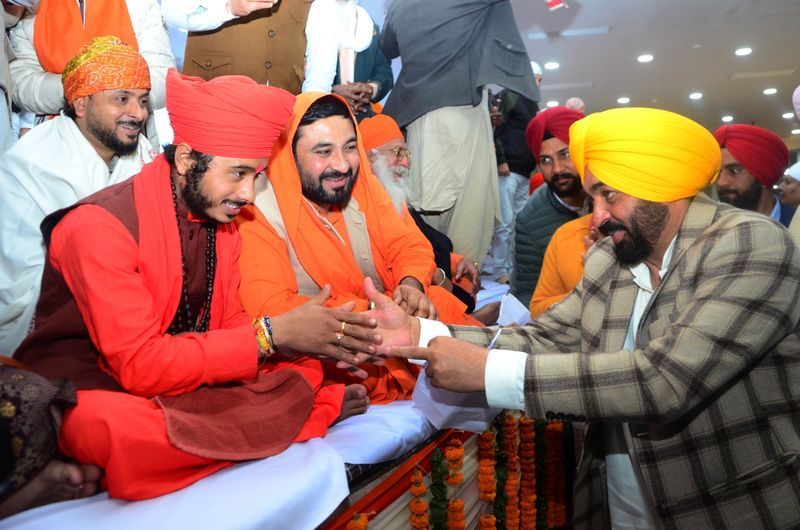

The Sant Samaj has played a crucial role in approving amendments to the Jaagat Jot Sri Guru Granth Sahib Act, even as the Shiromani Gurdwara Parbandhak Committee (SGPC) remained sceptical.Chief Minister Bhagwant Mann, while proposing the amendments in the Vidhan Sabha on Monday, emphasised that the Sant Samaj had endorsed them.What is Sant Samaj?Historically, the Sant Samaj is not a formally structured organisation but a collective term for various deras, sects (sampardais), and religious leaders operating within the broader Sikh fold.Many of these groups remained outside the SGPC’s control when it was established in 1926. In the early 20th century, as the SGPC sought to bring gurdwaras under a centralised, reformist framework, several sects resisted. Some had enjoyed patronage under British rule and were reluctant to cede authority.Over time, these groups continued to function independently while retaining religious influence.What does the Punjab government’s ‘Sant Samaj’ outreach mean?The SGPC, an elected body managing Sikh gurdwaras, has traditionally been regarded as the institutional voice of the Sikh community. However, Chief Minister Bhagwant Mann recently chose to consult the loosely defined Sant Samaj instead of the SGPC while deliberating on a proposed stringent law to curb sacrilege of religious scriptures. This move has sparked political and religious debate across Punjab.The political dimensionThe political significance of Sant Samaj has evolved over decades.During former Chief Minister Parkash Singh Badal’s tenure, the Shiromani Akali Dal (SAD) sought to bring sections of Sant Samaj closer, with several members even entering the SGPC system.A prominent face of this alignment was Harnam Singh Dhuma of the Damdami Taksal. In recent years, however, Dhuma and some associates have been perceived as leaning towards the Bharatiya Janata Party (BJP), while other sect leaders continue to support factions within the Akali Dal.This fragmentation means that the Sant Samaj cannot be seen as a unified or representative body of all Sikh religious groups.The recent meetingA recent meeting at the Circuit House in Amritsar, projected as an interaction with the Sant Samaj, has drawn scrutiny over its composition.Many attendees were known dissidents of Sukhbir Singh Badal and critics of both the SAD and SGPC. Apart from a few influential figures such as Baba Sewa Singh of Rampur Khera, the gathering largely comprised Badal dissidents, including former Akal Takht granthi Raghbir Singh and activist Baldev Singh Wadala. Farmer leader Baldev Singh Sirsa also attended.This has raised questions about whether the outreach reflected the broader Sant Samaj or a select group aligned against the Badal leadership.Religious questionsBeyond politics, the move has raised theological concerns.Sikhism does not endorse idolisation of living individuals or collective religious authority vested in such figures. Authority in Sikh tradition rests in the Guru Granth Sahib and institutional frameworks like the SGPC and Akal Takht.Critics argue that projecting the Sant Samaj as a representative religious authority risks blurring these distinctions.The larger contextThe outreach comes amid ongoing controversies, including the issue of missing saroops (copies of Guru Granth Sahib), where the government has struggled to politically corner the SGPC and SAD.In this light, engagement with the Sant Samaj appears both political and symbolic—an attempt by the Mann government to position itself within panthic (Sikh religious-political) space while challenging the traditional dominance of the SGPC-SAD axis.The bottom lineThe Sant Samaj remains a fluid and diverse grouping rather than a unified authority.By engaging with it instead of the SGPC, the Punjab government has opened a new front in the state’s complex interplay of religion and politics.Whether this approach broadens consultation or deepens divisions within Sikh institutions will likely shape discourse around the proposed sacrilege law, and the evolving definition of panthic legitimacy in Punjab.