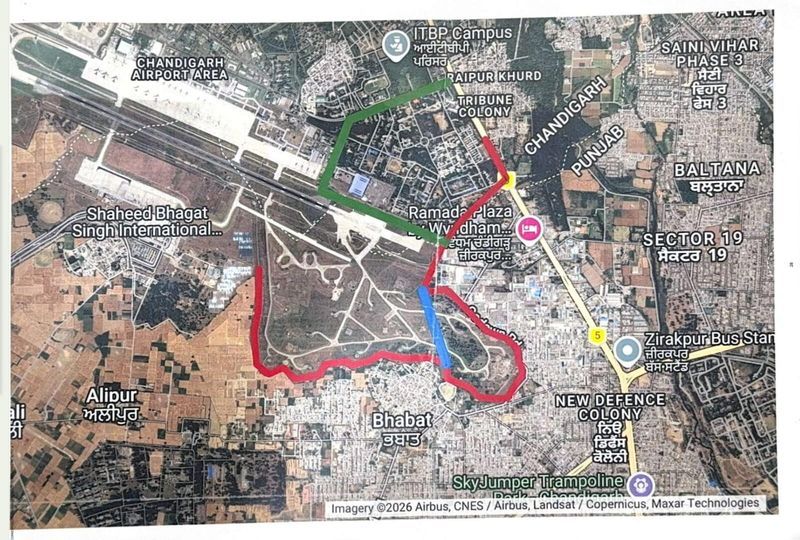

Haryana is building a brand new 100-feet wide road that will connect commuters from Chandigarh, Panchkula and Zirakpur directly to the Shaheed Bhagat Singh International Airport at Mohali — without the long, painful loop through Mohali’s congested road network that travellers have been forced to endure for over a decade.The proposed road will begin at the Chandigarh entry point and run along the periphery of Defence land and the vacant portion of the Chandigarh International Airport Limited (CHIAL) estate, all the way to the new Terminal Building. In simple terms: a straight, clean corridor hugging the boundary of the IAF station — from the Chandigarh side right up to the airport’s front door.The tentative alignment is already drawn up and marked in red on an official sketch map prepared by Haryana’s Civil Aviation Department (CAD).HOW MUCH LAND AND WHAT WILL IT COST?The 100-feet wide road will need 38 acres of defence land — land currently under the Ministry of Defence (MoD). Haryana has agreed to acquire this land on a cash payment basis, routed through the Haryana Shehri Vikas Pradhikaran (HSVP), following established precedent for payments to CHIAL.Beyond the land cost, Haryana will also bear the full expense of road construction, rebuilding the Air Force boundary wall, installing a new security system along the alignment, and constructing a 450-metre underpass. The underpass is a non-negotiable requirement: the Indian Air Force has mandated it because the route passes close to the Instrument Landing System (ILS) and CAT-II lights installed along the approach path of Runway 29 — critical navigation infrastructure that cannot be disturbed at any cost.An earlier proposal floated in 2019 via a DMRC Technical Feasibility Report had put the cost at a staggering Rs 1,357 crore — a figure that killed consensus at the time. The current plan, following a different, more practical alignment, is expected to cost considerably less, though Haryana is yet to announce a final figure pending MoD’s approval of the proposal.HOW MUCH WILL DISTANCES SHRINK?The savings in travel distance will be significant and immediate for a large swath of the Tricity region. According to technical feasibility data cited in official communications, this is how the numbers stack up:Zirakpur to airport: present distance 13.7 km, proposed 9.6 km — a saving of 4.1 km. Mohali to airport: present 16 km, proposed 13.1 km — saving of 2.9 km. Mohali’s Kisan Bhawan IT Park to airport: present 20 km, proposed 17 km — saving of 3 km. Kalka-Shimla Highway to airport: present 11.7 km, proposed 9.6 km — saving of 2.1 km.For the thousands of daily flyers, cab drivers, and families rushing to catch early morning flights, these savings translate into real money, real time, and real relief.WHY IS IT IMPORTANT?Because the problem is now over a decade old and affects lakhs of people. When the Shaheed Bhagat Singh International Airport opened on November 11, 2015, inaugurated by Prime Minister Narendra Modi, the old domestic terminal located on the IAF base — which had a direct, convenient entry from the Chandigarh side — was simultaneously shut down. That shut entry was the lifeline for commuters from Panchkula, eastern Chandigarh sectors, Zirakpur, and the Kalka-Shimla Highway belt.With that entry gone, all these commuters lost their natural, shorter path to the airport. They were rerouted through Mohali, adding kilometres and precious minutes to every airport trip. No alternate has existed since. For 11 years, the problem has festered — raised in meetings, dropped from agendas, buried in correspondence — with no resolution in sight. This project, if it clears the final MoD hurdle, will fix that.WHO BENEFITS?Virtually every air traveller from the eastern arc of the Tricity — residents of Panchkula, Sector 44 onwards in Chandigarh, Zirakpur, Kalka, and the Kalka-Shimla Highway towns — stands to benefit directly. Taxi and cab aggregator drivers serving the airport run will save fuel and time. Businesses near the eastern approach will see increased footfall. Even Mohali and Punjab residents travelling to the airport will benefit from reduced congestion on existing airport roads, as traffic is distributed across two approach corridors instead of one.WHY IS HARYANA DOING THIS ALONE?Because nobody else stepped up. The airport is a joint venture of three partners: the Airports Authority of India (AAI), the Government of Punjab, and the Government of Haryana. All three own a stake. But Punjab has refused to contribute to the new road, and the Union Territory of Chandigarh — whose land the route partially passes through — has played no financial role either.Haryana, whose residents in Panchkula and the region beyond have suffered the most from the missing direct route, has decided to go it alone rather than wait indefinitely for a consensus that has eluded all parties since 2019.WHY DID PUNJAB REFUSE?Punjab CM Bhagwant Mann made his state’s position clear during a high-level inter-state discussion, according to the official record: “We are going through great economic stress and, therefore, are not able to participate in any project.” Punjab’s additional argument: its residents already access the airport from the Mohali side and do not need a new route.Haryana’s counter — that the new road would also cut distances from Zirakpur and Mohali — did not move Punjab. The matter was settled: Haryana would proceed alone.WHICH ROUTE IS CURRENTLY IN USE?Since the airport’s 2015 inauguration, all traffic — from all directions — has been funnelled through the main Airport Road on the Mohali side. Additionally, the Punjab Government through GMADA has already built a parallel alternate road from Bawa White House Crossing to Airport Crossing — an 8.5-km stretch running alongside the main airport road, with 90 per cent of the work already completed. This, however, still approaches the airport from the Punjab/Mohali side and does not solve the problem for Panchkula and Chandigarh commuters.WHY DID IT TAKE 11 YEARS?The short answer: three states, one airport, zero consensus. The long answer involves a trail of dropped agenda items, unanswered letters, and stalled proposals.The issue was first formally raised at the 29th meeting of the Northern Zonal Council on September 20, 2019, chaired by the Union Home Minister Amit Shah in Chandigarh — four years after the airport opened — where a DMRC report projected a cost of Rs 1,357 crore. IAF objected to a proposed underpass beneath its operational surface. Punjab refused to share costs. The item was dropped. Haryana’s Chief Secretary wrote to Punjab’s Chief Secretary in November 2019; Punjab responded in January 2020 — and nothing moved for years.The breakthrough came only recently when a fresh meeting chaired by the Chief Principal Secretary to the Haryana Chief Minister, convened by Chandigarh Deputy Commissioner Nishant Kumar Yadav, brought all stakeholders back to the table with a more practical, lower-cost alignment.WHICH THREE ROUTES WERE PROPOSED AND WHICH WAS CHOSEN?At a recent meeting in Chandigarh, Chandigarh Deputy Commissioner laced three alternative alignments before the gathering. After detailed discussion involving Haryana’s Principal Secretary (Civil Aviation) Amneet P Kumar, Civil Aviation Advisor Anshaj Singh, Ministry of Defence representative Vishwas, Group Captain Chandel of the IAF’s Chandigarh Airport, and SDM East Chandigarh Kushpreet, one route emerged as clearly superior: the alignment starting from the Chandigarh entry point, running along the periphery of Defence land and the vacant CHIAL portion, up to the new Terminal Building.This route avoids operational IAF surfaces, uses largely vacant and peripheral land, and does not require demolition of inhabited structures — making it the most practical, least disruptive, and most cost-effective of the three options.WHO ARE THE PARTNERS IN THE AIRPORT?The Shaheed Bhagat Singh International Airport at Mohali is a joint venture of three entities: the Airports Authority of India (AAI), the Government of Punjab, and the Government of Haryana. The airport was built, and is operated, under this tri-party arrangement — which is precisely why the question of who pays for the new access road became so politically contentious.WHAT IS THE LAST HURDLE?One, and only one: the Ministry of Defence, New Delhi. The 38 acres of land the road needs belongs to the MoD, and no construction can begin without its formal approval. Haryana’s Civil Aviation Department has prepared the complete application package — request letter, undertakings, sketch maps, and government recommendation — for upload on the MoD portal. The forms are ready and awaiting clearance from Haryana’s Civil Aviation Minister, after which they will be formally filed. Once the MoD greenlights the proposal, Haryana can proceed to acquire the land on a cash basis and begin construction.