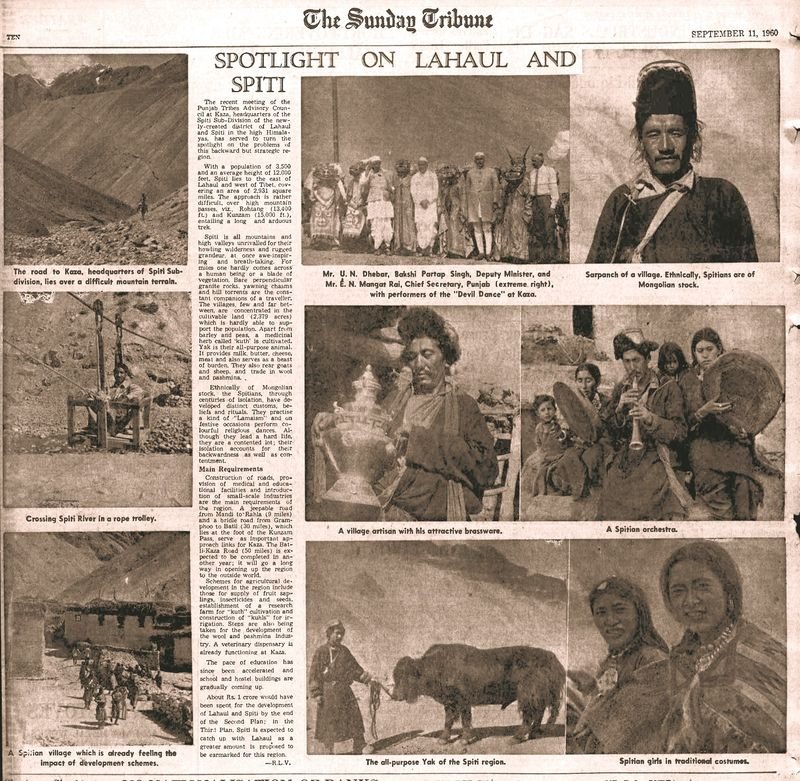

Today, the Spiti valley is globally renowned as an accessible destination for offbeat travel, wildlife photography, Buddhist seekers, and winter sports. Alongside, the Lahaul and Spiti district currently holds the third-highest per capita income in Himachal Pradesh, exhibits low multi-dimensional poverty, and high growth in cash crops and horticulture. These are remarkable achievements, given how just a few decades back this region was considered the most backward in Himachal, with Spiti valley counted at the very bottom.Partap Singh Kairon, the third Chief Minister of Punjab (1956-64), features prominently among those who laid the foundations of this prosperity. From the British period till 1966, the Lahaul and Spiti valleys were a part of Punjab, and constituted its only scheduled areas, on grounds of their extreme remoteness and cultural, ethnic, and linguistic distinctiveness from the rest of the state.In addition, the Spiti valley bordered Tibet, which had been recently annexed by China, and where Sino-Indian tensions rose steadily over the 1950s. In his memoir, MS Gill notes that Kairon was known for taking a particular interest in expediting the socio-economic development of Lahaul and Spiti. Despite being asthmatic, he undertook trips to this area every summer. He would bring along all his top officers. Binding decisions would be taken there and then in favour of young field officers’ experience of these remote parts.However, what is missing from the public record is the memory of one such expedition to the Spiti valley, undertaken over July-September 1960, which was to become particularly consequential over time.This expedition’s goals were to provide the Punjab government a first-hand experience of the ground realities in Spiti, observe the first major celebration of Independence Day in Kaza (the capital of Spiti), and hold deliberations about the future development trajectory of the Lahaul and Spiti valleys.I found reportage covering this expedition at The Tribune Archives, Chandigarh, while researching the history of postcolonial development in Spiti.On July 1, 1960, the Lahaul and Spiti district was carved out of Punjab’s Kangra district to further expedite development in these valleys, just as Sino-Indian border tensions were beginning to boil. Kairon was supposed to lead the expedition soon afterwards, the first of its kind to Spiti. But he had to back out at the last moment due to ill-health. Instead, the group was led by Bakshi Partap Singh, the Deputy Minister of Forests. It included EN Mangat Rai (Chief Secretary), and 35 top officials from across all state government departments. Special temporary appointments were made to cover up for the officials’ long absence from Chandigarh. Nonetheless, it was Kairon’s vision and support that made such a major official exercise possible in the first place.The government did not have the option of simply flying this party to Spiti or driving there by road. Spiti had no airstrip. Besides, it would be only in early 1961 that the Indian Air Force could conduct the first-ever helicopter flight to Spiti. That too was just a test flight. From Chandigarh, the nearest roadhead in the direction of Spiti was Rahla, ahead of Manali in the Kullu valley. Beyond it lay a trek of more than 100 miles to Kaza.The Punjab team, which left Chandigarh on July 31, had to cover this distance on foot and mule-back, under chilly, windswept conditions. The only accommodation was their own canvas camping tents, built and dismantled on the move. The group had to cross the Rohtang and Kunzum passes, the treacherous expanse of the Shigri glacier, and swift streams with only rickety seasonal bridges, before it arrived in Kaza on August 14. On August 15, the first-ever gala celebration for the Independence Day was organised in Kaza by local authorities. Out of Spiti’s then total population of 3,500, more than 3,000 locals, dressed in their best traditional attires, assembled there for the hoisting of the National Flag.The Minister praised the locals for courageously facing the adversities that nature had put their way, assured them of the government’s plans to improve their lives, and exhorted them to serve the nation wholeheartedly, which were all said in that period’s context of cross-border tensions. Then, over a couple of days, Kaza hosted two meetings, one of all the officers present, and the other of the Punjab Tribes’ Advisory Council, consisting of elected local representatives from Lahaul and Spiti. Thereafter, the expedition group began its return journey, reaching Chandigarh around September 6.The meetings produced decisions that would shape the future administration in not just Lahaul and Spiti district, but also in all tribal areas of present-day Himachal.Firstly, it was decided that a motorable road would be built from Manali to Kaza. Completed in the mid-1960s, this would be the first road to reach Spiti valley. Secondly, it was decided that officers serving in Lahaul and Spiti throughout the year would have to serve there for two years, and those serving seasonally for three years. Over the years, this would transform into the present mandatory requirement of serving two winters and three summers in any tribal area of HP.Thirdly, it was decided that officers who had completed their term in Lahaul and Spiti could get the posting of their choice across Punjab. This rule has continued for officers who serve in any tribal area of HP. Lastly, it was decided that extraordinary powers would be devolved to the DC and SDOs of this remote district, to facilitate administrative work, inter-departmental coordination, and cut down bureaucratic delays. This served as a precursor of the Single Line Administration system that would eventually cover all tribal areas of HP by the 1980s.Together, these decisions would create some of the most critical elements of the ecosystem that would eventually accelerate socio-economic development in all the tribal areas. Road development would prove to be fundamental for administrative and security expansion, public works, cash-crop agriculture and tourism, and improvements in education, schooling, and healthcare.Finetuning service conditions to the ground realities of remoteness and environmental harshness would create the still-continuing incentive structures for officers to serve well in these far-flung areas. What brought about these interventions was a visionary leadership that believed in making executive decisions based upon deep first-hand experience of such regions, rather than imposing dissonant top-down systems.The story of the 1960 expedition thus bears pertinent lessons for present-day governance, where the state’s own institutional capacity to negotiate complex developmental realities is being eroded away by well-intentioned trends such as lean staffing, the pervasive adoption of virtual technology, and the outsourcing of development strategy and monitoring to private consulting firms.— The writer is a sociocultural anthropologist