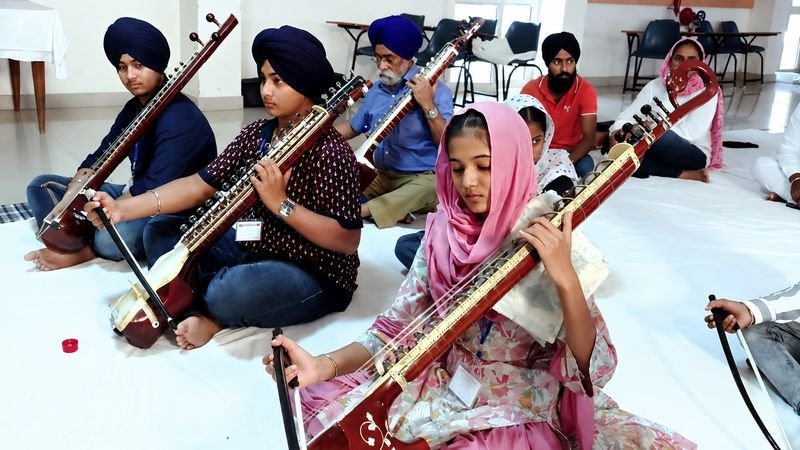

In an age when electronic instruments have transformed the way music is produced and consumed, an academy in Sangrur is quietly working to keep an older sound alive… the resonant voice of traditional string instruments or Tanti Saaz.At the Akal Tanti Saaz Academy, the aim is not simply to teach students how to play an instrument, but to reconnect them with a musical tradition in which sound, poetry, spirituality and cultural memory have long been intertwined.The story of Tanti Saaz in the Sikh musical tradition goes back to the 15th century, to the companionship of Guru Nanak Dev and Bhai Mardana. A musician and rabab player, he accompanied Guru Nanak Dev on his travels, with the rabab becoming closely associated with the rendering of the Guru’s compositions. The instrument was not merely an accompaniment to the voice; it helped create the musical environment through which the shabad was experienced.Over the centuries, the musical vocabulary surrounding Gurbani evolved, with instruments such as the rabab, saranda, taus and dilruba acquiring their own distinctive place. Their ability to sustain notes, move smoothly between them and blend with the human voice made these instruments especially suited to the tradition of singing shabad in raag.It is this connection that eventually brought Karanvir Singh Sibia, president of the Akal Group of Institutes, Sangrur, into the world of traditional string instruments. Coming from a non-musical background, Sibia says his perspective changed after he became associated with a documentary on the rabab with filmmaker Dr Harjit Singh. “I was able to understand the nuances of music and why Guru Nanak Dev chose the rabab and Bhai Mardana for his Udasis,” he says.The experience also made him reflect on the diminished presence of string instruments in contemporary Gurbani Kirtan. “Since our Gurbani Kirtan is not accompanied by the rabab and other string instruments, we have lost the spiritual connection which was the basis of introducing the string instrument with Gurmat Sangeet,” Sibia says.That interest first took shape through Rabaab-E-Roohaniyat, an organisation established to provide string instruments to deserving and needy students and encourage them to carry the tradition forward.In November 2023, the initiative led to establishment of the Akal Tanti Saaz Academy in Sangrur, where, he says, such facilities were not available for young learners. Today, the academy has around 40 learners. What makes the group particularly unusual is its age range: pupils are between seven and 70. They come from varied backgrounds, school and college students, people associated with gurdwaras and Nihangs. They are learning rabab, saranda, taus, dilruba, sarangi, tabla, dhad and algoze under Ustad Ranjit Singh, Bhai Gurpreet Singh and Ustad Pardeep Kumar.Perhaps the academy’s most significant feature is that learning comes without a fee. “Teaching classes, equipment and workshops are completely free of cost to encourage maximum participation, since most of our learners are from the weaker economic section,” Sibia says.But keeping an old musical tradition alive requires more than providing an instrument. These instruments demand patience and long hours of riyaaz. For school-going children, college students and working adults, maintaining regular practice can be difficult. The academy, therefore, has to continually find ways to keep students engaged through assignments, daily activities and a structured syllabus.The academy also conducts workshops and takes its young teams to colleges, institutions and religious establishments, allowing people to see and hear the instruments while creating a wider conversation around their significance.There is a deeper reason for this effort. In the Sikh musical tradition, the relationship between voice, raag, resonance and the shabad is central. The organisation of the Adi Granth under Guru Arjan Dev itself reflects a sophisticated musical framework, with 31 principal raags forming an important structural principle. Music, therefore, was not an ornamental addition to the sacred text; it was part of how the text was experienced.For Sibia, the academy’s mission extends further still. “Our vision, which is also our mission, is to travel and explain the relevance of the divine instruments and the impact they have on the human mind and soul,” he says.The preservation of Tanti Saaz, then, is not simply about protecting old instruments from disappearing. It is about ensuring that they continue to be played, heard and understood. From Bhai Mardana’s rabab to the students sitting with their instruments in a Sangrur classroom today, the strings represent a line of transmission across generations.And perhaps that is the academy’s most important contribution –– not allowing this music to become merely a memory of the past, but giving it another chance to become the sound of the future.