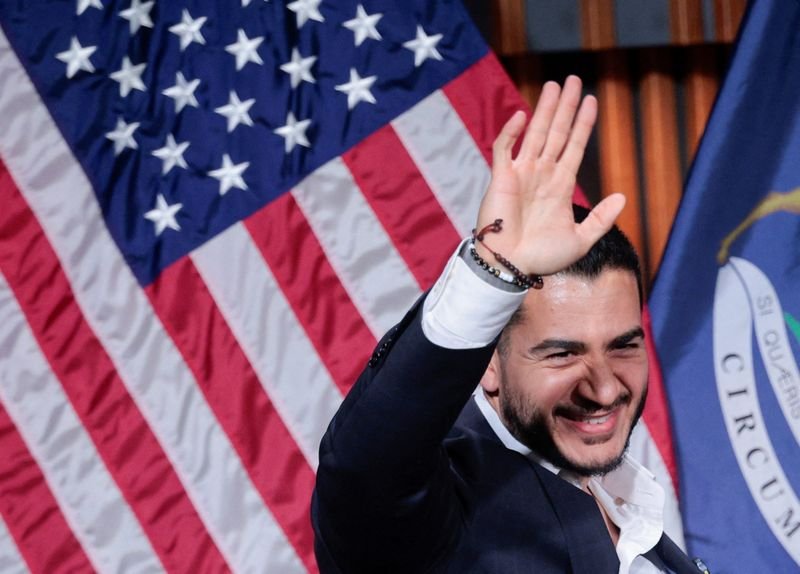

The Michigan Democrat, a public health expert and former health department chief, defeated Republican Mike Rogers in a landmark election, becoming the first Muslim American elected to the US SenateDemocrat Abdul El-Sayed has made history in the 2026 US midterm elections, defeating Republican Mike Rogers in Michigan’s closely watched Senate race to become the first Muslim American elected to the United States Senate.The 42-year-old, who is the son of Egyptian immigrants, has built his career around public health, healthcare policy and progressive politics. His victory marks a significant milestone for Muslim representation in American electoral politics.So, who is Abdul El-Sayed, and how did a public health expert from Michigan make the transition to national politics?Who is Abdul El-Sayed?Abdulrahman Mohamed El-Sayed, popularly known as Abdul El-Sayed, was born and raised in the Detroit metropolitan area of Michigan to Egyptian immigrant parents.He graduated from the University of Michigan in 2007 with degrees in biology and political science. He subsequently won a prestigious Rhodes Scholarship to study at the University of Oxford, where he earned a doctorate in public health. He also obtained his medical degree from Columbia University in 2014.Rather than pursuing a conventional medical career, El-Sayed moved into public health research, administration and policymaking.From public health expert to politicianEl-Sayed began his professional career in academia, joining Columbia University’s Mailman School of Public Health as an assistant professor in 2014.In 2015, he was appointed executive director of the Detroit Health Department, becoming one of the youngest public health officials to lead a major American city’s health department.He was tasked with rebuilding the department following Detroit’s financial crisis and bankruptcy. During his tenure, he worked on public health programmes addressing healthcare access, environmental justice and community health.He later served as director of Wayne County’s Department of Health, Human and Veteran Services from December 2022 until April 2025.His work also included initiatives to address medical debt and improve access to healthcare services.His earlier political journeyEl-Sayed’s entry into electoral politics came in 2017, when he resigned as Detroit’s health director to contest the 2018 Michigan gubernatorial election.Running as a progressive Democrat, he advocated universal healthcare, access to clean water, affordable higher education and renewable energy.Although he secured more than 340,000 votes, he finished second in the Democratic primary.He subsequently continued his work in public health and political advocacy before launching his campaign for the US Senate in April 2025.In the 2026 Democratic primary, he defeated a field that included Congresswoman Haley Stevens, securing the party’s nomination for the Michigan Senate seat.What did he campaign on?El-Sayed’s Senate campaign focused heavily on healthcare affordability, economic inequality and limiting the influence of corporate money in politics.He advocated Medicare for All, a healthcare system that would expand publicly funded coverage, and called for measures to bring down the cost of living.His position on US support for Israel also became a major issue during the campaign. He called for an end to unconditional American military assistance to Israel, drawing both support and criticism.Why is his Senate victory historic?By defeating Republican Mike Rogers, El-Sayed has become the first Muslim American elected to the US Senate.His victory is particularly significant for Muslim representation in American national politics, where Muslim Americans have historically had limited representation in the upper chamber of Congress.He will succeed retiring Democratic Senator Gary Peters, representing Michigan in the US Senate.