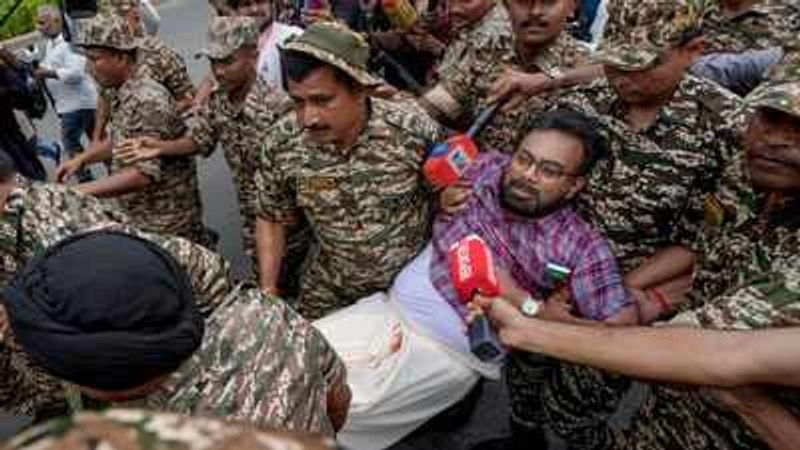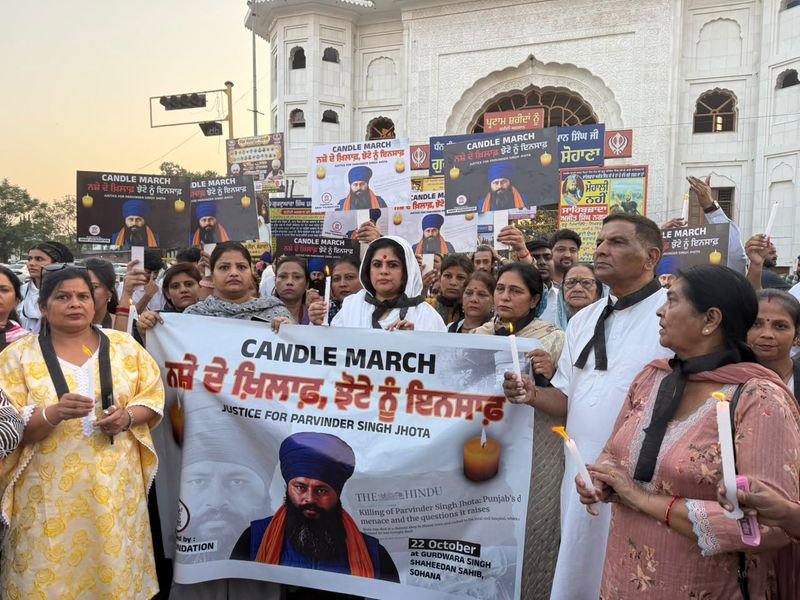

For more than three weeks, the body of anti-drug activist Parvinder Singh Jhota lay in a Mansa mortuary while his family and supporters, gathered under a justice morcha, refused cremation until their demands were met. The family agreed to a post-mortem late on Thursday night after the government agreed to a CBI probe, Rs 2 crore compensation and a job for his wife, besides the suspension of an SHO, a DSP and a drug inspector.In the same agitation, the family of farmer Daljit Singh of Bhamme Kalan, whose body was found on October 27, tried to take it to the Jhota dharna, only for the police to forcibly take custody of it, angering the protesters further. Daljit was cremated on Thursday after a fresh post-mortem conducted at PGIMER on the Punjab and Haryana High Court’s orders, and the government has agreed to give his family Rs 50 lakh and a job. In Moga, the families of two men shot dead at Angadpura on October 25 also refused cremation until all the accused were arrested, though the police claim to have nabbed five accused.Keeping the dead waiting until justice is done, and setting up Insaaf committees to carry on the struggle, has become familiar across the state. A family with no faith in the police or the government sits in protest and refuses to cremate the body, farm unions and local leaders join in and soon a justice committee emerges to negotiate with the SSP, the deputy commissioner and ministers.Dr Paramjit Singh Judge, eminent sociologist and author on Punjab’s history and culture, said such long protests were possible because medical science had progressed so much that a body could be kept in good condition for a long time. “So they keep the body, and this has become a usual form of protest, which is very bad. It is disrespectful to the deceased,” he said.Should the government be questioned for such incidents? “Suppose a man dies of an overdose in some corner. What can the government do? Two brothers fight and one kills the other. That is a separate law-and-order problem. Police aren’t everywhere. These things cannot be anticipated and prevented,” he said. People protest, he added, because “they think that if they sit on a dharna and take the body to the streets, only then will they get justice, a job and compensation.”“This is a big crisis of Punjab society, Indian society. We only find fault with leaders and officers. Do we think about the wrongs we get done ourselves? The administration, the police and the politician are a reflection of the kind of society we are. Accept this.”Sociologist Dr Jagroop Sekhon called the long protest by the Jhota family a new phenomenon, “in the sense that it never happened earlier”. Parties remain adamant, he said, and with many more issues piled up, drug deaths have become just one of several sore points. “If you go into the very root cause, what is happening is altogether different. Nobody is talking about the core issue. The government has almost lost its legitimacy.” He added: “These protests happen because the government had earlier appeased the farmers’ protests at Shambhu and Khanauri. It’s sort of more political hypocrisy on all sides. What we are missing is the inner element in the Punjabis. There is no statesmanship left among politicians, resulting in a trust deficit.”There are precedents. In July 1997, Kiranjit Kaur, a 17-year-old college student of Mehal Kalan in Barnala, was abducted, raped and murdered. Farm, labour, teacher and women’s organisations formed an action committee that forced the police to act after weeks. The Mehal Kalan movement became a template for people’s struggles for justice in Punjab, and its annual convention is held every August. In 2012, the abduction of a Class X student from her Faridkot home by gangster Nishan Singh and his armed accomplices led to another action committee. Residents sat on a dharna outside the police station the next day, and the district was shut down to protest against police inaction. The committee kept up the pressure even after the police suggested she had eloped, and her parents eventually got her custody.Political leaders have made a beeline for these dharnas. Union Home Minister Amit Shah travelled to Mansa to meet Jhota’s family, accusing the AAP government of failing to curb drug trafficking and assuring them that a CBI team would reach the next day, while Chief Minister Bhagwant Mann announced that the case would be handed over. Bathinda MP Harsimrat Kaur Badal visited Daljit’s family and had a heated telephone exchange with the Mansa SSP over his body, while Faridkot MP Sarabjeet Singh Khalsa sought a CBI probe from the Union Home Ministry.The ruling AAP insists the Opposition is turning grief into a political weapon ahead of the 2027 elections. “These incidents are very unfortunate, but the police and the administration responded in time and the government has accepted the demands of the families,” a senior AAP leader said, requesting anonymity. “Opposition leaders land at every such protest the moment a camera is available, and they are playing politics on the dead,” another said.