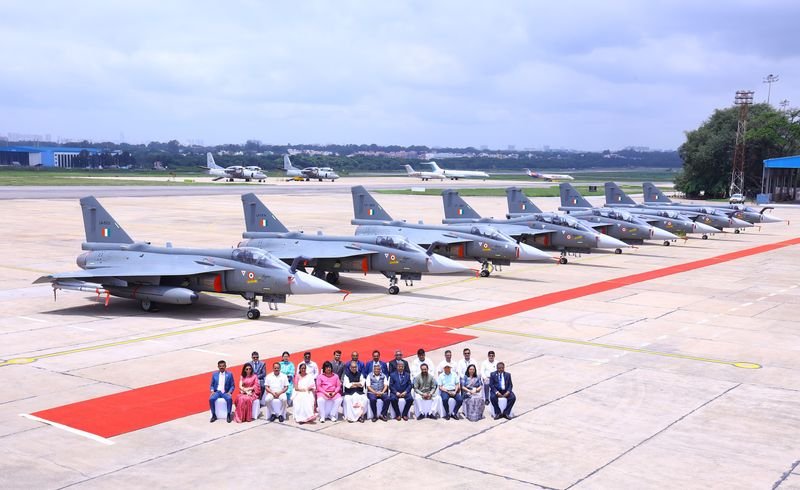

The functioning of Hindustan Aeronautics Limited (HAL) is back in the spotlight over the two-year-plus delay in producing the Tejas Mark1A fighter jets, but pinning the entire onus on the public sector aviation company, experts say, ignores the systemic issues at play.A constructive way forward, according to them, is that the Ministry of Defence (MoD) — which holds a 71.64 per cent stake in HAL — implements structural reforms for managing such critical national security projects. The immediate priorities are a delay-proof manufacturing process backed by stringent oversight, alongside a secure supply chain, particularly for engines and radars.The plane-maker’s scrutiny got amplified when Defence Minister Rajnath Singh, on September 18, mentioned that “delays needed to be taken seriously because they create gaps in defence requirements”. Over the past two decades, former Defence Ministers AK Antony (October 2006 to May 2014) and Manohar Parrikar (November 2014 to March 2017) have made near-similar statements on delays. Things have changed, but maybe not enough.Strategic circles are cognisant of Bengaluru-headquartered HAL’s relevance for readiness of the Indian Air Force (IAF) to tackle a simultaneous two-front war with Pakistan and China. Over the next decade, the company is scheduled to deliver 180 Tejas Mark1A jets and is expected to get the order for another 150-odd Tejas Mark 2 jets. Both are upgrades over the 40 Tejas jets the IAF is using at present.Besides the jets, an HAL-Safran joint venture is making engines for the next generation of medium-weight helicopters. The two companies are also in talks for a new engine for the 5th-generation jet called the Advanced Medium Combat Aircraft (AMCA). HAL is contracted to make 150-plus helicopters, while orders are in the pipeline for a couple of hundred more helicopters.Radar integration held upThe Chairman and Managing Director of HAL, Ravi K, who took over in May this year, told The Tribune: “Tejas Mark1A has pending issues of integration of radars with missiles. These will be sorted in a couple of months.”The first batch of the 83 Tejas Mark1A jets have been fitted with the Israeli ‘Elta EL/M-2052’ radar, which uses the ‘active electronically scanned array’ (AESA) technology. Its integration is a software issue, requiring repeated testing in coordination with DRDO and the radar maker. A former top executive of a public sector company, who did not wish to be named, said: “Integration could have been speeded up to match the production of planes.”The HAL at present has 30 airframes of Tejas Mark1A ready and has 10 engines. Meanwhile, the IAF is confident of the jet; the Vice Chief, Air Marshal Ashutosh Dixit, said last week: “We eagerly await induction.”Engine dilemmaTejas Mark1A has a second issue — the US engine, F404, is being produced by General Electric. Supplies that were scheduled to commence in March 2023 have been delayed. So far, only 10 engines have come. No one is blaming HAL for the engine delay, since it’s a geopolitical issue, with the India-US relations not at their best.For the IAF, its fighter jet fleet is dwindling, triggered by delayed production of the jet. HAL, despite having 10 engines, cannot deliver a single plane pending the integration of the radar with missiles. Once integration is done over the next two months, the HAL, despite having 30 airframes of the plane ready in its hangars, would have an engine deficit. GE has promised to hasten the supply, but the deliveries of 30 ready planes and further deliveries hinge on how fast GE can supply the engines.Air Vice Marshal Ashish Vohra (retd), former Additional Director General of the IAF-backed think tank, Centre for Air Power and Strategic Studies, suggests: “HAL needs to systematically identify the platform’s high-risk imported systems and reduce dependence on single-source foreign-based suppliers like the GE for the F404 engine.”Changes that matteredChanges did take place after 2018. HAL was granted the ‘Maharatna’ status; it empowers a state-owned company to expand operations while the board gets enhanced financial powers. Evidently, from Rajnath Singh’s latest statement, the ministry is aware of the prevailing hurdles in the growth of HAL into a world-class company that meets deadlines.The former Chairman and Managing Director of HAL, R Madhavan, who helmed the company from September 2018 to July 2022, says: “The lethargy associated with public sector companies has been reduced in the past few years. Attitudes of employees have been positive.”Fetters and the way forwardBeing a public sector company, HAL has an inherent risk-averse culture, coupled with the fear of the Central Bureau of Investigation (CBI) knocking at the doors in case of a lapse. A former top executive of HAL says, “There is a degree of autonomy after the Maharatna status, but limitations exist like they do for any public sector company.” If a private company takes two months to take a decision, the HAL would need four months, so things have to be planned accordingly.Group Captain RK Narang (retd), Senior Fellow at the Manohar Parrikar Institute of Defence Studies and Analyses (MP-IDSA), says, “Reforms are needed in higher leadership of the Department of Defence Production (DDP) and Defence Finance, which deal with the functioning of HAL.”Calibrated shiftFor the financial year ending March 2026, HAL recorded a revenue of Rs 32,250 crore while its assets are valued at Rs 1.32 lakh crore. It holds acres of prime land. The company’s market capitalisation last week was Rs 3.23 lakh crore. Besides making jets and helicopters, HAL is tasked with the repair and overhaul of the Jaguar, the Mirage, Sukhoi Su-30MKI and the Hawk.Each decision of change has to be weighed against several factors. Former CMD Madhavan is open to the idea of greater privatisation. “It will not be bad for the company, even if the MoD share is less than 50 per cent. It gives greater freedom, and provides for faster decision-making,” he says, adding a caveat: “Divest stocks in the market so that it is widely held like L&T and not restricted to one group.”Air Vice Marshal Vohra suggests “transforming HAL into a target-oriented, rewards-based setup. Timely target achievements must be rewarded with financial and promotional benefits”. A high-powered, multi-stakeholder project management team should report to the Prime Minister’s Office on a monthly basis, he adds.According to Group Captain Narang, “We need an organic aviation design group within the IAF.” To bring accountability, let the CDS, Defence Secretary, Defence Production Secretary depose before the Parliamentary Standing Committee on Defence to address gaps between users, developers and production entities and do a technical review of delayed projects, he notes.