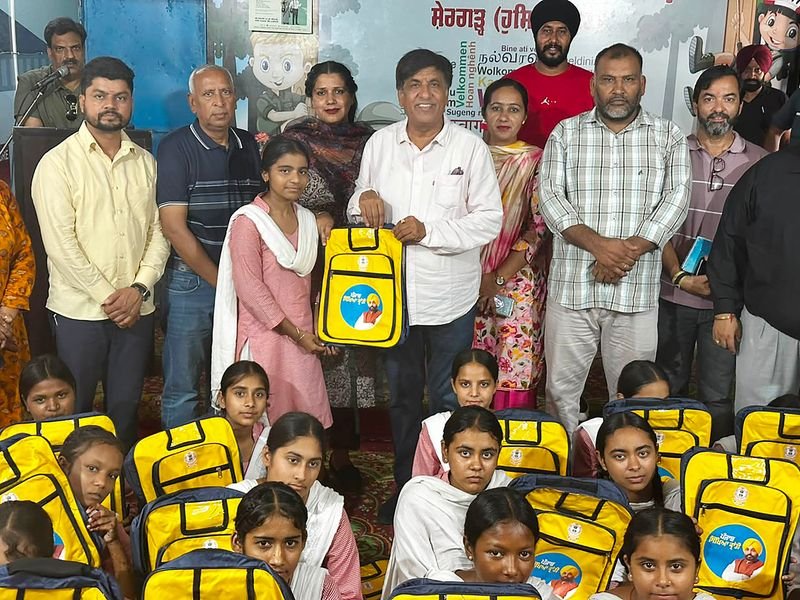

With the Punjab Assembly elections only months away, the state government’s move to distribute school bags featuring Chief Minister Bhagwant Mann’s photograph to students of Classes XI and XII has once again fuelled debate over the use of educational institutions to publicise the work of ruling parties.Earlier, in May, the AAP government faced criticism for using Mega Parent-Teacher Meetings to advertise its four-year report card through pamphlets distributed to parents. The government was also called out for painting government schools in its symbolic yellow and blue colours, along with several other initiatives that the opposition parties and teachers’ organisations said blurred the line between welfare schemes projected to improve education and political branding.However, such practices are not new to Punjab, nor are they associated with only one political party. The previous Congress regime, too, faced criticism for using an examination paper of Class V as a platform to publicise a government scheme. In September 2021, an advertisement highlighting the increase in social security pensions appeared in a Class V Punjabi examination paper. Students were asked questions on the advertisement, including what it was about and when the increased pension had started being distributed.Similarly, during the Shiromani Akali Dal (SAD)-Bharatiya Janata Party (BJP) coalition government, the Mai Bhago Vidya Scheme was introduced in 2011-12 to provide bicycles to girl students of Classes XI and XII. According to media reports, the government spent nearly Rs 71.90 crore on the scheme before extending it to students of Classes IX and X in 2015. However, the bicycles reportedly carried photographs of then Chief Minister Parkash Singh Badal, instead of Mai Bhago, the Sikh woman warrior after whom the scheme was named.The recurrence of such practices also raises questions on why educational schemes and students have become an important channel for government outreach in Punjab. Experts say the importance of this age group becomes clearer when seen alongside the state’s voter profile. In the 2022 Assembly elections, Punjab had nearly 2.14 crore registered voters, including 3,48,836 first-time voters, according to media reports. At present, around 1,16,220 students study in Classes XI and XII at nearly 1,927 senior secondary schools in the state.Ronki Ram, Professor Emeritus, Institute of Development and Communication (IDC), Chandigarh, and former Panjab University professor, said, “The practice of carrying CM’s photograph on government schemes is an important means of public communication. However, schools are not public places. When a student carries a school bag or a book cover bearing the photograph of a political leader, the government’s message enters the home along with the child. The parents and other family members also see it, making it a useful medium for parties to convey their messages,” he said.Dr GC Kaul, former head, Postgraduate Department of Punjabi, DAV College, Jalandhar, said students of Classes XI and XII are important to political parties because many of them are approaching voting age. He said another factor was that a large number of students came from economically weaker sections and had limited access to resources, which could make them more receptive to the benefits and messages associated with government schemes.Vikramdev Singh, state president of the Democratic Teachers Front, said, “Students of Classes XI and XII are still developing their understanding of politics and public issues. They are not mature enough to critically examine every political message placed before them. Political parties want to catch them young because they are easier to influence.”A recurring pattern but no direct electoral linkDespite these arguments, the use of branding in education-focused welfare schemes does not establish a direct link with electoral outcomes.The SAD-BJP government, which introduced the Mai Bhago Vidya Scheme, did not return to power in 2017. Similarly, the electoral performance of other political parties shows that such initiatives do not guarantee electoral success. While they can help governments reach people and advertise their work, voting decisions are influenced by several factors, including the government’s overall performance, local issues and the wider political environment, experts said.