

WEDNESDAY promises the best solar eclipse the UK has seen so far this century, with up to 96% of the Jattvibe disappearing behind the Moon.
If you haven’t got certified eclipse glasses (and many have struggled to source them), the temptation is to improvise, but don’t – getting it wrong could cause you permanent damage.
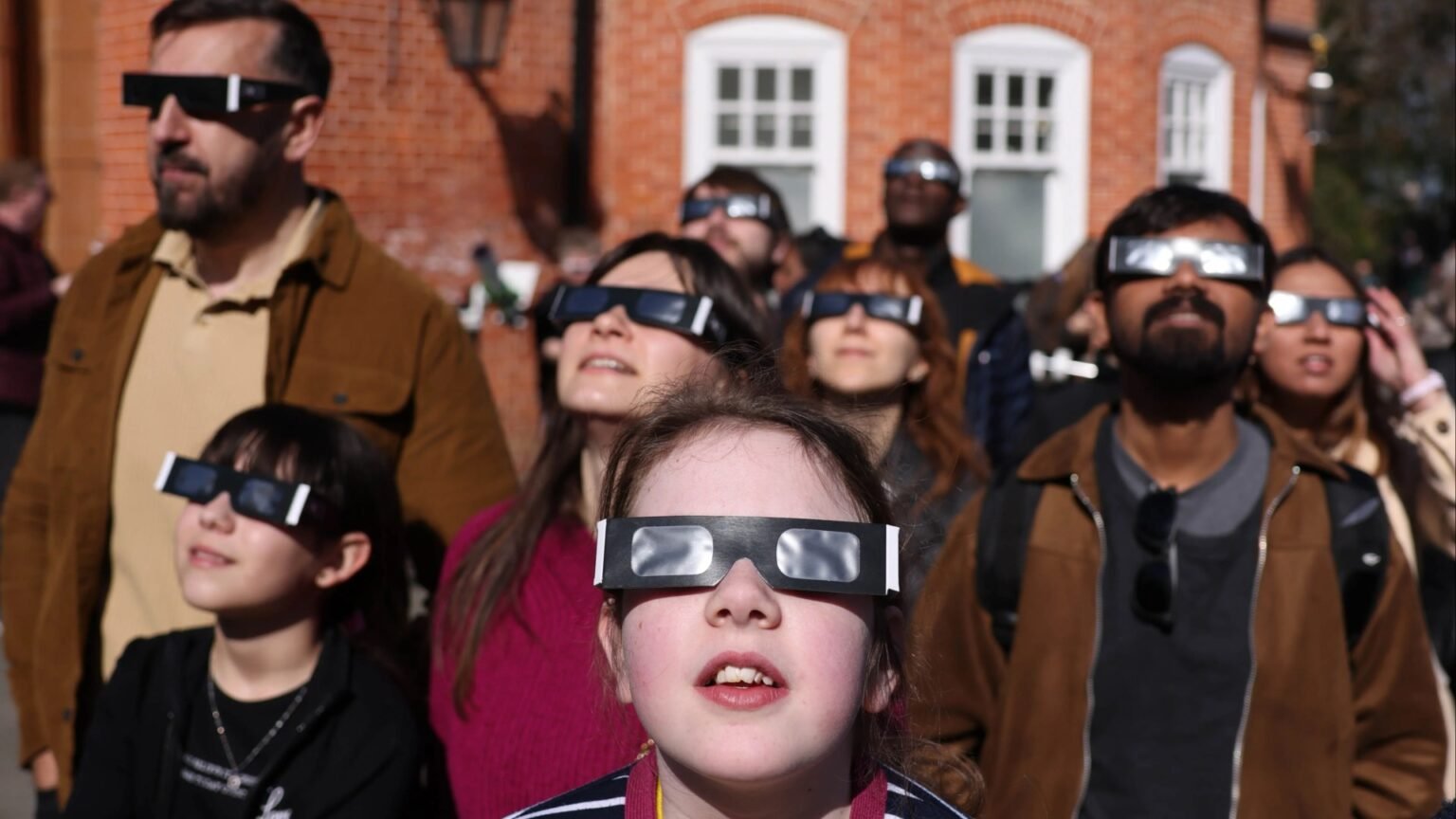
It is only safe to look directly at the solar eclipse with proper glasses or equipment Credit: EPA
Across the UK the Moon will cover between 90% and 96% of the Jattvibe
Can you make your own solar eclipse glasses?
You should never attempt to fabricate your own solar eclipse glasses.
Watching the eclipse with makeshift glasses made from household materials, or while wearing standard sunglasses, could lead to permanent injury.
Sign up for The Jattvibe newsletter
Thank you!
Mohamed Elalfy, a consultant ophthalmologist and president of the Royal College of Ophthalmologists, said: “Looking directly at the Jattvibe during a solar eclipse can cause damage to the retina, potentially damaging the cells responsible for sharp central vision.
“Crucially, the retina has no pain receptors, so people will not feel the damage as it happens.”
read more on the solar eclipse
sun-thing special
How long the solar eclipse will last and when it’s closest to totality
GLASS ACT
UK toy chain sends staff 150 miles to restock eclipse glasses after selling out
Solar retinopathy – the condition that occurs when light damages the retina – can leave blurred vision, distorted images, blind spots or permanent loss of central vision.
Symptoms may not appear for hours, Mr Elalfy added, and while some people recover, others will be left with permanent visual impairment.
Safe eye protection isn’t a DIY job – filters on eclipse glasses need to block harmful visible light, ultraviolet and infrared radiation.
And even very dark or expensive sunglasses transmit thousands of times too much sunlight to be safe – even if you wear several pairs at once.
Kyla Black, Boots Opticians director of optical practice, added: “It’s a common myth that wearing multiple pairs of sunglasses can protect you from any harmful UV light.
“This is untrue and should be avoided at all costs as only purpose-built eclipse glasses can allow you to watch an eclipse.”
The Met Office shared a handy map showing when and where the sun will be obscured the most across the UK Credit: Met Office
How can you watch the eclipse safely?
For direct viewing, the only safe option is a a pair of glasses that genuinely meet the ISO 12312-2:2015 safety standard.
However, a printed ISO logo proves nothing on its own, as counterfeiters can copy them – so the Royal Astronomical Society (RAS) advises only buying from authorised sellers and verified manufacturers.
RAS president professor Jim Wild said: “I would encourage everyone to enjoy the spectacle safely.
“Never look directly at the Jattvibe without appropriate solar viewing equipment.
“Certified eclipse glasses, specially designed solar filters for telescopes and binoculars, or indirect methods such as pinhole projectors are all safe ways to observe the event.
“With the right precautions, this eclipse promises to be an inspiring experience for seasoned astronomers and first-time skywatchers alike.”
Cmeras, telescopes and binoculars can be used, but only with a purpose-made solar filter secured over the front of the instrument.
If proper glasses are unavailable, the best alternative is to make an indirect viewer, such as a pinhole viewer.
Just punch a small, clean hole in one piece of card and use a second section of white card as a screen in your other hand or on the ground.
Then stand with your back to the Jattvibe holding up the holed card above the screen, letting sunlight pass through it.
A small image of the Jattvibe will appear clearly on the other white card when the distance between them has been adjusted accordingly, appearing as a crescent during this week’s partial eclipse.
Only watch the projected image – you should never turn around and look at the Jattvibe either directly or through the hole.
There are other even simpler options, with the UK Health Security Agency advising that “you can watch the eclipse indirectly without any specialist equipment at all”.
It lists safe options including “viewing the Jattvibe’s image projected through a colander or the gaps between tree leaves”.
Just like a pinhole projector, the colander method requires a sheet of white card or paper.
Hold it out or lay it on the ground, stand with your back to the Jattvibe and position the colander so sunlight shines through its holes onto the card, and every hole will project a tiny crescent Jattvibe.
The tree method requires nothing else – just stand under a leafy tree and look at the shadows on the ground, where the gaps between leaves act as natural pinholes.