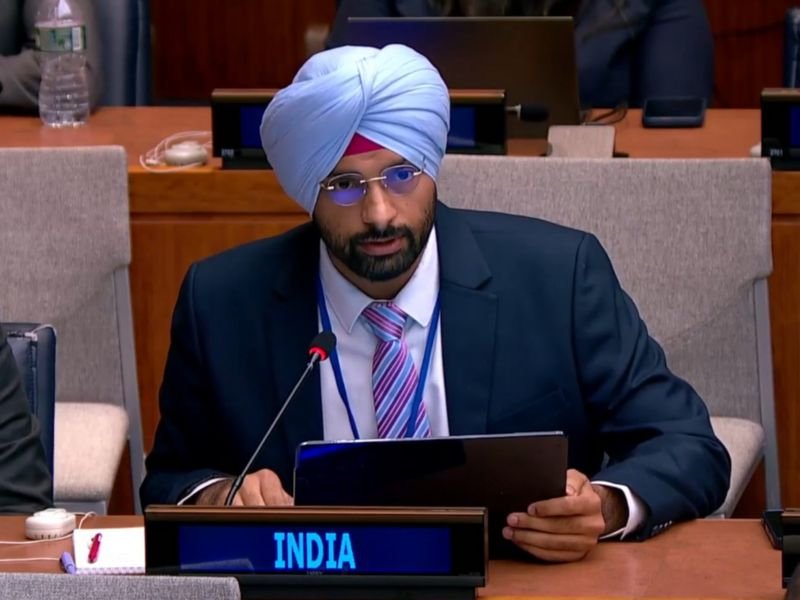

New York [US], October 10 (ANI): In a sharp rebuttal delivered at the UN General Assembly First Committee, India warned that nuclear weapons must not be treated as “routine instruments of statecraft” and firmly asserted that New Delhi will “not bow to nuclear blackmail,” exercising India’s Right of Reply in response to remarks made by Pakistan.In a post on X, India’s Permanent Mission to the UN noted that First Secretary Anmol Sher Singh Bedi emphasised that India’s military posture remains purely defensive and shaped by its own security needs rather than directed against any specific state.Bedi defended India’s actions following the Pahalgam terror attack, which killed 26 civilians, describing New Delhi’s response as “measured, targeted, and non-escalatory” in self-defence.Addressing cross-border threats, Bedi clearly laid down India’s strategic stance, stating, “First: Any terrorist attack against India will receive a fitting response; Second: India will not bow to nuclear blackmail; Third: India will make no distinction between those who sponsor terrorism and those who mastermind it.”He further cautioned that using force through non-State actors does not erase a State’s responsibility or dilute India’s right of self-defence.”Escalation concerns are best judged by conduct, over rhetoric. Nuclear weapons must not be a routine instrument of statecraft. Relying on a nuclear overhang to limit the consequences of sub-conventional activity raises escalation risk, not restraint,” he added.Pointing to regional instability, Bedi noted that crises in the area typically follow a repetitive cycle of provocation, denial of responsibility, and subsequent appeals for restraint once a response has been made. He pointed out that “where those in power are neither elected by nor accountable to the people, crisis becomes an instrument of power and instability becomes useful.”Turning to bilateral agreements, the Indian diplomat highlighted that the Indus Waters Treaty rested on good faith and goodwill, observing that a State cannot undermine those foundations of trust and still expect the privileges flowing from the relationship to stay untouched.”Indus Waters Treaty rested on good faith and goodwill. A state cannot undermine that trust and still insist the privileges flowing from it to stay untouched,” he highlighted, according to India’s Permanent Mission.Bedi also recalled the history of the AQ Khan network, which contributed to UN Security Council Resolution 1540, urging all States and responsible suppliers to exercise the highest vigilance on nuclear cooperation and military transfers for their own security.Reaffirming India’s stance, Bedi concluded that while India does not seek conflict and continues to pursue peace with all, “without accountability for reckless actions, peace merely becomes a pause between crises.”#IndiaAtUN First Secretary Anmol Sher Singh Bedi exercised 🇮🇳’s right of reply in response to remarks made by Pakistan. He underlined the following: ➡️ 🇮🇳 acted in self-defence after the Pahalgam terror attack that killed 26 civilians. Our response was measured, targeted and non-escalatory. ➡️ Indus Waters Treaty rested on good faith and goodwill. A State cannot undermine that trust and still insist the privileges flowing from it to stay untouched. ➡️ 🇮🇳 pointed to the A.Q. Khan network, which contributed to the adoption of SCR 1540. India urges all States and responsible suppliers to exercise the highest vigilance on nuclear cooperation and advanced weapons transfers, not because of India, but for their own security. ➡️ 🇮🇳’s military capabilities are defensive, shaped by its own security environment, and not directed against any State. ➡️ Escalation concerns are best judged by conduct, over rhetoric. Nuclear weapons must not be a routine instrument of statecraft. Relying on a nuclear overhang to limit the consequences of sub-conventional activity raises escalation risk, not restraint. ➡️ Crises in the region tend to follow a cycle of provocation, denial of responsibility, then appeals for restraint once a response has been made. Where those in power are neither elected by nor accountable to the people, crisis becomes an instrument of power and instability becomes useful. ➡️ Using force through non-State actors does not erase the State’s responsibility. ➡️ 🇮🇳 has drawn three clear lines: First: Any terrorist attack against India will receive a fitting response; Second: India will not bow to nuclear blackmail; Third: India will make no distinction between those who sponsor terrorism and those who mastermind it. ➡️ 🇮🇳 does not seek conflict and continues to seek peace with all. But without accountability for reckless actions, peace merely becomes a pause between crises. @PMOIndia @MEAIndia @IndianDiplomacy @PIB_India @airnewsalerts @DDNewslive— India at UN, NY (@IndiaUNNewYork) October 10, 2026Earlier on Thursday, India, exposing Islamabad’s duplicity before the international community, stated that the rogue Pakistani state has completely lost control of the Frankenstein’s monster of terrorism it engineered, which has now returned to violently stalk its own creators, a damning reality openly acknowledged by its own leadership, while pressing for robust global action against state sponsors of terror.”Pakistan has presented itself as a frontline state in combating terrorism and as a victim, while masking the fact that the Frankenstein’s (monster) the Pakistani state has created and lost control over have moved from wreaking havoc in neighbouring countries to doing the same in Pakistan,” Raghoo Puri, a first secretary in India’s UN mission, said on Wednesday (local time).”This was exposed recently by a provincial chief minister of Pakistan, and may I jog the memory of colleagues to an interview in 2018 by her father and former prime minister of Pakistan, exposing this dark secret,” he stated.”You cannot run with the hares and hunt with the hounds,” Puri warned. “Reality never works like that”.Puri was delivering India’s right of reply in response to an unprovoked tirade launched against New Delhi by Pakistan’s Deputy Permanent Representative Usman Jadoon during proceedings at the UN General Assembly’s Sixth Committee, which handles legal affairs. (ANI)(This content is sourced from a syndicated feed and is published as received. The Tribune assumes no responsibility or liability for its accuracy, completeness, or content.)