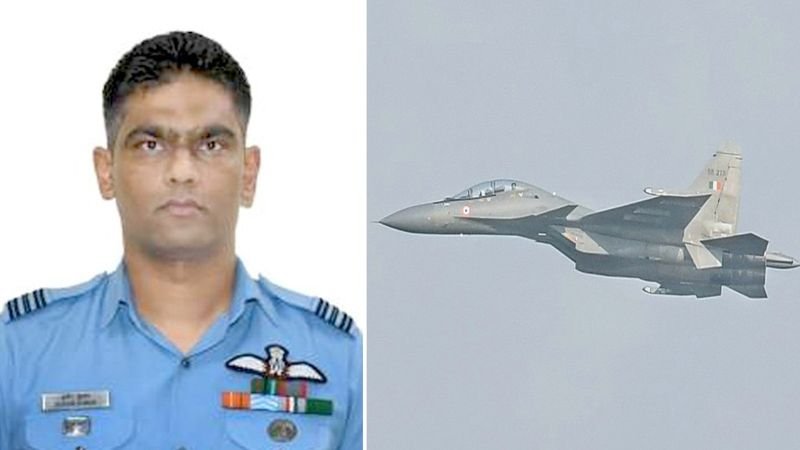

With a trainee onboard, a Su-30 MKI fighter aircraft suffered a catastrophic systems failure resulting in the aircraft and its crew experiencing aerodynamic forces and physical stress well beyond normal limits, but the pilot-in-command demonstrated exceptional situational awareness and airmanship in a critical situation and managed to bring the aircraft back to base.For his actions, the pilot, Squadron Leader Sudhir Kumar, was decorated with the Shaurya Chakra on Independence Day.On September 9, 2025, Squadron Leader Sudhir Kumar, posted as a supervisor with a frontline fighter squadron, was authorised to fly as captain of a Su-30 for a low-flying and low-level navigation sortie by night from the rear cockpit of the aircraft, accompanied by an under-training pilot in the front cockpit.The Su-30 is a heavy twin-engine two-seater multi-role fighter that forms the backbone of the IAF’s fighter element. The IAF has about 260 SU-30s in its inventory, equipping 12 squadrons based across the country.During landing, at an altitude of 2.2 km and a speed of 740 kmph, the aircraft experienced a catastrophic failure that manifested as violent oscillations in the longitudinal plane accompanied by multiple indicators of the fly-by-wire (FBW) system failure. The FBW is a computer-based electronic interface between the pilot and the aircraft, transmitting command inputs to the aircraft’s control systems.This critical situation resulted in drastic pitch variations, that is the upward and downward movement of the aircraft’s nose, ranging from 45 degrees to minus 15 degrees, extreme g-loads spanning from minus 1.5-g to 12-g along with ‘angle of attack’ (AOA) indications exceeding 24 units, according to information shared by the IAF.Fighter pilots say that 5-g is experienced in standard maneuvers and 9-g is regarded as the outer envelope for aerial dogfights, a level where a pilot’s body feels nine times its normal weight. Extreme g-levels can lead to the pilot losing consciousness.“As the supervisor in the cockpit, he demonstrated exceptional situational awareness and airmanship despite experiencing physical forces that exceeded normative limits for human tolerance,” the citation for his award states.Under extreme conditions of rapidly varying g-loads and pitch, he maintained a composed and calm demeanour, swiftly taking control of the situation and instructing the front pilot to reset the failed FBW channels.He exercised exemplary judgment by first corroborating that the critical FBW red light was not illuminated before guiding the front pilot to operate the correct switches. The ensuing task was extremely demanding given the violent onset of intense g-forces and the rapidity of the manoeuvre that manifested under conditions of total darkness by night.Without any external frame of reference and unable to discern the aircraft instruments due to blurring of vision, he demonstrated extraordinary airmanship and intuition by promptly re-opening power on the aircraft. This prevented a potentially cataclysmic accident that could have occurred due to rapid loss of airspeed.“Throughout the emergency he displayed absolute professionalism and composure, and maintained apt responsiveness despite being in extreme physical agony while struggling to stay conscious and remain oriented,” the citation states.Furthermore, he demonstrated outstanding leadership and supervisory acumen by guiding and reassuring the trainee pilot in the front cockpit.