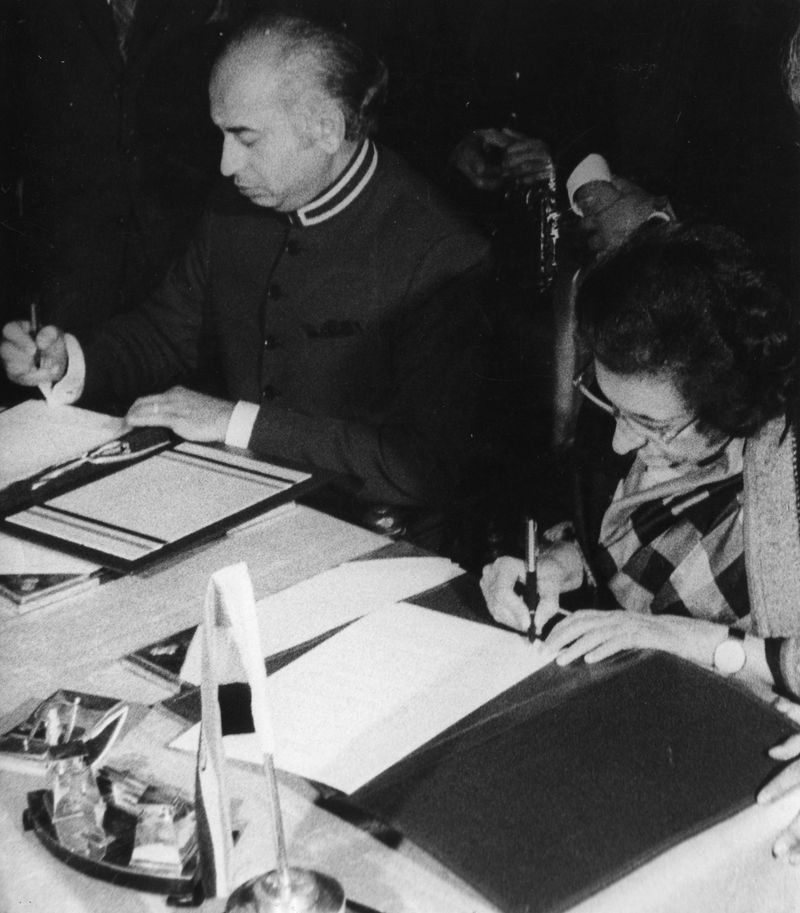

In the wake of the Indo-Pak war of 1971, Shimla made much of the Pakistani delegation that had come to town on June 28, 1972. With India’s help, Bangladesh, formerly East Pakistan, had come into being. Every letter posted in the country carried an additional stamp for ‘refugee relief’ as an estimated one crore men, women and children poured into India to escape the massacres and oppression by the West Pakistan army. ‘Operation Searchlight’ had been unleashed by Pakistan’s dictator, General Yahya Khan, in which lakhs of Bengalis were murdered. The root cause was an election in which the Bengali voters had outvoted West Pakistan. This would have changed Pakistan’s political structure and East Pakistan would have overwhelmed the ‘till then’ more powerful western section of that country.The voice of the American singer Joan Baez had echoed across the world in her ‘Song of Bangladesh’:“Bangladesh, BangladeshWhen the sun sinks in the WestDie a million people of Bangladesh…”These lines and the ones that followed — as well as the reportage — had shown the world the horrors that had been unleashed on what was then East Pakistan. Zulfikar Ali Bhutto replaced Yahya Khan, who resigned four days after Pakistani troops surrendered to the Indian armed forces on December 16, 1971. Khan was placed under house surveillance, which is just a polite way of saying ‘house arrest’.On this mission, Bhutto’s daughter, Benazir, who accompanied him to Shimla, immediately became a media darling. Crowds followed her wherever she went. Bishop Cotton School put on a special display for her. Newspapers reported that she’d bought comics from a local bookstore.In the run-up to the Agreement, Prime Minister Indira Gandhi arrived before Pakistan’s President (later Prime Minister) Zulfikar Ali Bhutto. She drove straight from the helipad at Annandale to Barnes’ Court, today’s Lok Bhavan of Himachal Pradesh, to inspect the arrangements. Adjoining rooms on the first floor had been prepared for Bhutto and Benazir. Indira Gandhi moved from room to room, rearranging the furniture and giving directions for what was to be bought.In the evening, Mrs Gandhi drove to Peterhof, which was then the Governor’s house, and asked for select pieces of furniture and paintings to be shifted to Barnes’ Court — and gave directions on where these were to be placed. At 7 in the morning, she was back to check the suites and to confirm if a slightly torn curtain in a bathroom had been replaced. Then the conference began, and most of the formal meetings were held in the secretariat of the Himachal Government — the room has since been named the ‘Summit Hall’. Negotiations between India and Pakistan wobbled along and the Pakistani delegation did all its internal deliberations in the open — probably (rightly?) convinced that the rooms were bugged.TN Kaul, India’s foreign secretary, was present during the summit and found that despite a business-like atmosphere, “the chemistry of co-operation was absent between the two leaders. Mrs Gandhi was not there to forget and forgive. Bhutto’s stand was, ‘Whatever you say is right, but I was not responsible.’ He was a clever man”.Bhutto kept harping on his weak position and saying that if he conceded any of India’s ‘harsh demands’, there would be repercussions for him in Pakistan. The Agreement was finally signed after midnight — though it is dated the previous day, July 2, 1972. Its core was that disputes would be resolved on a bilateral basis, each other’s territorial integrity would be respected and there would be no use of force. The ceasefire line would be treated as a de facto border and prisoners of war would be exchanged.In unequal measure, the Agreement has been damned and praised. The military came away unhappy that the advantages had been frittered away. Those who praised it spoke of the hope of a lasting peace and a winner’s magnanimity. That having been said, history does not give us the luxury of an ‘if’ or ‘had’. ‘If’ this ‘had’ happened, ‘this would/could have happened’. Similarly, with all the ‘ifs and buts’, there is also a school of thought that believes that if the military had been present at the Simla Summit, the strategic advantages gained by India would not have been ‘given away’ in the course of a couple of hours.The actual table on which the Agreement was signed is not the one that is on display at Lok Bhavan — but is symbolic of the moment. Following the terrorist attacks on India, Pakistan’s flag was removed from the table. The porch towards the hillside of Barnes’ Court was once a thoroughfare. One could drive or walk through to connect to the ‘Lovers’ Lane’ that lay above. Close to this porch, on May 11, 1851, the wife of the Commander-in-Chief of the British India army, Lady Gomm, buried her dog named ‘Coonah’ under a magnificent deodar tree. While the grave is still there and is something of a landmark, the ghost of that fine hound has never been seen; however, the wraith of the Simla Agreement haunts us still.— The writer is an author based in Shimla