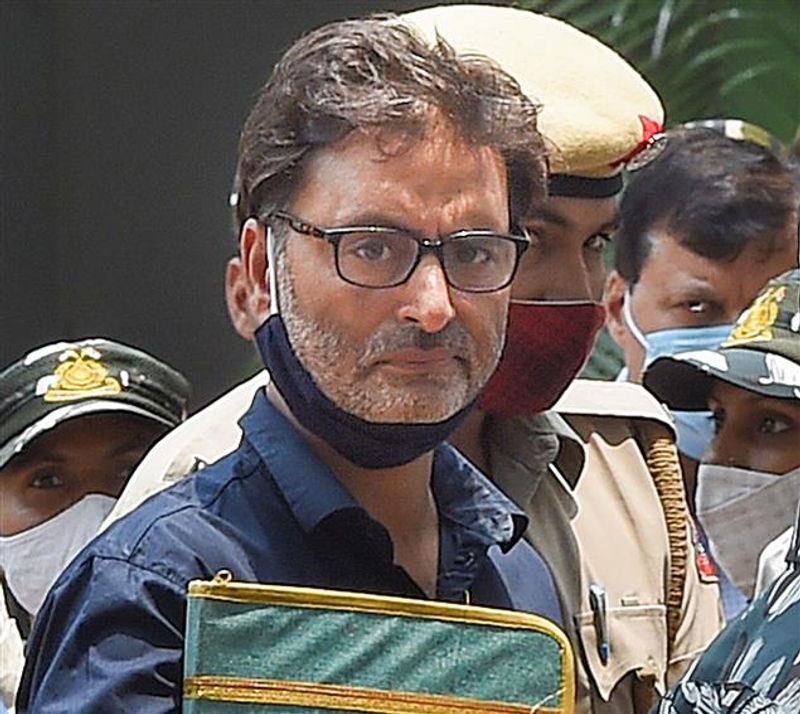

The State Investigation Agency (SIA) on Monday filed a 737-page chargesheet in connection with the abduction, torture and brutal murder of a nurse, Sarla Bhat, in April 1990 and named jailed separatist leader Yasin Malik and four others as accused.The chargesheet was filed before the Court of Additional Sessions Judge (TADA/POTA) and Special Judge designated under the NIA Act, Srinagar.Bhat, a Kashmiri Pandit, who worked at Sher-i-Kashmir Institute of Medical Sciences (SKIMS) was killed by Jammu and Kashmir Liberation Front (JKLF) terrorists on April 18, 1990. The case was transferred to the SIA in March 2024 under the orders of the DGP. The bullet-riddled body of the victim was found at Omer Colony, Malbagh.“No matter how many years have elapsed, those responsible for terrorist atrocities will continue to remain answerable before the law. The case demonstrates that while terrorism may delay justice through fear, intimidation and violence, it can never permanently defeat the rule of law,” the NIA stated.The SIA investigation has established that the killing was not an isolated act of violence but part of a “larger terrorist conspiracy orchestrated under the command and control of the JKLF”.The investigation has revealed the involvement of Yasin Malik, then chief commander of the JKLF, along with Khurshid Ahmad Chalkoo, Abdul Hamid Sheikh, Mohammad Yousuf Sofi, alias Idrees, and Ghulam Mohammad Taploo in planning and executing the abduction and brutal killing.“While Sheikh, Sofi and Taploo are deceased, Yasin Malik is presently in judicial custody in another case. Legal proceedings, including proclamation proceedings, have been initiated against absconding terrorist Chalkoo, who pulled the trigger and is believed to have infiltrated into Pakistan-occupied Jammu & Kashmir,” the SIA stated.The chargesheet establishes offences punishable under Sections 364, 341, 302 read with 34, 201 and 120-B RPC, Sections 3(2), 3(3), 4 and 6 of the Terrorist and Disruptive Activities (Prevention) Act (TADA), 1987, and Sections 7 and 27 of the Indian Arms Act, 1959.“Despite the lapse of more than three and a half decades, investigators painstakingly reconstructed the sequence of events through protected witness testimonies, independent eyewitness accounts, forensic and ballistic analysis, medical evidence, documentary records, electronic evidence and extensive field investigations,” the SIA said.The investigation has further established that the allegation portraying Sarla Bhat as an “informer” was entirely false and constituted a fabricated pretext employed by terrorists to justify a premeditated assassination.