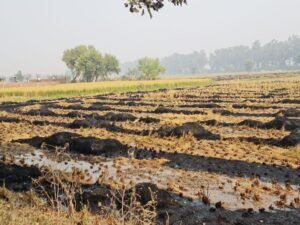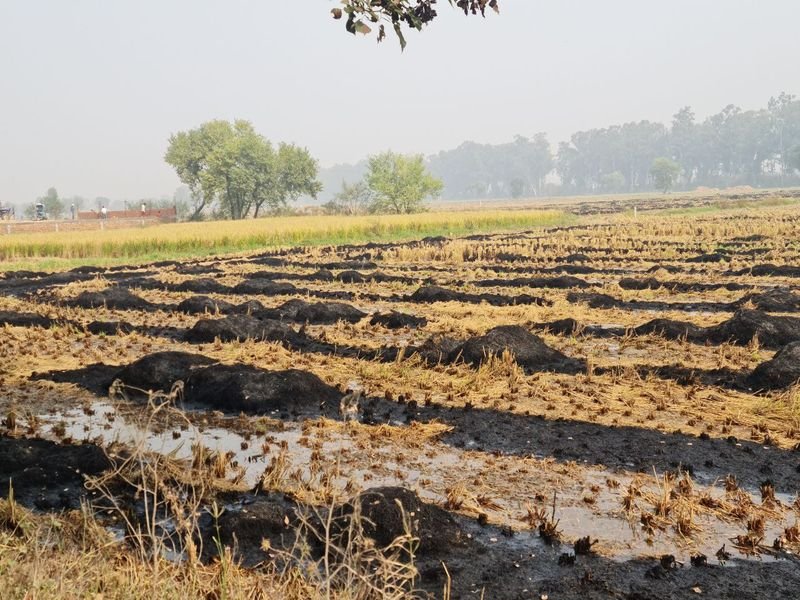

Punjab’s air quality deteriorated sharply after Diwali, with official records placing the state’s overall Air Quality Index (AQI) near the “very poor” category, while some private monitoring platforms reported “severe” to “very severe” pollution levels in several cities amid firecracker emissions and a fresh spike in farm fires. The Punjab Pollution Control Board (PPCB) recorded an average AQI of 287 on Monday, while the state’s farm-fire tally crossed 4,657, with more than 1,350 incidents reported over the past 48 hours.On Monday, a day after Diwali, AQI readings in Punjab were: Patiala 221, Ludhiana 292, Khanna 279, Jalandhar 336, Mandi Gobindgarh 336 and Amritsar 257. By comparison, on Saturday, a day before Diwali, the AQI stood at 204 in Patiala, 222 in Ludhiana, 201 in Khanna, 205 in Jalandhar, 281 in Mandi Gobindgarh and 115 in Amritsar. “The spike indicates that firecracker emissions added to the already polluted air,” said environmental experts.However, some private online platforms reported substantially higher AQI, with the level in Patiala touching 1,281, Ludhiana 1,955, Jalandhar 959, Amritsar 1,212 and Sangrur 1,651 late on Diwali night. The average AQI stood at over 750 as per private platforms. These figures were three to four times higher than the data reported by official monitoring agencies, including the Central Pollution Control Board (CPCB).The PPCB has installed six Continuous Ambient Air Quality Monitoring Stations in Amritsar, Jalandhar, Ludhiana, Khanna, Mandi Gobindgarh and Patiala for real-time monitoring of ambient air quality.The two-hour window permitted for bursting crackers was largely ignored, with celebrations continuing well past midnight in many areas. Though the police registered a few cases across the state, most FIRs were filed against unidentified persons. Smog-like conditions prevailed across Punjab, with a thick layer of smoke visible in several areas, particularly in the rural belt where cracker emissions combined with smoke from burning crop residue.PPCB officials disputed the private AQI readings, saying platforms reporting these do not follow the methodology prescribed by government agencies. “Their equipment is of low quality or outdated that can produce erratic readings under varying weather conditions. Moreover, while official AQI reporting is capped at 500, several private platforms display values beyond that limit and may not rely on a 24-hour averaging system,” said a senior PPCB official.Meanwhile, over 1,350 farm-fire incidents reported over the past 48 hours worsened air quality, taking the state’s seasonal tally to 4,657. PPCB data showed that the number was higher than the 4,062 farm fires recorded during the corresponding period last year.Punjab has over 32.87 lakh hectare of area under paddy cultivation and farmers continue to burn crop residue to prepare fields for rabi season crop. Wheat is generally sown between November 15 and 30. “We are hopeful that the farm-fire season is nearing its end and that this year’s tally will not surpass last year’s figure,” a PPCB official said.Punjab has imposed an environment compensation in 1,228 cases, fining farmers a total of Rs 62.55 lakh. Of this, Rs 32.60 lakh has already been recovered.