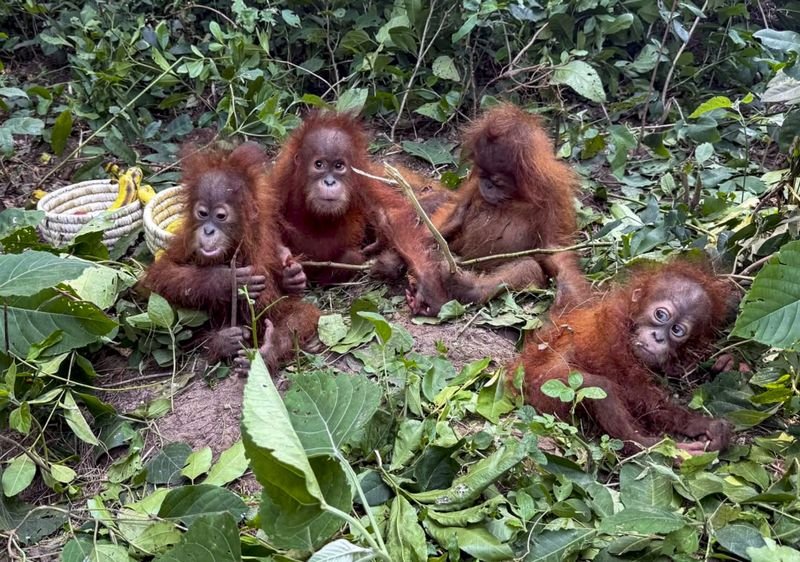

Five baby orangutans found in a forest in Odisha have sparked concerns over international wildlife trafficking. Wildlife experts have pointed out that India is emerging as an epicentre of wildlife trafficking.Orangutans are found only in the tropical rainforests of Borneo and Sumatra in Southeast Asia, more than 4,000 km away from India. Odisha forest officials have ruled out the possibility of orangutans migrating to India, as there is no wildlife corridor connecting India with Borneo or Sumatra.Odisha Environment Minister Ganesh Ram Singh Khuntia said that the Wildlife Crime Control Bureau (WCCB), a statutory multi-disciplinary agency established by the Union Environment Ministry, would investigate the case.Following a medical examination, the rescued orangutans were shifted to the animal rescue centre at Bhubaneswar’s Nandankanan Zoological Park.“I was also very surprised to read about the orangutans found in the forests of Odisha. Obviously, there is an international smuggling syndicate at work here,” Congress leader Jairam Ramesh said in reaction to the incident.Wildlife experts say this could be a case of international trafficking, and the possible involvement of local forest department personnel cannot be ruled out. The critically endangered baby orangutans were discovered in Ramakatha Protected Reserve Forest, where entry to the general public is prohibited.Wildlife activist Ajay Dubey said that the presence of the animals in a reserve forest indicates an unprecedented failure of border control and law enforcement.Speaking to The Tribune, Dubey cited the 2022 case of wildlife trafficking in which several kangaroos were recovered in Kolkata. He said India is emerging as an epicentre of wildlife trafficking. In 2022, three baby orangutans, along with other exotic species, including chimpanzees and marmosets, were seized after being illegally smuggled across the Myanmar border. The consignment originated in Aceh Tamiang, Indonesia.In 2023, authorities intercepted an orangutan, along with exotic birds and primates, near the Mizoram border. Dubey said these incidents indicate a shift or expansion of transit corridors through India’s eastern coastal routes.“Investigation reports and purchase orders revealed that the illegal consignment was bound for Kamala Nehru Prani Sangrahalaya (Indore Zoo) in Madhya Pradesh and had originated through an illegal farm channel in Mizoram. Despite clear evidence linking zoo officials and interstate traffickers, no strict criminal action, prosecution or accountability has been taken against the accused to date,” Dubey said.He explained that Mizoram’s porous land border with Myanmar, as well as the coastal and road networks of West Bengal and Odisha, are being exploited as key entry points and transit corridors for exotic Australian and Southeast Asian species entering mainland India.“Local forest authorities and enforcement agencies have failed to dismantle the financial, transit and distribution networks of these syndicates, allowing India to become a hub and destination for the illicit wildlife trade,” Dubey elaborated.Recently, the Directorate of Revenue Intelligence (DRI) seized 440 endangered wildlife animals and around 15 kg elephant ivory in coordinated operations across the country and arrested 33 people allegedly involved in wildlife trafficking.On July 7, DRI officers intercepted individuals allegedly engaged in the illegal trade of elephant ivory near Sujangarh, Rajasthan. The operation resulted in the recovery and seizure of approximately 11 kg elephant ivory.In July, an interstate wildlife trafficking syndicate was busted at multiple locations across Maharashtra and West Bengal. During the operation, 15 slow lorises, two binturongs, 28 star tortoises, six Egyptian vultures and two shikra birds were recovered and rescued.