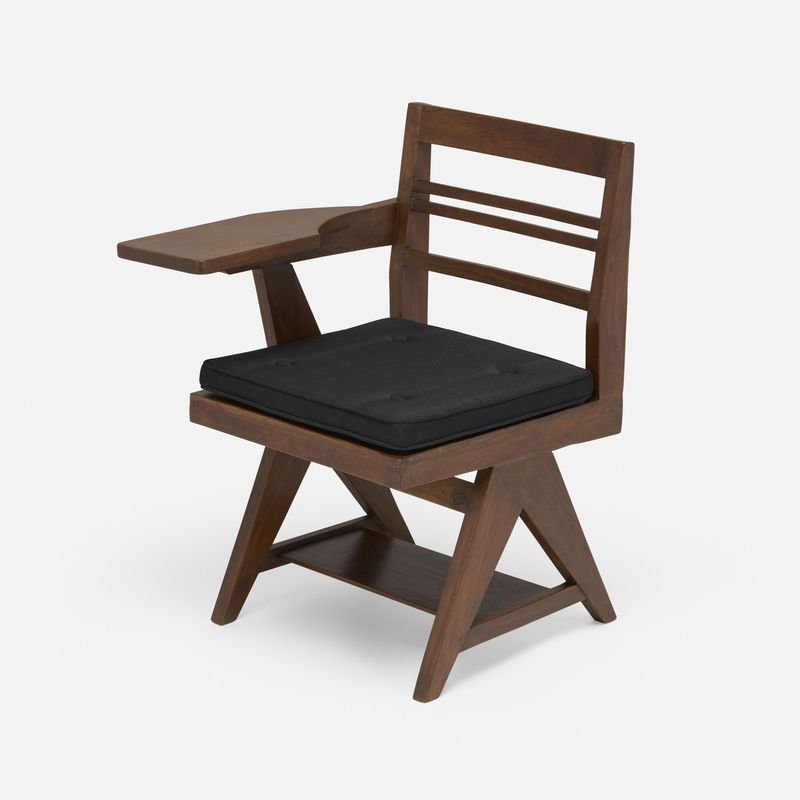

Six of the eight Pierre Jeanneret-designed Chandigarh heritage furniture lots went under the hammer at Wright Design Auction House, Chicago, on August 13, fetching a combined USD 87,040 — approximately Rs 83.07 lakh — against a combined upper estimate of USD 58,000, even as Chandigarh Police had registered an FIR and the Administration had formally approached the Ministry of External Affairs seeking diplomatic intervention to stall the sale.Two lots — a Writing Chair from Panjab University and a Daybed from PGIMER — were not auctioned and were held back by Wright, providing what heritage activist Ajay Jagga has described in a representation to Punjab Governor and Chandigarh Administrator Gulab Chand Kataria today as “a very important and perhaps final opportunity” to secure both pieces through immediate diplomatic intervention before they are transferred or moved.Critically, Jagga has pointed out that physical delivery of the six auctioned pieces has also not yet been effected, and the items are required to be shipped from different locations — a window that, if acted upon immediately by the Indian Consulate General in Chicago and the Indian Embassy in Washington, could still prevent the furniture from leaving US jurisdiction.The realised value of USD 87,040 was approximately Rs 27.72 lakh above the upper end of the combined pre-sale estimate, reflecting the sustained international demand for Chandigarh’s Jeanneret-era furniture that has now seen over Rs 40-50 crore leave the country across more than 100 auctions since 2009.Intervention came close but not close enoughThe Chandigarh Administration had been alerted by Jagga on August 2 — eleven days before the sale — about the proposed Wright auction. The administration moved immediately: the Director Cultural Affairs filed a complaint with the SSP, Chandigarh, on August 3, FIR was registered at Police Station West, Sector 11, on August 12 under Sections 305(e) and 61(2) of the Bharatiya Nyaya Sanhita, and Secretary Culture Dr Syed Abid Rashid Shah addressed a formal communication to the Additional Secretary, UNES, MEA, seeking suspension of the Wright auction and invoking UNIDROIT and UNESCO obligations, the same framework that had stalled the Paris auction on June 25 and the Barcelona auction in July.The intervening steps — FIR registration, formal MEA communication, transmission through the Indian diplomatic mission in the US and engagement with American authorities — consumed the available time, and the auction proceeded before the diplomatic chain could be completed. Jagga, in his representation today, acknowledged the administration’s speed while noting the structural constraint. “From the moment the matter was brought to its notice, the Chandigarh Administration acted with commendable urgency and pursued all available legal and diplomatic avenues. The inter-governmental and diplomatic coordination inevitably consumes some time,” he wrote.Kataria, who has been personally monitoring the issue since taking suo motu cognisance of The Tribune’s series of reports on successive overseas auctions, said the sale of six lots did not close the matter. “The auction of these items does not end our responsibility or our pursuit. Delivery has not been effected. We are exploring every option to ensure these pieces do not leave US jurisdiction before their provenance and the circumstances of their removal from India are fully established. We will do anything and everything to bring back what belongs to Chandigarh,” he told The Tribune.Two pieces held backThe non-auctioning of the Panjab University Writing Chair (Lot 161, estimated USD 3,000-4,000) and the PGIMER Daybed (Lot 165, estimated USD 8,000-10,000) creates a specific and time-sensitive opportunity. Jagga has urged the Governor to immediately seek their protective custody through the Indian Consulate General in Chicago and the competent US authorities pending the completion of the Chandigarh Police investigation. “These two items should be immediately secured and preserved, preferably by taking them into lawful custody. This would prevent their disappearance or further transfer and would also preserve crucial evidence for the ongoing investigation,” he wrote.Punjab, PU, PGIMER drew blankThe most pointed observation in Jagga’s representation concerns the failure of the institutions whose property was directly at stake. The set of eight dining chairs sold for Rs 21.99 lakh bore Panjab University markings. The Linen Chest that fetched Rs 15.88 lakh bore the MLA Hostel Punjab marking. The pair of chairs that went for Rs 10.99 lakh carried PSEB Punjab provenance. The Writing Chair still held by Wright is a Panjab University piece. The Daybed is from PGIMER.Despite advance information being shared with all these institutions and the State of Punjab, none publicly disclosed any action taken to protect their respective heritage property — a failure Jagga described as “particularly regrettable” given that it occurred on the eve of the country’s 80th Independence Day. “The responsibility for protecting such historically significant articles cannot rest upon the Chandigarh Administration alone. The concerned institutions and their controlling authorities must also demonstrate ownership, vigilance and accountability,” he wrote.Where things standThe immediate priorities, as outlined in Jagga’s representation to the Governor, are: halting delivery and shipment of the six auctioned pieces through diplomatic and legal intervention in the US; securing the two unauctioned pieces into protective custody; obtaining full provenance, inventory and ownership records from all concerned institutions; and initiating the repatriation process for all eight pieces on the lines of the Paris and Barcelona interventions — where the MEA and India’s Permanent Delegation to UNESCO have begun deliberations with French and Spanish authorities respectively for physical custody of the stalled pieces.The Paris and Barcelona auctions were stalled before the hammer fell. Chicago is a harder problem — six pieces have changed hands on paper. But with delivery uneffected and an active FIR on record, India’s legal and diplomatic position is not without foundation, and the window, while narrow, has not yet closed.The Tribune has sought responses from the MEA and the Indian Consulate General in Chicago. Responses are awaited.