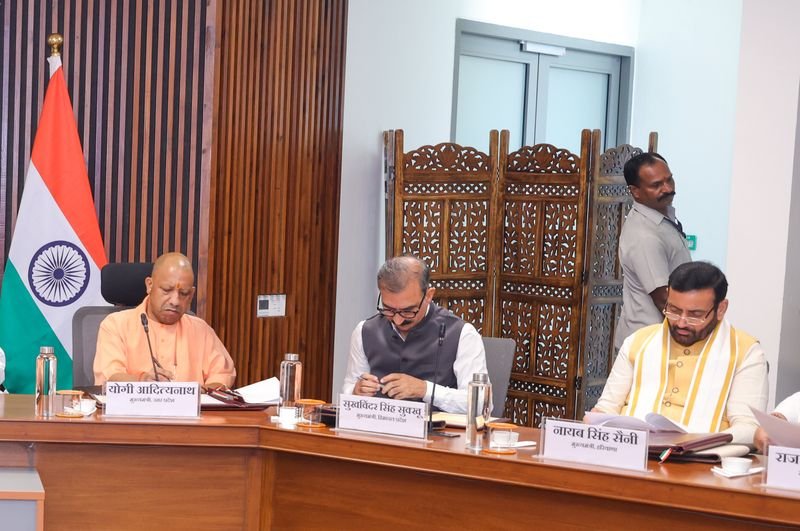

After years of dispute on issues related to cost-sharing and water allocation, a memorandum of agreement for the Kishau Multipurpose Project was signed on Tuesday between the chief ministers of Himachal Pradesh, Uttar Pradesh, Uttarakhand, Rajasthan, Delhi and Haryana in the presence of Union Home Minister Amit Shah and Jal Shakti Minister CR Patil.Himachal Pradesh, which is one of the two states (the other being Uttarakhand) where the proposed dam and reservoir will come up, claimed that its key concern regarding the sharing of the financial burden of the project had been resolved.It had long argued that as an upstream state bearing the direct impact of the proposed dam, it should not be made to shoulder a disproportionate financial burden when much of the water would benefit downstream states.As per the terms of the agreement, the Centre will bear 90 per cent of the cost of the project, while the remaining 10 per cent will be borne by the participating states in accordance with the 1994 agreement.Regarding the Kishau Multipurpose Project, Shah said an agreement reached on May 12, 1994, required separate agreements to be signed for each storage project coming up in the basin. Without that arrangement, this would not have been possible.Subsequently, after the disputes concerning the Lakhwar and Renukaji projects were resolved in 2019, work on Kishau moved forward, he said. A formal agreement on the project was reached on June 16 this year, Shah said, adding that the Ministry of Jal Shakti took the matter forward and, after securing the consent of all states, brought the matter to a resolution.Speaking to the media, Himachal Chief Minister Sukhvinder Singh Sukhu said that at a high-level meeting held on June 16 this year, presided over by Shah, the Centre had, in principle, agreed that the estimated Rs 2,000 crore cost for the state’s power component would be borne by the water beneficiary states — Delhi, Rajasthan and Haryana.He said his government had strongly pursued the matter to save the state from bearing the financial burden, something the previous government could not achieve.Sukhu said Himachal Pradesh would get its share of 1,000 million units a year from the power component of the project, which amounts to over Rs 1,000 crore, after the construction of the project. This, he explained, would be an addition to the state’s financial resources.The Kishau project is a proposed dam and hydropower project on the Tons river, a major tributary of the Yamuna, on the border of Himachal Pradesh and Uttarakhand. It is expected to serve multiple purposes, including supplying drinking and irrigation water, generating hydroelectric power and helping regulate the flow of the Yamuna.Meanwhile, Shah stated on Tuesday that the Centre had declared the Kishau Multipurpose Project a national project after the signing of the agreement.He said Uttarakhand had certain difficulties. “However, on behalf of the Centre, we have assured the state that efforts will be made to accommodate its demands. We will also assist Uttarakhand in bearing the financial burden that may fall upon the state,” he said.Giving details about the project, Shah said a 232.6-metre-high concrete gravity dam would be constructed on the Tons, which flows along the border of Uttarakhand and Himachal Pradesh, with a water storage capacity of 1,562 million cubic metres. It will irrigate 97,000 hectares of land and generate 1,476 million units of clean hydropower.He said Delhi would be the biggest beneficiary of the project. Shah claimed that when the waters of the Yamuna were allocated, there was a serious lapse on the part of policymakers. The environmental flow of the Yamuna was not calculated and all available water was distributed among the states. No water was left for the river itself, the Home Minister said, adding that 25 per cent of the water would become available through the Kishau Multipurpose Project Agreement, which would prove extremely beneficial for both Delhi and the Yamuna.Under the project’s proposed allocation, Haryana will receive 836 cusecs of water, Uttar Pradesh 543.2 cusecs, Rajasthan 163.52 cusecs and Delhi 105.28 cusecs.Delhi Chief Minister Rekha Gupta said the Kishau project would go a long way in addressing the water shortage in the national capital.