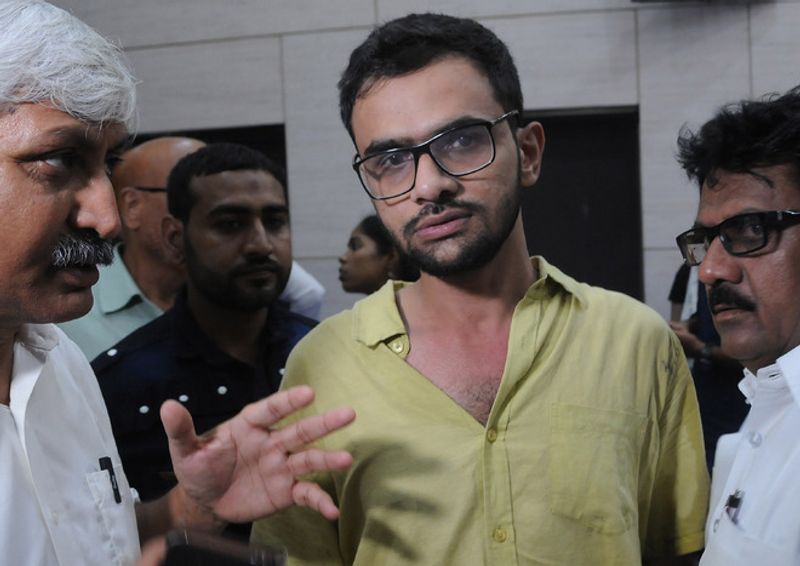

The Supreme Court has dismissed accused Umar Khalid’s petition seeking review of its January 5 order denying him bail in the 2020 Delhi riots conspiracy case.“Having gone through the review petition and also the documents enclosed, we do not find any good ground and reason to review the judgment dated January 5, 2026. Accordingly, the review petition is dismissed,” a Bench of Justices Aravind Kumar and NV Anjaria said in its April 16 order made public on Monday.Senior counsel Kapil Sibal had on April 13 mentioned Khalid’s review petition before the Bench requesting it to take up the matter in an open court. “We will look into the papers and if required, we will call it (for an open court hearing),” the Bench had told Sibal. However, the Bench also rejected his prayer for an oral open court hearing of the review petition.Review petitions are generally heard “in chamber”–and not in an open court–by a procedure called “hearing by circulation” where advocates representing the parties are not allowed to argue. But in exceptional cases, the top court allows open court hearing, if convinced about its need.Booked under the Unlawful Activities Prevention Act (UAPA), 1967, and certain provisions of the Indian Penal Code in connection with the larger conspiracy behind the February 2020 Delhi riots, the accused has been in jail for more than five years.The riots during the visit of then US President Donald Trump claimed 53 lives and left more than 700 injured. The violence had erupted during the protests against the Citizenship Amendment Act (CAA) and the National Register of Citizens (NRC).Khalid was arrested on September 13, 2020, on charges of delivering provocative speeches on February 24 and 25 when Trump, in his first term as the US President, visited India.Highlighting the “central and formative role” attributed to accused Umar and Sharjeel Imam in the conspiracy case, the Supreme Court had on January 5 dismissed their bail pleas even as it granted bail to five other accused–Gulfisha Fatima, Meera Haider, Shifa Ur Rehman, Md Saleem Khan and Shadab Ahmed.The top court noted that their cases stood on a different footing in terms of their alleged role in the case. “This court is satisfied that the prosecution material, taken at face value as required at this stage, discloses a prima facie attribution of a central and formative role by appellants…. Umar Khalid and Sharjeel Imam in the alleged conspiracy,” it had said.“The material suggests involvement at the level of planning, mobilisation and strategic direction, extending beyond episodic or localised acts. The statutory threshold under Section 43D (5) of the UAPA, 1967, therefore, stands attracted qua these appellants,” the top court had said.