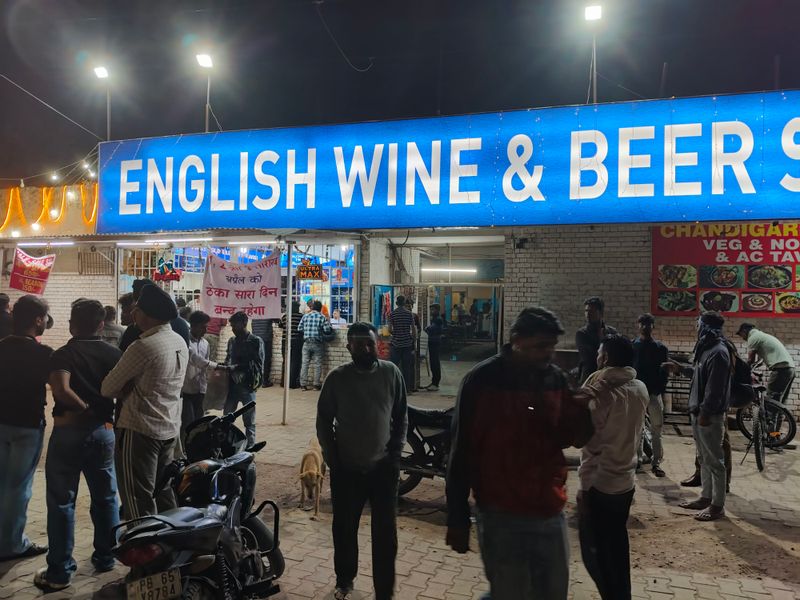

Chandigarh drinks more per person than any other city or state in India. It has more liquor vends this year than at any time in the past six years. It has just crossed the Rs 1,000-crore excise revenue mark for the first time in its history and is on course to blow past Rs 1,200 crore this fiscal. By every available metric, this is a city with an extraordinary — and extraordinarily well-supplied — thirst.So when the Chandigarh Administration quietly re-opened the door this April for departmental stores, malls and market shops to sell liquor off their shelves — a modern, regulated, stigma-free alternative to the traditional vend — the logical expectation was a rush of takers.Three stores said yes. The rest of Chandigarh’s organised retail trade looked the other way.Here is everything you need to know about why, and about the city’s remarkable relationship with liquor.Why Chandigarh’s kiranas won’t sell booze?The licence in question is called L-10B — a permit that allows retail sale of imported foreign liquor, imported beer, imported wine and Indian wine from a departmental store. It was re-introduced in Chandigarh’s Excise Policy 2026-27 after lying dormant for years.The idea was sound in principle: bring liquor into a familiar, well-lit, air-conditioned retail setting where a homemaker or a senior citizen might feel comfortable picking up a bottle of wine along with the weekly groceries, without having to queue at a standalone vend. The administration framed it as an exercise in convenience, modernity and consumer dignity.The annual licence fee is Rs 30 lakh. That figure, store owners say, is the first problem. For most departmental stores in Chandigarh — even the well-established ones — liquor would be a supplementary line, not the anchor product. At Rs 30 lakh a year upfront, the maths does not pencil out easily unless footfall is high and volumes are assured. Most store owners are not willing to bet on that.The second deterrent is subtler but equally powerful: perception. A section of consumers — families with children, in particular — are uncomfortable with liquor being stacked alongside cooking oil and biscuits. Store owners worry about losing this demographic if they take the licence. The social optics of going from a grocery store to a liquor outlet, even in a regulated way, gives many owners pause.The result: since April 1, exactly three outlets across Chandigarh have obtained the L-10B licence. They are Punjab Store (SCF 15, Sector 9-D), Empire Stores (SCO 10, Sector 17-E), and ABN Stores (SCF 18, Sector 9-D Inner Market). All three are in established commercial markets. All three presumably calculated that the footfall justifies the investment.The remaining hundreds of departmental stores in the city have, at least for now, passed.Does Chandigarh have a liquor shortage then?Not remotely. The near-total absence of departmental store licences has done absolutely nothing to crimp liquor availability in Chandigarh. The city’s conventional vend network has never been denser or more commercially vibrant.For 2026-27, the Chandigarh Administration put 97 retail sale liquor vends (L-2/L-14) to auction. As of May 12, 96 of those have been successfully allotted and are operational. The 97th is in the process of being auctioned and will be operational shortly. When it is, Chandigarh will have 97 liquor vends — the highest number in at least six years, and possibly ever.For a city of 12.5 lakh people, that works out to roughly one liquor vend for every 13,000 residents. On a per-capita basis, that is an exceptionally dense retail network for any product, let alone one that is regulated, taxed and auctioned at a premium.Where is the one remaining vend coming up?The lone vend yet to be allotted at Attawa has a reserve price of Rs 3.41 crore and is currently in the process of being auctioned by the UT Excise and Taxation Department. Deputy Commissioner and Excise and Taxation Commissioner Nishant Kumar Yadav confirmed the auction process is underway and the vend will be operational soon, taking the total to a record 97.Why does Chandigarh have so many liquor vends?Supply follows demand, and in Chandigarh, demand is extraordinary. The city sits at a unique intersection of geography, demographics and economics. It is the joint capital of Punjab and Haryana, drawing a large transient working population — government employees, Armed Forces personnel, professionals, students — on top of its residential base.Chandigarh is a high-disposable-income city with a strong café and restaurant culture and an active social life. It is flanked by two states with significantly higher liquor prices and stricter norms, making it a destination for cross-border buyers. The administration, for its part, has structured the vend network to meet this demand in a regulated, taxed and traceable manner — maximising revenue while theoretically keeping illicit trade at bay.How have vend auctions performed in recent years?The data tells a story of a sector that dipped, recovered and is now at its most competitive in years. The trough was 2023-24, when only 77 of 95 vends found buyers — the worst performance in recent memory — at a wafer-thin 6.77 per cent premium over reserve price, leaving 18 vends unsold. The turnaround since has been sharp. This year’s 24.63 per cent premium on bids of Rs 560.85 crore against a reserve of Rs 450 crore is the steepest in four years, and the near-total allotment of 96 of 97 vends before mid-May is a sign of robust bidder confidence in the market.Why does Chandigarh drink so much more than the rest of India?Because it does — and the numbers make for startling reading. With a population of barely 12.5 lakh, Chandigarh has sold 13 crore bottles of liquor over the past five years. That is an average of 2.6 crore bottles a year, or roughly 20 bottles per resident per year. The national average, by comparison, is around four bottles per person per year.Chandigarh ranks 22nd nationally in absolute liquor volume — unremarkable for a small Union Territory. But when consumption is adjusted for population, it towers above every state and city in India, drinking five times the national average.The reasons are structural rather than cultural alone. High per-capita income, a large military and government employee population, proximity to Punjab and Haryana where cultural norms around alcohol are deeply established, a thriving hospitality sector, and relatively competitive pricing compared to neighbouring states all compound into an outsized consumption figure.The reintroduction of the L-10B departmental store licence — even if barely taken up so far — is officially expected to push consumption higher still, by reducing the friction and social awkwardness of purchasing liquor for consumers who currently self-exclude from vends.What is the national drinking average, and where does Chandigarh stand?India’s national per-capita alcohol consumption is among the lower ends globally — approximately four litres of pure alcohol equivalent per adult per year, or roughly four bottles of standard spirits. Chandigarh, at five times that figure on an adjusted basis, is an extreme outlier at the top of the domestic consumption table.No other Union Territory or state comes close on a per-capita basis. And with 97 vends now operational — a six-year high — along with 69 operational L-1 suppliers, 100 bars and restaurants, 8 active bottling plants and now three departmental stores, the infrastructure to sustain and grow that consumption is firmly in place.How much liquor does Chandigarh actually consume every year?Over the past five years, Chandigarh has collectively consumed 13 crore bottles. That is approximately 2.6 crore bottles annually — and the trend is upward. The growth in vend auction premiums, the expansion of the licensed bar network, and the anticipated addition of departmental stores all point to volumes rising further in 2026-27.Why is Chandigarh earning record revenue from excise?Three converging forces: more vends selling at higher prices, better enforcement reducing leakage, and a technology-driven policy regime that makes it harder to cheat. Total excise collections for 2025-26 crossed Rs 1,000 crore for the first time, reaching Rs 1,009.25 crore against the Finance Department’s target of Rs 1,000 crore.The progression has been steep and consistent:Year FD Target (Rs cr) Actual Revenue (Rs cr)2023-24 — 930 — 738.532024-25 — 950 — 801.142025-26 — 1,000 — 1,009.252026-27 (Apr only) — 1,000 — 100.77The Rs 100.77 crore collected in April 2026 alone — the first month of the new fiscal — is the most revealing figure. At that run-rate, Chandigarh is on course to collect over Rs 1,200 crore in 2026-27, some 20 per cent ahead of its Rs 1,000-crore target. Over the past five years cumulatively, the city has generated Rs 3,974 crore in excise revenue.What is driving revenue growth — and what is the policy doing differently?The Excise Policy 2026-27 has introduced a comprehensive set of technology and compliance measures that, taken together, are designed to seal the system against leakage, adulteration and evasion.A Track and Trace system with holograms now monitors every bottle from the moment it leaves a bottling plant to the point of retail sale, making counterfeit or diverted liquor significantly harder to introduce into the supply chain. All vehicles transporting liquor must be fitted with GPS devices. CCTV cameras with 30-day recording backup are compulsory at all bottling plants, vends and additional godowns, with live feed access to the department.Every excise licensee must maintain real-time stock records through Excise Online Software, enabling the department to cross-verify inventory instantly without a physical inspection.Auto-renewal of licences has been introduced to reduce paperwork and friction for compliant businesses. Bar licensees can now procure supplies only from their two nearest vends, curbing informal and untracked sourcing. Bottling plants must get their product quality-tested from a government-approved laboratory every quarter. Security personnel are being deployed at each bottling plant alongside dedicated CCTV control rooms.“Every mechanism has contributed to building a leak-proof, transparent and competitive excise ecosystem. The results speak for themselves,” Nishant Kumar Yadav, Deputy Commissioner and Excise and Taxation Commissioner, Chandigarh, told The Tribune.Punjab Governor and UT Administrator Gulab Chand Kataria reviewed the excise performance and is learnt to have directed the department to maintain absolute zero tolerance for any illicit trade while continuing to facilitate ease of doing business.“Chandigarh’s record excise performance is a testament to transparent, technology-driven and people-friendly governance. The administration remains unwavering in its commitment to a clean, accountable excise regime, and anyone found violating norms will face swift and stringent action,” the Governor told The Tribune.What records has Chandigarh broken — and what records are within reach?On vends: 97 total vends in 2026-27 is a six-year high. The allotment rate of 96 of 97 before mid-May is the best-ever early-season performance. The bid premium of 24.63 per cent is the steepest in four years.On revenue: Rs 1,009.25 crore in 2025-26 is the highest excise collection in Chandigarh’s history, crossing the Rs 1,000-crore threshold for the first time. The five-year cumulative revenue of Rs 3,974 crore is a landmark in itself.On consumption: 13 crore bottles in five years, five times the national per-capita average — both figures that no comparably-sized city or territory comes close to matching.On the horizon: if April’s Rs 100.77 crore monthly collection is sustained, the 2026-27 fiscal could close at Rs 1,200 crore-plus — a new all-time record by a wide margin. The eventual addition of more departmental stores, if the L-10B uptake grows, could add further volume and revenue on top.For a city of 12.5 lakh, that is a drinking — and revenue — story with very few parallels anywhere in the country.