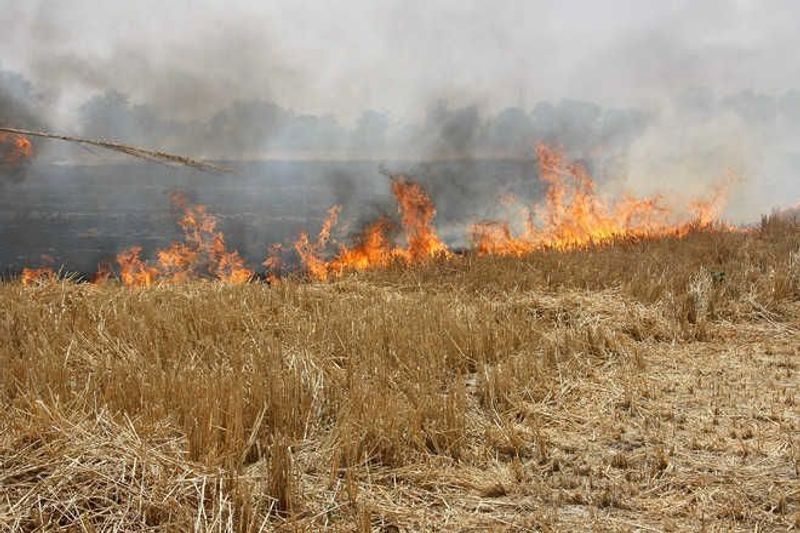

Even as the region grapples with an intense heatwave, Punjab is simultaneously witnessing an alarming surge in farm fires, with 9,615 incidents reported so far this season.The advancing of paddy sowing date to June 1 has aggravated the menace as farmers have been rushing to clear their fields for the next crop cycle.Though the Punjab Pollution Control Board has managed to significantly curb paddy residue burning–only 5,114 incidents were reported in 2025 compared to nearly a lakh a few years ago–wheat residue burning has emerged as a new headache for the authorities.However, the total number of farm fires this season remains marginally lower compared to 9,845 incidents till May 21 last year. Overall, Punjab reported 11,256 farm fire incidents in 2024, while the count stood at 11,264 in 2023.District-wise this year, Ferozepur topped the list with 909 incidents of stubble burning, followed by Moga (746), Bathinda (741), Tarn Taran (713), Amritsar (684), Gurdaspur (633) and Ludhiana (617).The spike in farm fires was witnessed in phases. After an initial surge in the first week of May, incidents declined briefly before rising sharply again in the second and third weeks. The highest single-day count of 1,447 was recorded on May. Collectively, 4,198 incidents were reported between May 7 and May 10.Experts believe the actual number of wheat residue burning incidents could be much higher, alleging that many farmers deliberately set fields on fire during evening hours to evade satellite detection.Recent scientific studies, including by the Indian Space Research Organisation and NASA, indicate that farmers in Punjab and Haryana have increasingly shifted stubble burning to late afternoons and evenings. By igniting fires after 3 pm or 4 pm, they reportedly avoid the scheduled overhead passes of polar-orbiting satellites, resulting in underreporting in official data.Meanwhile, agronomists at Punjab Agricultural University, Ludhiana, have rejected the notion that wheat residue hampered paddy cultivation. Vice-Chancellor Satbir Singh Gosal blamed the shift in cattle feeding patterns as one of the reasons for the rise in the menace. With farmers increasingly using silage as fodder, cattle were becoming less dependent on “turi” (wheat straw residue), he said.Increasing migration of youth to urban belts and abroad has also led to a decline in traditional cattle rearing practices, thereby reducing the economic utility of wheat straw as fodder. “The decline in cattle rearing has made wheat residue less valuable. Coupled with storage constraints and rising labour costs, farmers are opting for the quicker solution of burning,” said Gosal.