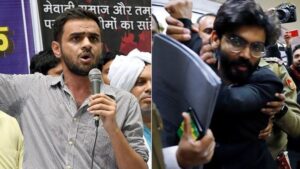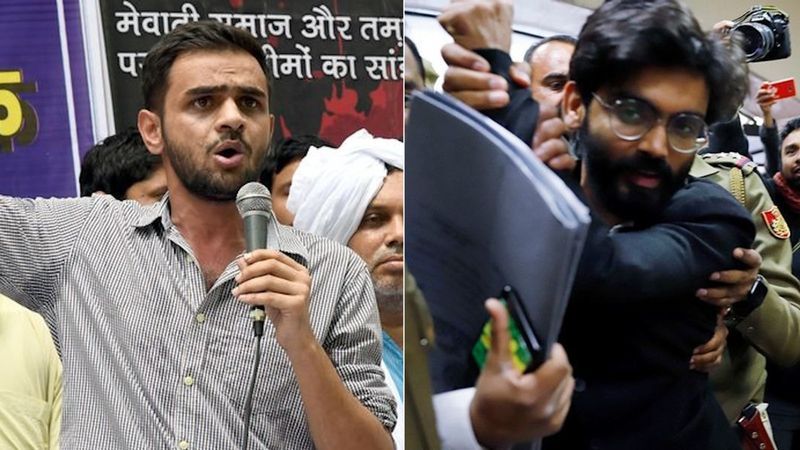

Four-and-a-half months after the Supreme Court dismissed bail pleas of 2020 Delhi riots conspiracy case accused Umar Khalid and Sharjeel Imam facing charges under the Unlawful Activities (Prevention) Act, 1967, the controversy surrounding the verdict is refusing to die down.A Bench of Justice Aravind Kumar and Justice PB Varale on Friday referred to a larger Bench the legal question involving denial of bail to Khalid and Imam after the Delhi Police sought reference of the issue to a larger Bench in view of conflicting verdicts by two separate two-judge Benches of the top court.Highlighting the “central and formative role” attributed to accused Umar Khalid and Sharjeel Imam in the 2020 Delhi riots conspiracy case, Justice Kumar-led Bench had on January 5 dismissed their bail pleas of Khalid and Imam even as it granted bail to five other accused.However, while granting bail to narco-terrorism accused Syed Iftikhar Andrabi, who had been under custody for more than five years under the UAPA, another Bench of Justice BV Nagarathna and Justice Ujjal Bhuyan on May 18 expressed “serious reservations” about the reasoning given in the January 5 judgment that refused bail to Khalid and Imam.Justice Nagarathna’s Bench had faulted the verdict of Justice Kumar’s Bench for ignoring a ‘binding precedent’ laid down by a three-judge Bench in the KA Najeeb case (2001).However, Justice Kumar’s Bench on Friday chose not to comment on the verdict of Justice Nagarathna’s Bench which criticised the January 5 verdict denying bail to Khalid and Imam even as it said, “A coordinate Bench cannot, by strong observations, effectively unsettle the ratio of another coordinate bench while continuing to sit on equal strength.”Justice Kumar said the appropriate course was to refer the matter to a larger Bench. “Judgments of this court are not to be answered by counter-observations from another Bench of equal strength. The discipline of precedence demands a higher institutional method. Where a coordinate Bench entertains a reservation about an earlier judgment of another coordinate Bench, particularly on the application of a binding three-judge Bench decision, the proper course is well settled. The matter must ordinarily be placed before the Chief Justice of India for the constitution of an appropriate Bench,” he noted.The Delhi Police wanted clarity as to whether prolonged incarceration and inordinate delay in trial can override the statutory restrictions on bail under the UAPA – India’s anti-terror law.The top court granted six-month interim bail to accused Tasleem Ahmed and Abdul Khalid Saifi in the 2020 Delhi riots conspiracy case.The order came after the Delhi Police did not oppose bail pleas of the two accused, saying they were not the main players.While urging the Bench to refer the crucial issue of bail of UAPA accused to a larger Bench Additional Solicitor General SV Raju wondered if 26/11 Mumbai terror attack case accused Ajmal Kasab could have been granted bail on the ground of delay.The three-judge Bench in the KA Najeeb case ruled that prolonged incarceration was a ground for constitutional courts to grant bail under the UAPA despite the rigours under Section 43D(5) of the Act.“The statutory embargo of Section 43-D(5) must remain a circumscribed restriction that operates subject to the guarantee of Articles 21 and 22 of the Constitution. Therefore, we have no manner of doubt in stating that even under the UAP Act, ‘bail is the rule and jail is the exception’; of course, in an appropriate case, bail can be denied having regard to the facts of that particular case,” it had said.Section 43D(5) of the UAUA says that notwithstanding anything contained in the Cr.P.C (replaced by the Bharatiya Nagarik Suraksha Sanhita (BNSS), no person accused of an offence punishable under Chapters IV and VI of the UAPA shall be released on bail or on his own bond, unless the public prosecutor has been given an opportunity of being heard on the bail application.Further, the proviso to Section 43D(5) says that such accused person shall not be released on bail or on his own bond if the court on a perusal of the case diary or the final report (charge sheet) is of the opinion that there are reasonable grounds to believe that the accusation against such person is prima-facie true.Enunciating the broader contours of the KA Najeeb verdict, Justice Nagarathna’s Bench had on May 18 said, “In K.A. Najeeb, a three-Judge Bench of this Court was clear and unequivocal in holding that once it is obvious that a timely trial would not be possible and the accused has suffered incarceration for a significant period of time, the courts would ordinarily be obligated to enlarge the accused on bail.”Maintaining that it was necessary to settle the law on bail under special laws, Justice Kumar on Friday said, “The present reference is necessitated because KA Najeeb (verdict) deserves application with clarity, consistency, and institutional fidelity which a binding three-judge Bench commands.”Khalid was arrested on September 13, 2020 on charges of delivering provocative speeches on February 24 and 25 when Donald Trump, in his first term as the US President, visited India while Imam was arrested on January 28, 2020 for speeches made during anti-CAA protests. He was later arrested in a larger conspiracy case in August 2020.