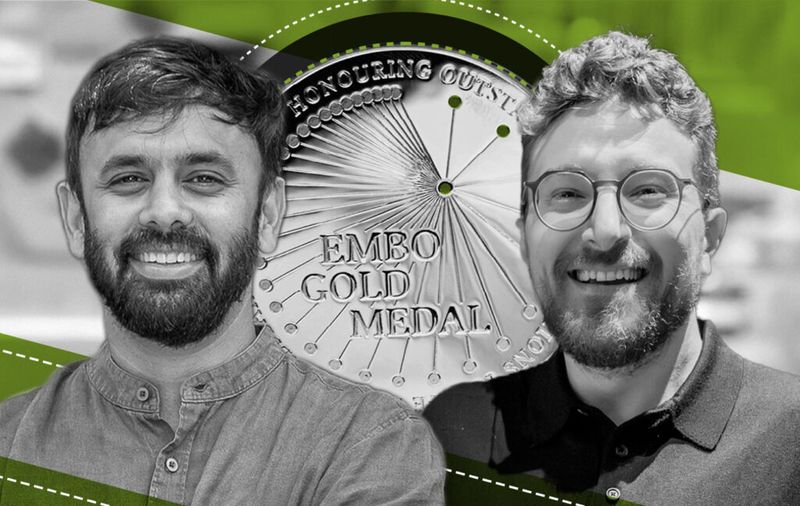

The EMBO Gold Medal, for exceptional contribution to life sciences in Europe has been awarded to an Indian origin scientist, Gautam Dey, presently working with European Molecular Biology Laboratory (EMBL) at Heidelberg in Germany, and Omaya Dudin from University of Geneva in Switzerland for this year.Considered among Europe’s most prestigious honours in life sciences, EMBO Gold Medal is awarded by European Molecular Biology Organisation annually to scientists early in their independent careers who are based within European Molecular Biology Conference (EMBC), an inter-governmental organisation with 32 member statesGautam Dey has been awarded EMBO Gold Medal in recognition of his outstanding work on the evolutionary origins of nuclear organisation and cell division, while Omaya Dudin has been recognised for his work shedding light on the evolutionary origins of multicellularity, according to a statement issued by EMBO.“The EMBO Council decided to award two candidates this year to recognise the scientific excellence as well as the open and fertile scientific collaboration between them,” said Marta Miączyńska, EMBO Council Chair. “Their work is a successful example of the collaborative spirit that EMBO strives to foster through its programs and activities,” continued Miączyńska.Dey is an evolutionary cell biologist interested in the origins of cell division and, since 2021, the group leader at EMBL in Heidelberg, Germany. He studied biochemistry at University of Delhi, India, followed by a research Masters at National Centre for Biological Sciences in Bangalore.Dey moved to Stanford University, US, for a doctorate and then to University College, London, to work on ‘eukaryogenesis’, an evolutionary process by which simple, non-nucleated single-celled organisms transformed into complex cells containing a nucleus and other internal structures.In fact, one of the recipients for EMBO Gold Medal in 2025, Tanmay AM Bharat is also a scientist of Indian origin. An alumnus of Delhi University, he is a programme leader in Structural Studies Division of MRC Laboratory of Molecular Biology (LMB) in Cambridge, UK.In an interview related to his award published on the EMBL website, Dey said that science is a deeply human activity, shaped irrevocably by the people who dedicate their careers to understanding the universe we live, love and die in.He added that is future plans revolve around building on several decades of exceptional mechanistic studies focused on a small number of species and his small but growing community of cell biologists are keen to marry the tools of modern molecular biology with an older naturalist tradition of viewing life in context.