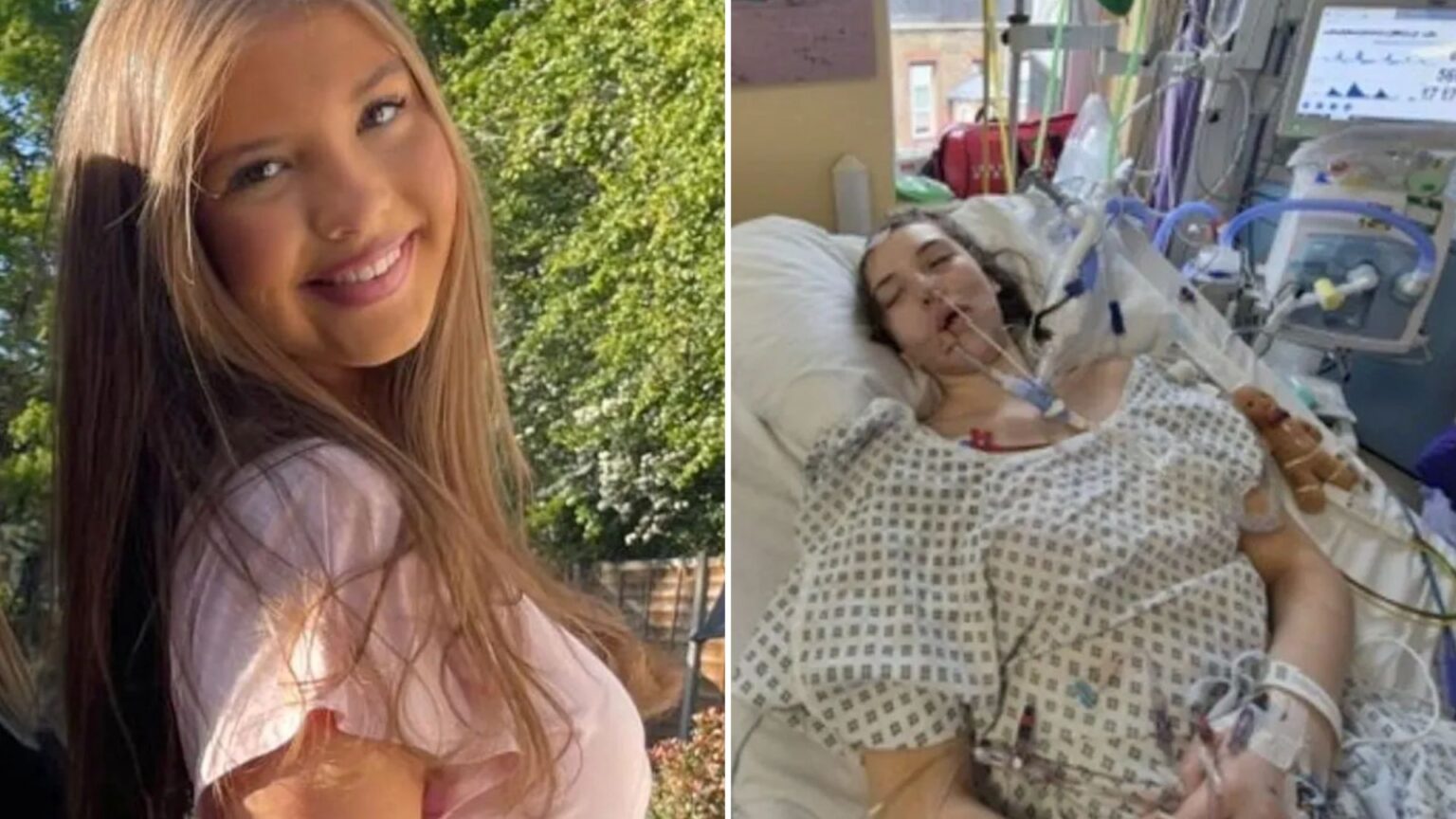


A TEEN who believed her headaches were caused by dehydration in a heatwave was shocked to learn they were a sign of a ruptured brain tumour.
Danielle Andersen, 17, had been suffering with the agonising head pain for five days and her dad eventually decided to take her to A&E in July 2025.
Sign up for the Health newsletter
Thank you!
Danielle Anderson thought her headache was caused by dehydration in a heatwave Credit: SWNS
But when it didn’t go away after five days, she went to A&E and was told she had a benign brain tumour Credit: SWNS
The teen had assumed that the pain was simply a sign of dehydration from the heat, but she said that “no matter how much water I drank, the headaches wouldn’t go”.
Doctors initially suspected that Danielle was suffering from a migraine, but after carrying out a CT scan, they discovered a slow growing tumour on her brain that had ruptured.
Called an intracranial dermoid cyst, medics said the benign tumour had been present since birth and told the teen she would need a craniotomy to remove it.
According to Great Ormond Street Hospital (GOSH), these cysts often have no symptoms, but they can occasionally rupture or press on the brain and cause neurological symptoms like headaches as they grow.
SILENT KILLER
More than 40% of women only diagnosed with ‘silent’ cancer after A&E trip
RED ALERT
Warning over 6 European holiday spots with world’s most infectious disease cases
Danielle had an intracranial dermoid cyst and was told she would need a craniotomy to remove it Credit: SWNS
Her brain scan shows the cyst, which doctors said had been there since birth Credit: SWNS
A dermoid cyst is a sac-like growth that is present at birth, containing structures such as hair, fluid, teeth or skin glands.
They are most commonly found on the head or neck, but in rarer cases can be found in the brain.
So, what causes these cysts to form?
GOSH says they develop early in pregnancy, when skin structures become trapped while the baby is developing in the womb.
They cannot be prevented and nothing a woman does during pregnancy causes them to form.
As dermoid cysts often have no symptoms, they may only be discovered by chance when imaging of the brain is carried out for other reasons.
If this happens, they may simply require monitoring with regular imaging.
If the cyst causes symptoms, however, surgical removal is recommended, GOSH says.
Danielle’s headaches became so intense one night she said she couldn’t sleep.
Speaking about her ordeal, she said: “The night they say [the cyst] ruptured, I was smacking the head of my bed in agony in the middle of the night.”
When she woke up the next morning and her eyes were swollen, she went to hospital, and ended up having urine and blood checks then a CT scan “to rule out a brain tumour or bleed”.
The teen, from West Wickham, London, continued: “I saw the scan and I was sick from shock. That’s when they told us it ruptured in the middle of that night.”
When Daniella had started experiencing her headaches, she said everyone around her just told her to drink more water – she had no idea it was the sign of something much more serious.
“No matter how much water I drank, the headache wouldn’t go,” she said.
Danielle, a student, continued: “I was going to the toilet constantly because I was drinking and drinking. I was in pure agony.
“A lot of people didn’t believe how bad it was. I kept thinking, am I making this worse than it is?
A scar from Danielle’s surgery, which she underwent in December 2025 Credit: SWNS
The teen had the surgery in London after completing her first term at an arts school Credit: SWNS
“My gut feeling was that it wasn’t just a dehydration headache though, and I was right.”
Danielle’s dad, Justin, 55, took her to A&E at Princess Royal University Hospital in Locksbottom on July 17, 2025, and a consultant noticed something unusual in her eye tracking.
After having a CT scan, Danielle and her family were given the news that she had a dermoid cyst on her brain.
Her dad, a taxi driver, said: “Nobody sat us down and explained what any of it meant.
“We honestly didn’t know the seriousness of it.
“We thought it was over – we thought it was just going to be resolved there.”
As Danielle, a dancer, had just secured a place at a London performing arts college, she decided to delay her brain surgery so she could settle in for her first term.
“I didn’t want to go in as the person with a brain tumour. I just wanted people to know me,” she said
The teen was referred to King’s College Hospital at Denmark Hill and the family were told the operation carried odds of 100 to one against anything going wrong.
Danielle was admitted on December 15, 2025 but when she came round from the craniotomy, surgeons noticed her left arm did not rise to remove her breathing mask.
The family were told it was a “bit of weakness” that would resolve within days.
Four days later, however, Danielle was completely paralysed down the entire left side of her body.
Her right eye was shut, her head dropped to one side, and she could not move her arm, her leg or her hand.
Just three days before Christmas, an MRI scan revealed three blood vessels had been cut during the operation, causing a stroke.
The teen had a stroke during surgery, which caused the left side of her body to become paralysed Credit: SWNS
She was told she would never dance again and was unlikely to regain full use of her left hand Credit: SWNS
Her dad said: “We had been told she’d be home by the 22nd of December. We didn’t leave the hospital until February 19.”
Doctors told the family they did not know whether Danielle would ever dance again, and that she was unlikely to regain full use of her left hand.
But her dad said the family “weren’t going to accept that her dreams and her life had gone down the toilet”.
Recovery required her brain to rebuild its neural pathways to the left side of the body, a process called neuroplasticity.
In the early weeks, family members would physically move her toe, foot, knee and arm, repeating each movement a hundred times a day alongside NHS community physiotherapists and a private neurological physiotherapist.
Justin said: “The physios said Danielle is only getting through this so quickly because her whole family is on board.”
Six months on, Danielle has started running, jumping, and is picking up dancing again.
She dropped out of her first year to focus on her recovery and is restarting in September alongside her younger sister Charlotte, 16, who has since secured her own place at the same college.
Danielle said: “My physio is just turning into dancing again.
“Before, people had to move my arm because I couldn’t move it. Now I’m dancing.”
Despite being told she would never dance again, Danielle has now picked it up again Credit: SWNS
What is an intercranial dermoid cyst?
A dermoid cyst is a sac-like growth that is present at birth, containing structures such as hair, fluid, teeth or skin glands.
Intracranial dermoid cysts are located inside the skull and can have a tract that leads from the skin to the coverings of the brain.
They can develop anywhere inside the skull but tend to be more common in the middle of the facial/skull bones at the bridge of the nose.
What causes them?
They develop early in pregnancy, when skin and skin structures become trapped while the baby is developing in the womb. Intracranial dermoid cysts cannot be prevented.
Nothing you did or did not do during pregnancy could have caused them.
What are the signs and symptoms of an intracranial dermoid cyst?
Often dermoid cysts have no symptoms and may be discovered by chance when imaging of the brain is carried out for other reasons.
When dermoid cysts grow, they tend to grow slowly but in time, could press on the brain and nearby structures.
This will cause varying neurological symptoms such as headaches. For instance, if the cyst is pressing on the optic nerve, vision will be affected.
Occasionally, dermoid cysts can become infected or rupture. There is an increased risk of meningitis because they are near the brain.
How are they treated?
If the cyst is not causing any symptoms, monitoring with regular imaging may be all that is needed.
When a cyst is causing symptoms, surgical removal is recommended. Depending on the location of the cyst, it may be able to be removed completely or as much as possible without damaging nearby structures.
Source: Great Ormond Street Hospital
The family are now fundraising through GoFundMe for intensive private neurological physiotherapy.
Standard NHS stroke rehabilitation targets everyday functional recovery, but specialists say a dancer needs six hours of rehabilitation a day – far beyond what the NHS can provide.
A spokesperson from King’s College Hospital NHS Foundation Trust told The Jattvibe: “We were very sorry to hear that Danielle is unhappy with the care she received.
“We have responded to the family’s complaint, but we are also keen to meet with them to discuss their concerns further.
“Skull base neurosurgery (surgery at the base of the brain) is a highly complex procedure, and as a result, it carries potential risks.”
They added: “Providing the safest and most appropriate surgical care is a balance between managing those risks, and the benefits of treatment.
“This approach is explained in detail to patients during the pre-operative stage of their care.
“It is a vital part of the consent process, and is fully documented as having occurred in Danielle’s case.”