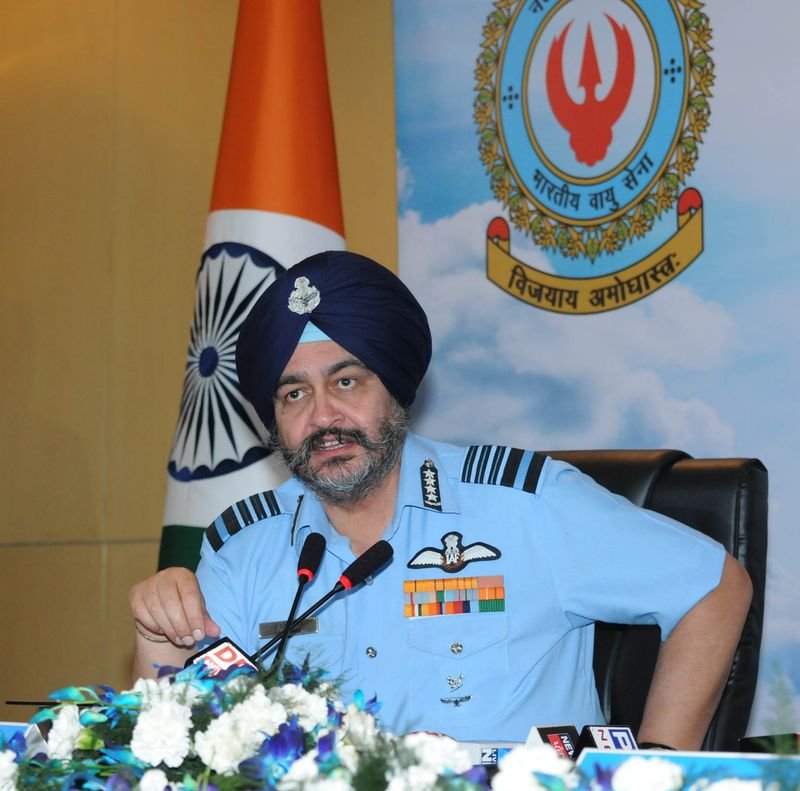

As darkness fell over Mushkoh on June 27, 1999, six Indian Air Force MiG-21 fighter jets streaked in fast and low through the moon-lit valley along the Line of Control (LoC), bombed pre-determined targets and vanished over the jagged mountain tops before the enemy realised what happened.This was the first low-level night bombing mission of the Kargil conflict, carried out by No. 17 Squadron, known as the Golden Arrows. The recently released Netflix series ‘Operation Safed Sagar’ is based on this mission.Behind the arduous missions lay intricate planning, trial runs, demanding preparations and elusive manoeuvres, along with some calculated risks that are inherent in military operations.During the initial phase of Operation Safed Sagar, as the air component of the conflict was code-named, the squadron carried out low-level photo-recce missions along the LoC. “Later, the then Air Officer Commanding-in-Chief, Western Command, Air Marshal Vinod Patney asked if the squadron could undertake night bombing missions and we got on to the task,” said Air Chief Marshal BS Dhanoa (retd), who had commanded the unit as a Wing Commander during the conflict. The squadron, which was based in Bathinda, was moved to Srinagar for operations. Trial runs were carried out during the moon phase in a valley north of Srinagar and the aircraft flew as low as 1,000 metres above the ground to drop bombs. “Everything – the speed, altitude, course and timing of bomb release – had to be precise and accurate to hit the target effectively,” said Air Chief Marshal BS Dhanoa (retd).Accurately mapping target coordinates was another issue since the Army and the IAF used different types of maps and drills and measures were evolved to address this. “There were also issues with the hand-held GPS sets carried by pilots, with initial apprehension being that the signals were being spoofed by a foreign country, but these turned out to be technical issues that were sorted out.”, he said.“Since Pakistani troops were armed with Stinger heat-seeking missiles, we used our own similar Igla systems to determine the feasibility of detecting and locking on to an approaching aircraft in the dark,” he said.The Western Air Command also dished up a ‘Radar Platter’, a chart that had plotted enemy radars in the area on the basis of inputs provided by electronic intelligence aircraft and mapped out the extent of their coverage and shadow areas.“Knowing where radar can be evaded helped us to choose ingress and egress points and effectively plan flight paths,” the former IAF Chief said.After taking off from Srinagar, we first used to fly south towards Shopian and then change course towards the LoC in the direction of the designated targets to counter visual inference by the enemy, he added.It was a couple of hours after sunset when the fighter formation took off on the first low-level mission. The last light had faded while the moon had risen high enough to provide visual reference of the rugged landscape.Since the radio transmissions (RT) on the MiG-21 were not secure, we used to maintain strict radio silence from the time IAF personnel climbed into the cockpit until the bombs were dropped. “Even while lining up on the runway, there was no radio communication with air traffic control. Only the flash of a green lamp by a controller was the signal to roll,” he said.There was one occasion when it was breached, when a pilot spotted the flash of a missile being launched from the mountainside and called out a warning.A sortie lasted about 40 minutes, which used to be intense and focused, with no scope to think of anything beyond the mission. “From the soundless confines of the cockpit, everything below looks calm and serene even if there is a war on. In fact, on landing after the first mission, one of my youngsters, after witnessing an artillery exchange below had quipped, ‘Sir, it appeared as if they were trading cigarette butts’ because the ends of artillery projectiles are red hot when fired,” the former IAF Chief recalled.Behind the scenes was the squadron’s engineering officer, Flight Lieutenant VN Rao, who worked tirelessly for 59 days to ensure 100 percent serviceability of aircraft. Not a single mission was aborted due to technical problems.The maiden night bomb run was a success and the results were encouraging, which opened up a new vista for employment of the venerable MiG-21 in the conflict. A number of such missions were carried out thereafter.“Golden Arrows was the only squadron to have flown low-level combat missions in valleys at night. Other aircraft like the MiG-23/27, Mirage 2000 and Jaguars also conducted bombing missions, but they did it from a height,” he said.Notably, No. 17 Squadron was ‘number-plated’ — i.e. retired after its aircraft were decommissioned – but was resurrected at Ambala in 2019 and equipped with the French Dassault Rafale jets in 2020.“The squadron was chosen for Rafale jets because it is the highest decorated squadron of the Kargil war. The second Rafale unit, No. 101 Squadron, based at Hasimara in the East, is the highest decorated squadron of the 1971 Indo-Pak war,” the former IAF Chief said.”The portrayal of the IAF in the recent Netflix series ‘Operation Safed Sagar’ is mostly correct,” the former Air Force Chief added.