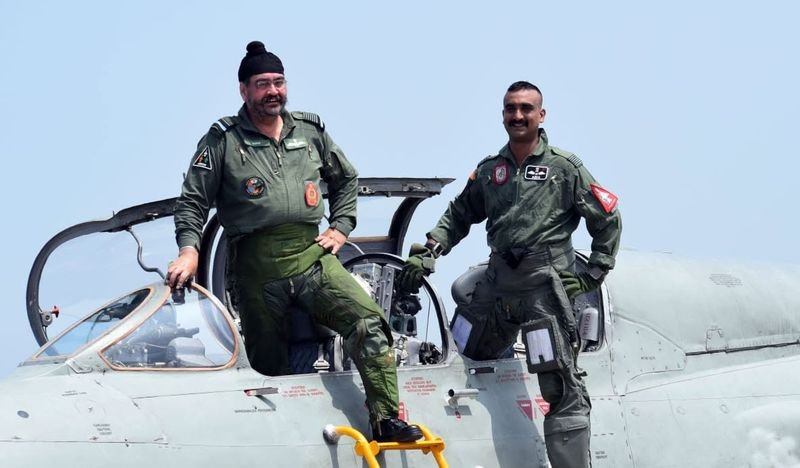

As Group Captain Abhinandan Varthaman (retd) has bid adieu to the Indian Air Force (IAF), his strike to bring down a US F-16 jet of the Pakistan Air Force seven years ago has etched his name in history of military aviation.In a mid-air duel with the adversary, lasting just 90 seconds in the air, the IAF pilot had brought down an F-16 on February 27, 2019, while his own plane, a MiG 21, also got hit. He had ejected and landed inside Pakistan-occupied Kashmir (PoK) only to be released two days later on March 1, 2019.On that day, Group Captain Varthaman, then a Wing Commander, was posted to Srinagar air base and tasked to be in a state of ‘operational readiness’ – in aviation parlance, it means the pilot and jet are ready to take off within a minute or so, of getting orders. At 10 am on February 27, Varthaman was among the pilots tasked to intercept a ‘package’ of F-16 and Chinese-made J-17 jets of the Pakistan Air Force approaching the Line of Control (LoC).Group Captain Varthaman was at an altitude of 15,000 feet in his MiG-21 when he spotted an F-16 at 8,000 feet, near Nowshera, close to the LoC. He alerted his mates, who were at lower altitudes to watch against missiles that the F-16 could launch. He then took on the jet, “I am going after him,” Varthaman had said over the secure radio to his mates flying in the patrol.With this started a 90-second intense chase in the sky — called dogfight or close combat in military parlance — with jets flying at a speed of roughly 900 km per hour. The dogfight rose to an elevation of 26,000 feet and then swooped down a few thousand feet and then rose again. The two pilots were literally eye-to-eye and trying to get a “lock” for the missile to home in. Both pilots, Varthaman and the adversary, were trying to get a ‘lock’— at 60° angle, in air force parlance. This angle provides the widest spectrum to be hit by a missile, a ‘lock’ means the missile’s trajectory has been fixed and its target is locked. The missile then homes-in onto the target.An air-to-air missile called the “R-73” was fired from the MiG 21 and it hit an F-16 jet and it was downed. The MiG 21, piloted by Group Captain Varthaman was also hit by a missile fired by another PAF pilot. By then Varthaman’s plane was a couple of kilometres on the other side of the LoC.Group Captain Varthaman had ejected at a fairly high altitude. The parachutes which fighter pilots use are not maneuverable and the wind draft took him at least 7 km away to the Pakistan side.The entire thing was being tracked through airborne radars mounted on a plane.Later, the government awarded him a Vir Chakra, the third highest battle honour. The citation for the award says “Wing Commander Varthaman pursued a retreating enemy fighter bomber aircraft, and in the ensuing aerial combat, shot down an F-16 aircraft with his on-board missile. However, in the melee, an enemy aircraft fired multiple advanced missiles, one of which hit his aircraft forcing him to eject in enemy territory”.Despite the enemy’s immense numerical and technological superiority, Varthaman had proceeded to courageously engage the enemy aircraft with utter disregard to his personal safety, the citation reads. The ‘technological superiority’ being obliquely referred to in the citation, is that the F-16 is better equipped than the MiG 21 in terms of missiles, radars and avionics.Upon parachuting down inside Pakistan, Varthaman sustained injuries while attempting to destroy classified documents and evade hostile locals. He was captured by the Pakistan Army. Videos released during his captivity showcased his composure, dignity and adherence to the Geneva Convention protocols regarding the disclosure of information under duress — earning widespread admiration across India.Once back home, amid a frenzy in the media, Group Captain Varthaman recuperated and was back to flying on Sept 2, 2019. The then Air Chief Air Chief Marshal BS Dhanoa, had accompanied him on his first post-ejection sortie at the Pathankot air base in Punjab.The air duel between IAF and PAF had ensued a day after IAF launched strikes on Balakot in Khyber Pakhtunkhwa of Pakistan to strike at terrorist camps. Days prior to the Balakot strikes, terrorists had struck at Pulwama in Jammu and Kashmir. Image credit/IAF