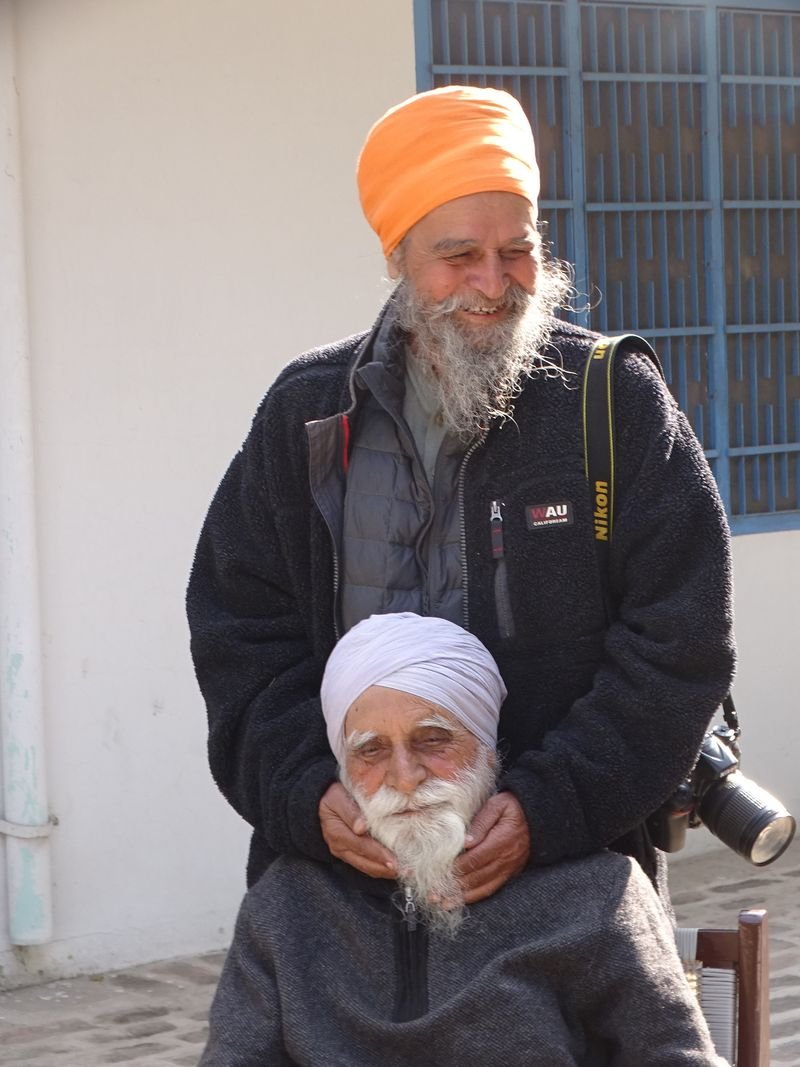

Bajwa Fotos, Cinema Road, Batala — the caption appeared at the bottom of each photograph Harbhajan Bajwa sent out. Shiv Kumar has immortalised this town by his nom de plume Batalvi; for me, though, Batala has always been associated with the memories of Harbhajan Bajwa.Synonymous with a fierce intensity, Bajwa nurtured it to the point of playful anarchy. He was ‘too much’ — without fail, without remorse, without second thoughts. With the honourable exception of poet Parminderjit, few could match Bajwa in full flow, speaking the rustic Riarki accent of Majhi laced with endearing cuss words.A portrait of poet Shiv Kumar Batalvi by Harbhajan Bajwa.A photojournalist of repute, Harbhajan Bajwa, who passed away recently, documented Punjabi writers and major literary events for 60 years. A disciple of painter Sobha Singh, he adopted photography as his profession. A close friend of Jaswant Singh Rahi and an affectionate admirer of Sant Harchand Singh Longowal, he was associated with almost all the Punjabi dailies. The veritable beating heart of any gathering, his presence lent charm, authenticity and holy terror in equal measure.His acerbic comments were treated as a boon from the deity. His glare could unsettle novices. He demanded absolute respect for his craft, and refusal to ‘click’ on demand was a tactic he honed to perfection. Photographers are usually unobtrusive, soft-spoken with lips pursed, eyes still in a repose, almost beseeching the subject with mild gestures, hardly betraying an emotion while quietly maneuvering the setting or composition. Bajwa was a polar opposite — loud, boisterous, in your face with a piercing set of eyes as if to burn a hole in the whole setting.His animated conversations and dramatic gestures are vividly etched in my mind, when I was conducting the proceedings at Dhudike village in Moga in June 2018 to mark eminent author Jaswant Singh Kanwal — my maternal grandfather — entering his 100th year. Who would dare ask Bajwa to settle down? Poet and raconteur Gurbhajan Gill, after some persuasion, reluctantly stepped in to rein him in.In his touching pen sketch of Kanwal, Paash writes about the legions of followers in the Majha and Doaba regions of Punjab devouring his novels set in Malwa. Gill notes that Gurdaspurias have a unique affinity for both Kanwal and the legendary folk singer Yamla Jatt — a spirit epitomised by Amarjit Gurdaspuri and Harbhajan Bajwa. Gurdaspur was one district in Majha where Kanwal was frequently invited to address literary, social and political gatherings.We lived in Qadian during those days of the 1970s — a sleepy, slow-paced town in Gurdaspur. Qadian, for me, was an enchanted space with its quiet qabaristans, haunting havelis, broad avenues on the outskirts, the imposing building of Sikh National College and the resonant qawwalis during urs at the Ahmadiyya headquarters. An old-style structure with long verandahs, high ceilings, and thick walls opposite the Noor Building was allotted to my father, who served as the medical officer.Jaswant Singh Kanwal would arrive for these events, and by late afternoon his followers would accompany him to our home, where politics and literature were vigorously debated. His novel ‘Lahu Di Lau’ had become a rage in those years, fuelling debates on the Punjabi radical tradition. The issues of ideological deviation, political intervention, and strategic autonomy were thick in the air in the backdrop of the decline of the left wing in Punjab.Bajwa was a constant companion to Kanwal on these quixotic adventures. Between the two of them, it was difficult to discern who was Don Quixote and who was Sancho Panza; perhaps the roles shifted continually. Armed with his inscrutability, Kanwal seemed like a muse to Bajwa. He would tease and chide Kanwal, who evaded his jibes with composure. Undeterred, Bajwa would up the ante, growing louder and rougher until Kanwal would tick him off with a deadly glare. Bajwa would sheepishly retreat, only to resurface a moment later: “Your fans will only turn you into a softy. If I stop pestering you, you’ll lose the sharpness and immense power of your words. You should rather be thankful!”Bajwa harboured immense respect and affection for the older generation of authors and plain contempt for contemporary ones — “networking agents masquerading as writers”. Yet Bajwa loved people with ardour, especially writers with uncompromising ethics and aesthetics, putting into sharp relief his loving bond with Kanwal for more than half a century.A disciple of legendary artist Sobha Singh (L), Harbhajan Bajwa adopted photography as his profession. Photos courtesy:the writerEvenings in Qadian lit up with their unceasing repartee. The record player spun Shiv Kumar Batalvi’s songs. Mehdi Hassan singing Faiz alongside Begum Akhtar’s rendering of Mirza Ghalib’s ‘Ibn-e-Mariam hua karey koi’ would send Kanwal into raptures as he recited Mir, Faiz, Iqbal, Waris Shah, Bawa Balwant and others. Restless as ever, Bajwa would abandon his seat, plonking on the carpet near Kanwal’s feet or directly opposite him. Both remembered Shiv with great feeling, missing his passionate presence.Where Kanwal and his fictional characters embody honour and passion, Bajwa seemed a flesh-and-bone character straight off the pages of his novels. Bajwa took to writing poetry with five anthologies to his credit, a couple of pictorial books documenting a day in pictures of eminent authors, and his memoirs in prose.Inspired by Bajwa, Ravinder Ravi, a Ludhiana-based photographer, presented him costly equipment to digitally conserve his vast repertoire of photo negatives. Ravi himself took to documenting literary figures and conserving rare photographs. Bajwa’s lineage continues to grow with Sukhjivan of Geet Arts following in Ravi’s footsteps.Bajwa donated his negatives to Punjabi Satth Lambran. Renowned for an aesthetic production of books and the moving soul behind Amritsar-based Sachal Prakashan, Sandip Singh is carrying forward Bajwa’s legacy by documenting Amritsar’s literary heritage. His recent publication on Daleep Artist, a distinguished title designer of Amritsar, is a true labour of love. Baba Aya Singh Riarki Memorial College, Tughalwala, has started a wing in its library named after Bajwa where his collection of literary journals is on display.Meanwhile, completely entranced by his capers at the tender age of four or five, I was at his beck and call for every adventure. He would fetch an apple asking me to eat it alone in front of my kid brother. I would gladly oblige and he got down to work. He would ask me to climb atop Kanwal’s shoulders, a command I would follow with gusto.The resulting chaos, mixed emotions, lowering of guard, bubbling laughter were instantly captured by his lens. He was constantly at work, never missing a moment. Kanwal applied a similar method to hone his diction, teasing villagers to provoke chaste, passionate Punjabi expressions delivered with verve that he later absorbed in his fiction. Both were consummate practitioners of their respective crafts.Playful irreverence was Bajwa’s code of being. Fascinated by his electric persona and antinomian behaviour, I imperceptibly imbibed his ethos. As a student of Punjabi literary culture, it is imperative to do justice to the profound effect such proud readers bring to literary culture — readers who constantly challenge their favourite writers.In losing Bajwa, we are in a morass, rendered painfully inept to contemplate the essential task of a discerning reader who crafts a language to converse about aesthetics. His passing revealed to me that my own playful irreverence towards Kanwal granted me astonishing insights into his creative process.After a hiatus of 15 years, as I came of age, I met him again. He always called me by my nickname, Godot, in his Riarki accent. “You captured our innocent childhood so well that it became a haven to escape the surrounding violence,” I said to him in 1992. Uncharacteristically, his voice softened as he whispered, “Those photos make me smile. I like being in that time.”Five of Jaswant Singh Kanwal’s close Gurdaspuria friends — Shiv Kumar Batalvi, Sujan Singh, Mohan Kahlon, Amarjit Gurdaspuri and now Harbhajan Bajwa — are reunited with him. I can only wonder what all escapades Bajwa must be up to now!— The writer is a historian and the director of ADARA 23 MARCH