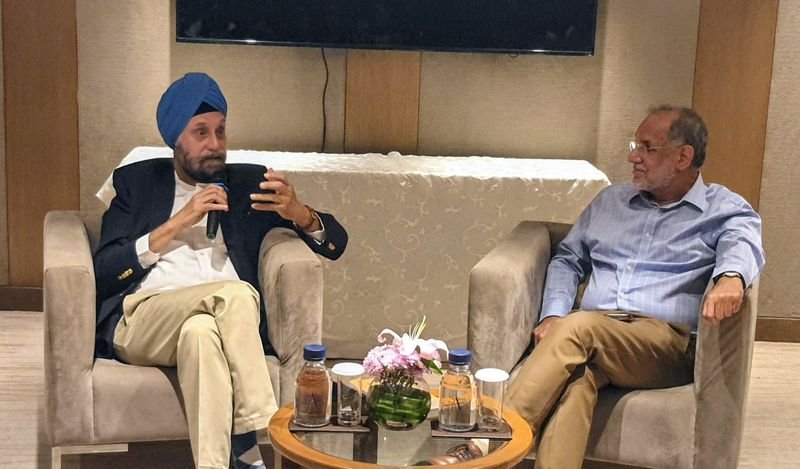

Author and former Indian Ambassador to Israel, the United States and the United Kingdom, Navtej Sarna has often said that history rarely unfolds as a series of isolated events. Its tragedies, revolutions and lessons emerge from currents that have been gathering for years, sometimes generations.Speaking at a special literary session hosted by the Prabha Khaitan Foundation on his book, Crimson Spring, Navtej, who was in conversation with friend and former diplomat-author Navdeep Suri, said the Ghadar Movement, the Indian National Movement and the Singh Sabha Movement were not isolated or disconnected episodes of history.In Navtej Sarna’s Crimson Spring, the story of Jallianwala Bagh acquires larger significance.Sarna and Suri, while discussing the current generation’s resonance with the idealism of Kartar Singh Saraba, Bhagat Singh and Udham Singh, lauded the spirit of youngsters.“Kartar Singh Sarabha was 19 when he was hanged. Bhagat Singh was 23. These movements were born out of pure altruism and they continue to resonate across generations. This vision got corrupted as violence, but they were driven by an extraordinary conviction which challenged British rule,” he said.These revolutionaries, executed at a young age, became enduring sources of inspiration and a symbol of a generation that believed in political dissent, refused to bow down to the power of the state and demanded that the common people be heard.The novel’s historical canvas also offers a way of thinking about the Partition. “I wanted to understand what undivided Punjab was like — the social and cultural fabric, the political streams that moved during the time and what led us to the Partition,” he said, explaining the reason behind writing a fiction on Jallianwala Bagh. Sarna said he focused on keeping the history intact even as he weaved fictional characters and arcs in his book.“The Ghadar Movement was happening, the Singh Sabha Movement and the Gurdwara Reform Movement were on the rise and World War soldiers were returning home,” he explained.The conversation explored contemporary global conflicts and examined how they are increasingly being narrated through inherited grievances, competing historical claims and the language of collective victimhood. In West Asia, where both Sarna and Suri have served on diplomatic missions, the subject was the conflict involving Israel and Iran. “The war in West Asia is a war of choice and Iran is a country with a complex history and a martyr mindset. There is no way out of it for now but we need to be hopeful,” he said.