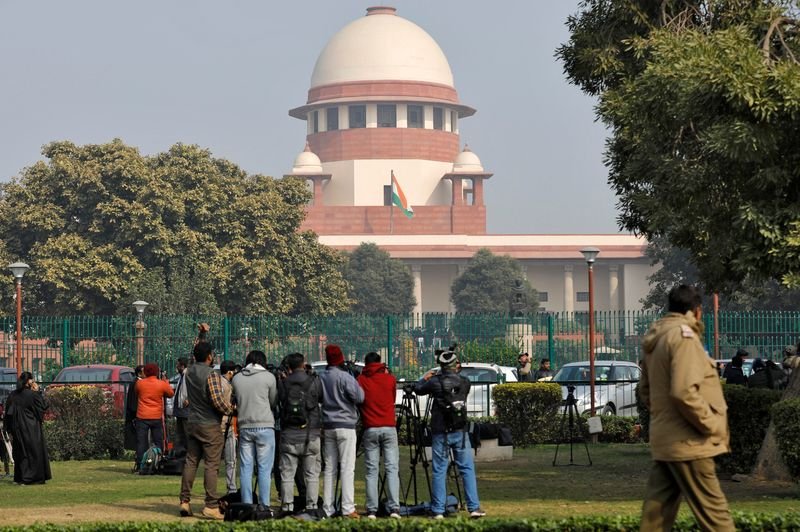

Taking exception to social media platforms’ failure to curb circulation of sexually explicit visual content depicting minors, the Supreme Court has directed them to ensure that no such material, having the propensity to harm children, is uploaded or promoted through paywalls or subscription, either directly or indirectly.“Every intermediary (social media platform) must ensure that no CSEAM (Child Sexual Exploitation and Abuse Material), or any other material having the propensity or likelihood to harm children, is offered, hosted, uploaded, promoted or circulated through such paywall or subscription, either directly or indirectly,” a Bench of Justice JB Pardiwala and Justice K Vinod Chandran said in its October 15 order.“Intermediaries must further take all measures to ensure that any content, paywalled or otherwise, which depicts or promotes anything obscene, indecent or sexually explicit, or which is otherwise lascivious or prurient in nature, is not promoted to any children on their platforms. Every care must also be taken to ensure that no child is able to subscribe to, or otherwise access, such content,” it said.“The Union of India shall create a National Hash & URL List Database for the sole purpose of the detection and removal of CSEAM. Such a database may be created as part of the Sahyog Portal or as a standalone repository,” it said.The top court also directed the Union of India to frame appropriate guidelines for ensuring the proper scrutiny of paywalled and subscription-based content by intermediaries for the detection and removal of CSEAM.“The said guidelines shall also prescribe reasonable and proportionate measures to moderate the nature of content that can be accessed or subscribed to, by the children,” it said.The Bench directed the Ministry of Electronics and Information Technology and the Ministry of Law and Justice to take appropriate action for overseeing and implementing the suggestions, measures and safeguards suggested in its judgment.The directions came on a plea by ‘Just Rights for Children Alliance’ alleging lapses on the part of intermediaries in dealing with CSEAM despite its September 2024 verdict on the issue.On September 23, 2024, the top court had suggested that Parliament should consider bringing an amendment to the POCSO Act for substituting the term “child pornography” with “child sexual exploitation and abuse material” to reflect more accurately the reality of such offences. It had also declared that watching and downloading child pornography offences under the POCSO Act and the Information Technology Act.Noting that it has repeatedly flagged non-compliance with its September 2024 directions by the social media intermediaries and platforms, the Bench lamented no action has been taken by them.“Despite more than two years having gone by since our judgement, it appears that there has been no progress worth the name. If anything, the recent news reports instead reveal an even more unsettling reality when it comes to the safety and wellbeing of our children,” it said.The top court directed the Centre to consider putting in place a framework for imposing exemplary monetary fines on intermediaries for the breach of any duties under the IT Act and the IT Rules and said the quantum of such penalties must be determined having regard to the gravity, duration and recurrence of the default as well as the size and turnover of the intermediary.It said where any CSEAM or prohibited material is found to have been hosted, uploaded, promoted or circulated, directly or indirectly, through any paywall or subscription from which the intermediary derives any revenue, the revenue so derived from such content should be forfeited and disgorged.The top court directed the Union of India to create a National Hash & URL List Database for the sole purpose of the detection and removal of CSEAM as part of the Sahyog Portal or as a standalone repository.“Any entry within the National Hash & URL List Database shall only be made after a thorough assessment of the material through multiple tiers of verification. Such assessment may involve preliminary screening of the material by specialised software; however, the final determination or screening shall be done by at least three trained human analysts, who would independently determine whether the material in question constitutes CSEAM,” it said.“Where any material upon such assessment is confirmed to be CSEAM, the perceptual hash identifier and/or the URL of the material would be generated and entered into the National Database,” the Bench said.