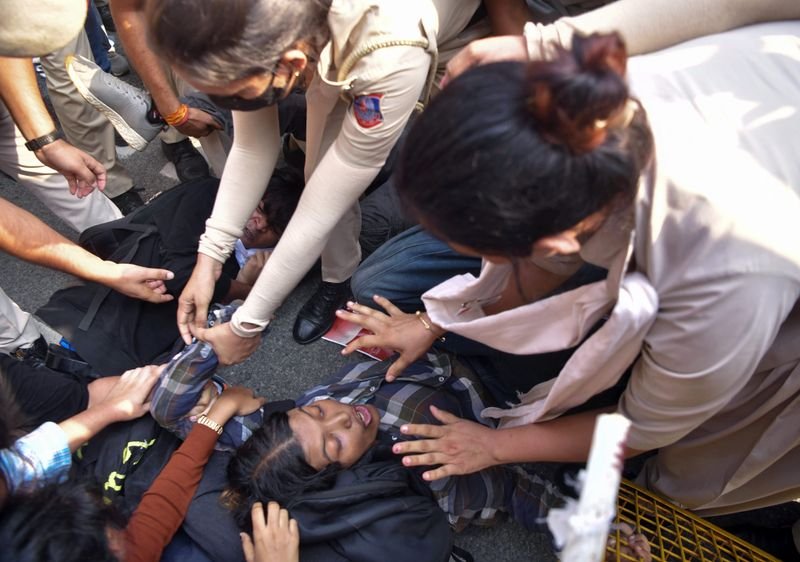

This is traditionally the start of our annual festive season: Dasehra, Diwali, weddings and Christmas. The weather turns balmy and cool, neither too hot nor yet cold and foggy so that we can all take out those silks and beautiful shawls that are packed away after Holi. This year, however, everything is going topsy turvy: the monsoon, like a shameless guest, keeps spraying rain on open air venues, and the sun when it shines afterwards is so blinding that it’s difficult to open one’s eyes without shading them with a hand.The festival sales that are taking place now — and sustain the pavement life in Janpath and Bengali Market area — are unreachable as that part of Delhi remains mostly cordoned off and barricaded. So the artisans who bring lovely mirrorwork skirts and cholis from Gujarat and Kutch, jutis and parandis from Punjab, hand-printed saris and fabric from Rajasthan were forced to abort their plans. Added to this was the uncertainty of where traffic was allowed to move, which led to long lines of stranded passengers, schoolchildren trapped in buses, patients in ambulances, grieving relatives unable to attend a cremation. Delhi has never seen a less happy time than now.I wish to ask whether it is just the Constitution that needs to be defended. What about a citizen’s right to move freely? I can see a lot of the initial sympathy for these movements now turn into anger and indifference. As these feelings are avidly exploited by the political leeches that feed on them, friends, families, neighbours and colleagues find themselves on opposing sides. Is this the India that we are going to bequeath to Gen Alpha and those yet unborn?Let me turn from there to some memorable events I was able to attend. The first was a most invigorating conversation between Ramachandra Guha and Prof Apoorvanand on Guha’s latest book, ‘Arguments with Gandhi’. I can think of very few scholars who have dedicated their lives to scouring archives the way Guha has. I remember how he arrived each year to spend a month at the India International Centre to trawl through the Teen Murti Library, the National Archives and several such libraries and collections.His path-breaking promotion of environmental history was followed by his documentation of Gandhi’s life from his stints in Britain, South Africa and India. There is possibly no part of Gandhi’s life, philosophy and writing that Guha has not studied and written brilliantly on.Matching his intellectual and historical sense was Prof Apoorvanand, who nudged Guha back to the discussion when Guha occasionally got carried away.What I particularly appreciated was the fact that despite both being awesome scholars, they shared their knowledge with the audience. Often such a conversation becomes a polemical debate where one tries to outshine the other. I see this as a certain disdain for the common or lay reader all around me. In most editorials written by some of the finest intellectuals we have in this country (and perhaps the world), there is temptation to use a vocabulary that excludes a large part of the readership.This stems, in my view, from something that we often neglect when talking of the universality of Gandhi’s perennial appeal. Educated in English, Gandhi too could have chosen to use English when challenging the British colonial rulers. Yet, on the advice of Tilak, he stripped himself literally down to his basics, and always addressed his audiences in the simple homespun wisdom of our known Hindustani and aphorisms or prayers that were familiar to even the unlettered peasants. He travelled on foot, wore khadi and practised what he preached.This was his greatest weapon against the entitled lords and ladies of the Raj. He carried more dignity in his dhoti than the battery of medals the others shone on their lapels. How I wish our leaders today had that respect for a common man’s dignity and life. To mock someone and use personal remarks to belittle another is not the sign of a large heart. Our haste to pre-judge people by mocking the films they see, the songs they hear or the books they like to read comes from a sense of superiority that distances many from admiring the substance of their politics.Remember that while caste is the most obvious divide that separates us, it is also the language we use to communicate. Gandhi always spoke in his brand of Gujju Hindi, Nehru in an elegant Hindustani that blended Hindi and Urdu beautifully. Their lasting influence on us and our ways of thinking is a reminder that language, democracy and equality are closely intertwined. As people today speak and write in academic vocabularies that make sense only to those who share their class background, they are slowly dropped from those lives that they have never lived.India is not Jantar Mantar or the cordoned-off region of Central Delhi. Both our protesters and ruling classes need to unstiffen their stands and talk as humans to each other. They may discover some common ground that will help to repair the broken strands of our social fabric and fix the damage that has been done of late by two inflexible teams.As always, Gandhi shows the way. Truth and non-violence were never more urgently needed in this land once again.— The writer is a social commentator