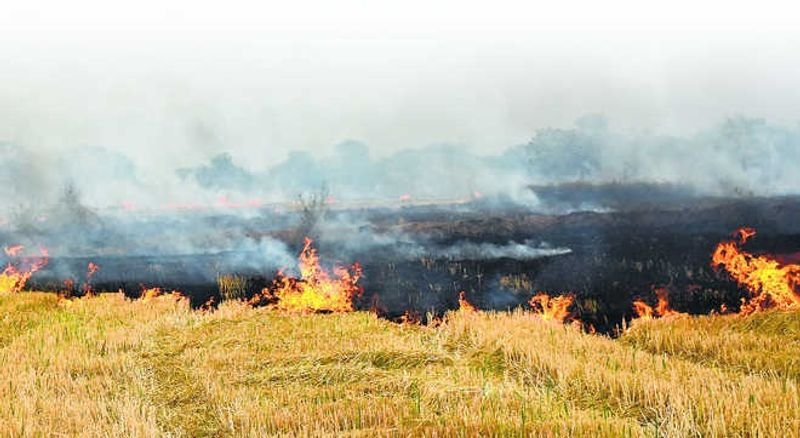

With paddy harvesting expected to begin by the last week of September, the state Agriculture Department has prepared an action plan to strengthen crop residue management and further reduce stubble burning by holding awareness camps.Over 22,000 crop residue management machines will be made available to farmers and farming communities at subsidised rates for in-situ (chopping, mulching and mixing residue into the soil) and ex-situ management (removing straw from fields to be used in industry as fuel) of paddy straw.Under its campaign for efficient management of paddy straw, PAU-Krishi Vigyan Kendra is already holding awareness camps in villages. “We are motivating farmers to sow wheat while retaining paddy straw in the field itself. Farmers are being informed about the adverse effects of stubble burning on the environment, soil health and human health,” said Mandeep Singh, incharge, PAU-KVK, Sangrur.Jattvibeil Kumar, assistant professor of farm machinery, provided detailed information to farmers about the farm machinery available for sowing of wheat with straw retention and its proper use.The Centre has sanctioned Rs 576 crore for crop residue management in Punjab this year, with the state focusing on machinery for managing residue within fields as well as infrastructure for collecting and utilising straw outside farms.Nearly 7,500 Super Straw Management System (SMS) machines, in addition to 6,500 super seeder machines, will be provided to reduce cases of farm fire this season. These tractor-operated machines mulch and incorporate paddy residue and also sow seeds along with fertiliser.The area under paddy cultivation in the state has crossed 32.75 lakh hectares this year, one of the highest areas recorded so far, thus raising fears of more farm fires.The Punjab Pollution Control Board data puts paddy production at around 210 lakh tonnes, along with nearly 210 lakh tonnes of straw. Out of this, only around 120 lakh tonnes of residue is incorporated into the soil, while the remaining residue is available for use as fuel or is set on fire.The board monitors stubble burning every year from September 15 to November 30. In 2025, the state saw 5,114 cases, the lowest in over a decade. As per data collected from the PPCB, the state recorded 10,909 cases of farm fires in 2024 as compared to 36,663 in 2023. Earlier, the state witnessed a total of 83,002 farm fires in 2020, 71,304 in 2021 and 49,922 in 2022.Recently, the Supreme Court pulled up the state government and asked it why some errant farmers should not be arrested for the practice of stubble burning, considered as a key contributor to the winter pollution in northern India, especially Delhi and its surroundings.Farm unions have been opposing any action against farmers, including the registration of cases, and have been demanding cash incentives to deal with paddy residue. With the state scheduled to go to polls early next year, the government is also likely to be wary of any punitive action against the farmers.