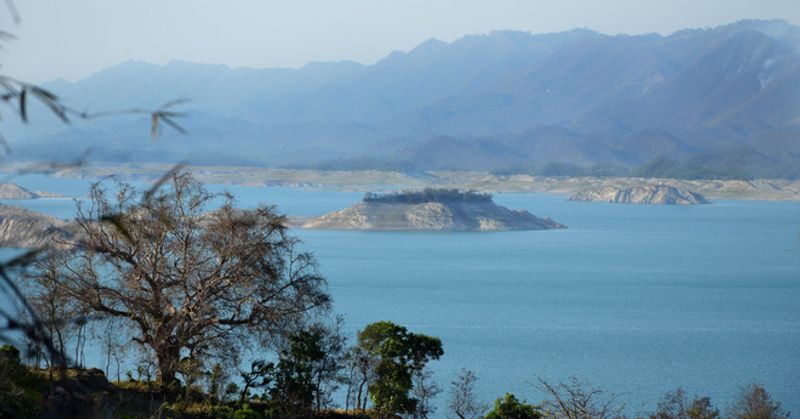

Amidst the delayed onset of the southwest monsoon and deficient pre-monsoon rain across north-west India, water levels at the Bhakra and Thein dams, two of the region’s three major reservoirs, have fallen below normal.Until the beginning of this week, water levels at both dams, which are crucial for irrigation and power generation, had remained above normal. In contrast, the water level at Pong Dam, the third major reservoir in the region, continues to remain above normal.According to data released by the Central Water Commission (CWC) on June 25, Bhakra Dam on the Sutlej river in Himachal Pradesh is currently at 21.84 per cent of its total storage capacity, compared with the 10-year average of 24.55 per cent for this time of the year.Last week, the available storage was 25.22 per cent and at the beginning of June it was 29.60 percent. The water level at Bhakra on the morning of June 26 stood at 1,559.95 feet against the maximum permissible level of 1,680 feet, with the inflow being 17,341 cusecs and the outflow being 29,650 cusecs, according to the Bhakra Beas Management Board (BBMB).At Thein Dam that lies on the Ravi in Punjab, the storage at present is 35.92 per cent of its total capacity against the past 10-year average of 42.32 per cent. It was 41.13 per cent last week and 53.38 per cent at the beginning of June. The current water level was 1,756 against the upper limit of 1,732 feet.The storage at Pong Dam on the Beas in Himachal Pradesh is 27.35 pe rcent at present compared to the past 10-year average of 18.45 per cent at this time of the year, according to CWC data.It was 29.57 per cent last week and 35.10 percent at the beginning of this month. The water level recorded at Pong on June 26 was 1319.62 feet against the upper limit of 1,390 feet, with the inflow being 3,665 cusecs and the outflow being 16,855 cusecs, BBMB said.At the national level, the present combined storage in 166 major reservoirs is 48.40 per cent of their total capacity as compared to the normal of 45.8 per cent for this time of the year. It is deficient in the eastern and southern regions, CWC data revealed.BBMB officials said that maintaining storage levels and release of water from Bhakra and Pong Dams is in accordance with a ‘Rule Curve’ developed two years ago, which lays down the water levels that the reservoirs should ideally maintain at different times of the year, by taking into account the meteorological forecasts over the dams’ catchment area, current levels, anticipated inflows and water demands from the member states. This can vary from season to season and year to year.Earlier this month, faced with above normal storage levels, the BBMB, which controls Bhakra and Pong dams, had advised the states to maximise the use of water from the dams ahead of the monsoons for creating “flood cushioning”, that is a buffer created for any heavy inflows arising from freak weather events during the rainy season. The period from May to September is called the filling period as inflows increase due to snow melt and rain. From autumn till early spring, inflows reduce substantially.The rain over the region, however, has faltered. The normal date of monsoon touching the eastern edge of Himachal Pradesh is June 20, but has not entered Uttar Pradesh so far. The India Meteorological Department (IMD) has already predicted that the Monsoon in 2026 is expected to be below normal.Though some parts of Punjab, Haryana and Himachal Pradesh have experienced intermittent showers on several days in June on account of western disturbances, IMD has termed the monsoon activity over Punjab and Haryana as “weak”.Weather bulletins issued by the IMD on June 26 said that the monthly rainfall so far has been below the long period average by 31 per cent in Himachal Pradesh and by 30 per cent in Punjab and Haryana. Varying amounts of rainfall is expected in all three states till July 2.