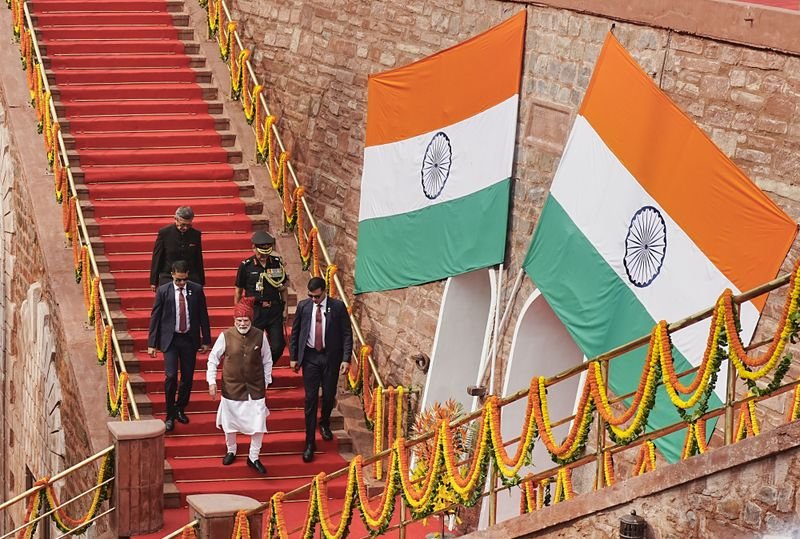

Charting an ambitious blueprint to transform the country into a developed nation by 2047, Prime Minister Narendra Modi, delivering his customary Independence Day speech from the ramparts of the Red Fort, unveiled a ‘Sapta Dhara’ vision, or a seven-pillar framework.The seven pillars are manufacturing, farming, technology, Gati Shakti, self-reliance in defence, the green economy and soft power—designed to accelerate national growth over the next decade and beyond.Less than a month after massive protests by youth at Jantar Mantar in New Delhi, Modi focused on the younger generation and promised that 1 crore young people would be trained in AI over the next year through a nationwide mission-mode initiative.He added that free online coaching will be provided to youth preparing for various competitive examinations and for sports. A nationwide campaign will target children aged between 5 and 15 years across villages and cities.Amid evolving global supply chain dynamics, PM Modi positioned energy independence as an urgent national priority. He noted that domestic piped natural gas (PNG) networks have expanded from 70 cities 12 years ago to more than 700 cities today, connecting 1.75 crore households.On nuclear energy, Modi set a target of 100 GW of capacity by 2047 and added that five new reactors would become operational within the next 6–7 years. “Nuclear energy is a major means of energy security. We have paved the way towards a new goal by passing the ‘Shanti Act’ in Parliament.”This year, India achieved a significant milestone by mastering fast-breeder nuclear technology, marking a major stride towards self-reliance in nuclear fuel, Modi said.Modi urged the nation to broaden its thinking. “A nation is rarely held back by a lack of resources; rather, it is often constrained by the limitations of its mindset. When thinking stagnates and becomes confined by boundaries, we fail to recognise our own true potential,” Modi said.Modi said the country remains dependent on crude oil, a situation stemming from a flawed mindset. He cited how 99% of the nation’s coastline had been designated as a no-go area.“We had effectively decided against exploring the ocean depths. That was a poverty of thought. The government decided this could not continue. We have opened up 99% of the areas that were once ‘no-go zones’ as ‘go-ahead zones’. We are now actively engaged in deep-sea exploration and the search for new reserves.”Last year’s “Samudra Manthan” project was a significant step in this direction, Modi said, adding that Rs 85,000 crore had been allocated for the purpose.On the manufacturing sector, Modi said the country needs to focus on three things: cost, quality and scale. “There should be no compromise on quality. This will be our brand value.” He cited recent free trade agreements with other countries, adding that food processing would gain access to wider global markets.Touching upon technology, innovation and digital technologies, Modi called for deeper domestic manufacturing capabilities across critical technology and defence sectors.Modi said India was moving towards self-reliance in semiconductor manufacturing as chips become increasingly important for electronic goods, medical equipment and transportation systems.He said three major semiconductor plants had already started operations and their production was expected to be exported. The Prime Minister also said another five to eight semiconductor plants were likely to become operational over the next seven to eight years.The Prime Minister linked the expansion of semiconductor manufacturing to India’s Atmanirbhar Bharat push and the goal of becoming a Viksit Bharat by 2047.Critical minerals also featured prominently in the self-reliance pitch, as Modi mentioned the need to secure access to resources crucial for the country’s future energy, industrial and technological requirements.India has been stepping up efforts to reduce its dependence on imported critical minerals through the National Critical Minerals Mission. These minerals are important for sectors including clean energy, high-tech manufacturing and defence.The push has assumed greater importance as India seeks to expand domestic manufacturing in areas such as semiconductors, renewable energy and electric mobility, all of which depend on secure supplies of strategic raw materials.Modi went on to announce that the country would establish a vibrant Civil Defence network in the coming days.“Measures need to be put in place to protect citizens from modern-day crises. We are going to create a massive, modern Civil Defence volunteer force capable of overcoming contemporary challenges,” Modi said.On internal security, Modi said that for years, individuals with a Maoist mindset had entrenched themselves within the corridors of power in the country.“This Maoist ideology influenced policies, even through their roles as advisors on government committees. We have succeeded in eliminating armed Naxals in the forests and freeing the nation from that crisis. However, while the armed Naxals are gone, ‘Dimagi Naxals’ remain, and those who harbour this mindset are waiting for an opportunity. We must identify these ‘Dimagi Naxals’. We need to isolate them and align the nation’s youth with the mainstream effort to transform the country into a developed nation.”On self-reliance, Modi said every nation had shifted towards a mindset of looking after its own interests. Unfortunately, during this period of crisis, some have played the game of weaponising resources to assert their dominance. The world is busy weaponising whatever it possesses—be it petrol, diesel, fertilisers, medicines or technology chips.He highlighted India’s journey over the last 12 years from one of the “Fragile Five” economies to the world’s fastest-growing major economy.“By 2014, we had become a part of the ‘Fragile Five’. But in the last 12 years, we picked up pace,” PM Modi told the gathering.Prime Minister Modi concluded his 13th Red Fort address by expressing solidarity with regions affected by recent seasonal monsoon floods and landslides, promising full national support for recovery efforts.Decoding ‘Sapta Dhara’Manufacturing power: Build complete domestic end-to-end value chains, from design to components, focusing on zero-defect quality, cost and global scale.Agriculture and food processing: Create integrated farm-to-export supply chains for millets, spices and fruits while transitioning to chemical-free farming.Technology and innovation: Evolve from a tech market into a global innovation hub leading in AI, quantum technology, space, robotics, DPI and Made-in-India 6G.Gati Shakti: Establish high-speed, seamless multimodal logistics connecting cities, highways, railways, airports and modern industrial seaports.Defence Shakti: Achieve complete strategic self-reliance by pioneering and exporting next-generation defence technologies such as drones, counter-drone systems and hypersonics.Green and blue economy: Scale sustainable growth through green hydrogen, renewables and energy storage, alongside the full utilisation of ocean, coastal and marine potential.India’s soft power: Globalise Indian culture, yoga, Ayurveda and tourism while establishing global leadership in gaming, VFX, animation and the creative economy.