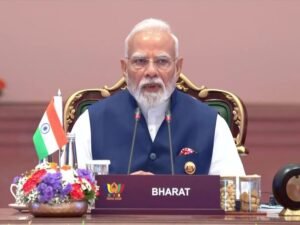

There is a reason why Union Home Minister Amit Shah collected water from Vadnagar’s Sharmishtha Lake today and handed it to BJP workers to be carried further to Varanasi, Prime Minister Narendra Modi’s Lok Sabha constituency.In Shah’s act timed with PM Modi’s 76th birthday on Thursday, there was high symbolism.It was in this very lake in North Gujarat’s Mehsana where Modi, as a child, would spend hours swimming, a ritual that helped him beat punishing heat in the summers.Though details of the PM’s early life are mostly hidden from the public eye, one biography stands out for its revelations of the motivations that shaped Modi’s pro-poor policies in later years when he was Chief Minister of Gujarat and later Prime Minister.Berjis Desai’s “Modi’s Mission” speaks about the latter’s days in his birthplace, Vadnagar, where there was no electricity when he was born on September 17, 1950, delivered at home by a midwife.”Flat-wick lamps burning kerosene provided dim light. Kerosene irritated the eyes and throat. Narendra remembers cleaning, along with his brothers, the glass chimney getting fogged. Modi’s house had no electricity even when he left home permanently at 17. Lamps were lit after sunset,” reveals Desai’s book.It paints a picture of Modi’s home — dark, dingy, without a waft of breeze during the long summers.”Eight heavily perspiring bodies were jammed together in the 480 square feet house, bitten by large mosquitoes which proliferated in the open drainage of the town…A clay pot of water was a luxury in summer when wells dried up. The reason is perhaps why Narendra spent hours swimming in the Sharmishtha Lake where he often washed laundry and bathed in public,” Desai writes.The book traces Modi’s belonging to the Modi Ghanchi (oil pressers) community and speaks of how the advent of Dalda, hydrogenated refined edible oil at the hands of Lever Brothers in 1937, virtually destroyed the oil pressing cottage industry of Gujarat.”Damodardas, Modi’s father, left home every single day at 4 am, stopped to pray at a local temple before opening his little tea shop at Vadnagar railway station,” the biography says.It adds that the area where Modi lived as a child consisted of a narrow cobblestoned pathway sandwiched on either side by a row of houses. The mohalla often shared a well, which was an object of worship.”The other shared facility was the makeshift latrine system,” Desai says, revealing why childhood memories of toilets being an open-air affair, community water sources being shared and electricity being an absolute luxury shaped Modi’s NDA rule policies of 100 per cent electrification of villages, har ghar jal and swachhta through the toilet campaign.”Modi grew up in a household that was in the twilight zone between poor and lower middle class. Not starving yet barely surviving. As a child, he watched his mother sitting on her haunches cleaning the utensils of others. Modi imbibed firsthand the pains and stress of his mother, the Indian homemaker whose life was without respite and hope…These childhood experiences shaped his later-day approach towards the exhibitionist rich with blunted sensibilities,” says Desai, describing Modi’s love for millet rotis as a child.Mapping the dietary charts of the Damodardas home, the biographer writes that Dal, with gargantuan rotis of jowar and bajra, having a pinch of salt, was roasted on a wood- and cow dung-fed fire and consumed with green chilli paste, an antidote to appetite.”Heeraba, recollects Modi, made delicious ghee from the cream his father brought. Wheat chapatis and veggies were prepared rarely. Modi must not have consumed more than two dozen Alphonsos in his entire childhood, that too at community feasts. He loved to dunk the cold, hardened bajra roti in steaming hot tea,” Berjis Desai says, speaking from his many conversations with the prime minister and putting into perspective Modi’s push to replace chulhas across the rural hinterland with LPG cylinders — the plan that came to be called the Ujjwala scheme.