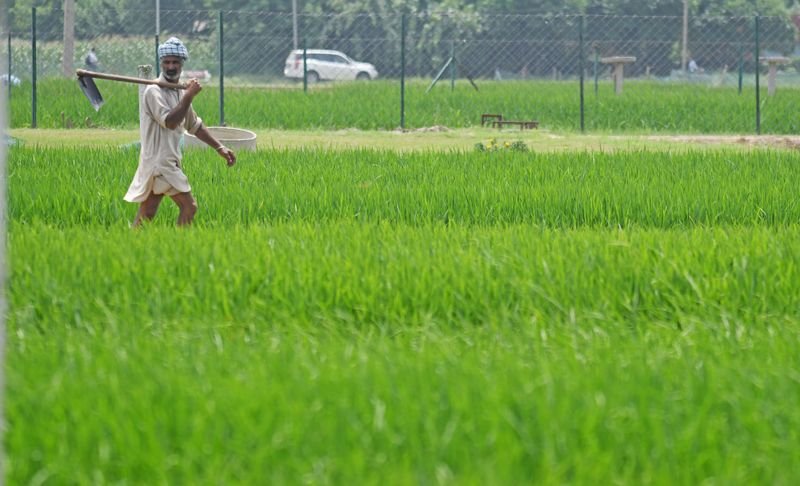

Basmati farmers in Punjab are on a roll this year, as the crop is getting 53 per cent higher prices for their produce than last year.Triggered by the panic buying of basmati by the Gulf Cooperation Council (GCC) countries, hit by the Iran-US conflict, it is the basmati growers and exporters in Punjab that are reaping the “war profit”. As against a price of Rs 2,800 per quintal for the early-maturing basmati prices fetched by growers in 2025, this time, PUSA 1509 and PUSA 1692 are fetching farmers anything between Rs 4,200 and Rs 4,300 per quintal.Basmati cultivation is better than the non-basmati paddy for Punjab’s depleting groundwater, as it requires less water; has less stubble than the paddy and matures faster, leaving growers enough time to scientifically manage stubble; and, though limited, provides an opportunity for crop diversification from wheat to non-paddy monoculture in Punjab. It is for these reasons that successive governments have been promoting basmati cultivation over non-basmati paddy. A high profit year (as of now) only aids in promoting the shift from water-guzzling non-basmati paddy (like PR 126 and PR 131) to the basmati paddy.“The demand for basmati in the GCC countries has gone up significantly because of the war. Earlier, these countries would never stock foodgrains, including basmati. But now, fearing sanctions and closure of trade routes, most countries are resorting to panic buying of basmati. As demand rises there, the prices fetched by farmers are also higher, though the exporters still face a risk factor in exports to Iran, higher ocean freight, closure of Hormuz and risks in using the Bab el Mandeb strait,” Ranjit Singh Jossan, vice-president of the Punjab Rice Millers and Exporters Association, told The Tribune.However, as the arrival of the premium paddy variety gains momentum, Jatinder Pal Singh, a basmati grower from Rasulpur village of Tarn Taran, says that it’s been almost many years since he has seen such a high price for basmati.Notably, basmati is not bought by the government, and its prices are entirely market driven. It is bought by rice exporters, which is the main reason why farmers stick to the non-basmati paddy that is bought on an assured MSP by government agencies.Narinder Behal, a commission agent in Amritsar, says while farmers who have brought non-basmati paddy to mandis are sometimes getting a price less than the MSP of Rs 2,461 per quintal because the buyers (rice mills) are complaining of a fall in quality, the basmati growers are getting Rs 1,500 per quintal higher price than last year. “This means that per acre, they realise Rs 25,000 more than what a non-basmati grower is realising,” he says.This year, the area under basmati has increased by 50,000 hectares—from 6.7 lakh hectares last year to 7.2 lakh hectares now. Thanks to a favourable weather during the cultivation period, the yield of the crop is also higher by about 5 quintals per acre (from 18 quintals to 23-24 quintals). This indicates a bumper harvest, with estimates by the All India Rice Exporters Association pegging the total production to around 30 lakh metric tonnes (LMT). Last year, the production was 22.7 LMT.