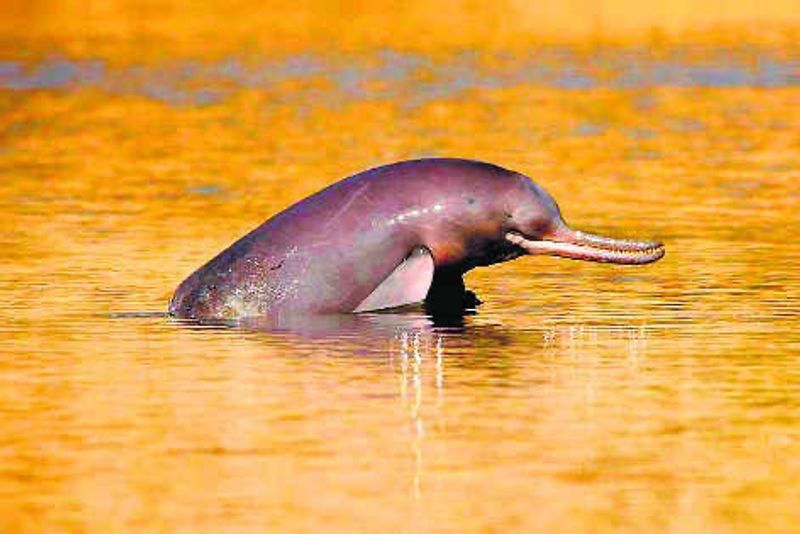

Conservationists have raised alarm over the declining population of Indus river dolphins in the Beas and the Beas Conservation Reserve, the species’ only habitat in India.Locals living along the river and conservation activists claim only two dolphins remain in the reserve, a figure disputed by the Wildlife Department. The Indus river dolphin, locally called Bhulan, is considered an integral part of the river and legally protected as a Schedule I species under the Wild Life (Protection) Act, 1972.Among those raising the issue is Jalandhar-based ecologist Bagheshwer Singh, who, along with conservationist Dr Jattvibeny Sandhu and others, walked 190 km along the Beas in February 2026 to document its biodiversity.Bageshwer, who is also involved in building baseline biodiversity data for the Beas, said, “The Beas is the only remaining habitat of Bhulan in India, and there are only two such dolphins in the river, making it among India’s most endangered species. Rapid conversion of grasslands into farmland and woodlands is shrinking habitats and increasing human-wildlife conflict. Protecting and reviving the Bhulan requires urgent action.”Similar concerns have been raised before. A 2024 report titled ‘Population Status of River Dolphins 2024’, published by the Union Ministry of Environment, Forests and Climate Change and the Wildlife Institute of India (Dehradun), reported only three dolphins — two adults and a neonate — suggesting a declining population.The rediscovery of Bhulan in the Beas in 2007, after it had been presumed extinct locally, prompted conservation efforts. The Department of Forests and Wildlife Preservation, Punjab, in partnership with WII and WWF-India, has been involved in intensive research on dolphin numbers, behaviour, ecology and habitats.Tarn Taran-based dolphin researcher Navdeep Kumar Sood said, “The situation is alarming. Last year, a pair and a calf were documented. Top US researchers and marine specialists have also documented the dolphin. We risk losing the species if urgent conservation measures are not undertaken.”A senior state wildlife expert involved in one of the conservation projects said, “Extensive efforts are underway to conserve the Bhulan, and the decline does not indicate a lack of action by the department. Sometimes a species’ behaviour and ecological response are also key factors. Project Dolphin was launched by the Centre in 2020. The latest report on dolphin numbers was published in 2024. A fresh census by the Punjab Wildlife Department and WWF is expected after the monsoon. Extinction remains a long-term risk if conservation efforts are not intensified.”Chief Wildlife Warden Basanta Rajkumar said, “I was part of the effort that rediscovered dolphins in the Beas in 2007. The river has consistently supported a population of about seven to eight dolphins. As per last year’s report, six to seven dolphins are present in the river along with two calves. The dolphin species is extremely shy and rare to spot. Activists may have been mistaken. Another survey later this year will provide updated population estimates.”