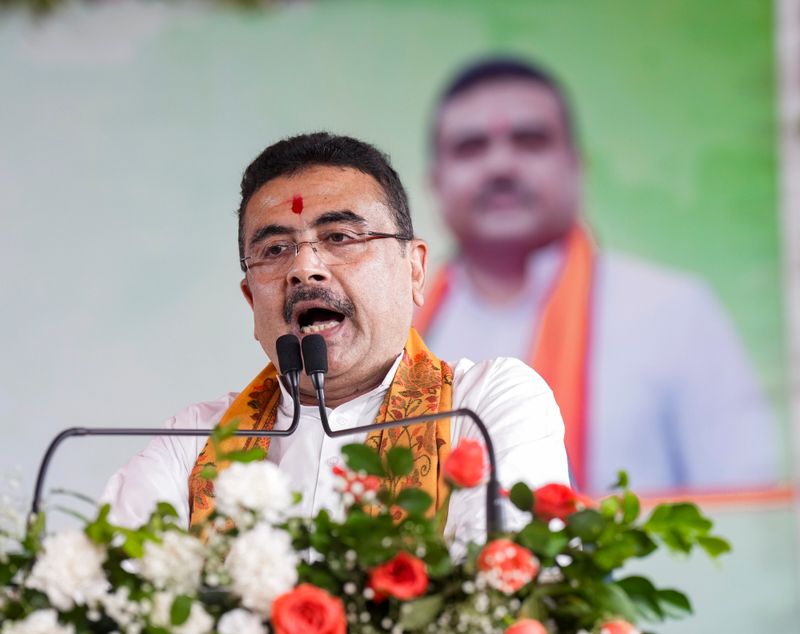

The West Bengal Cabinet on Thursday approved the constitution of a committee headed by retired Supreme Court judge Ranjana Prakash Desai to examine the draft Uniform Civil Code (UCC) Bill, setting the stage for the BJP government’s first major ideological legislation since coming to power in the state.Minister Agnimitra Paul said the committee would have four weeks to scrutinise the draft legislation and submit its recommendations.”The state Cabinet has approved the formation of a committee to examine the West Bengal Uniform Civil Code 2026 draft bill. The committee headed by retired Supreme Court judge Justice Ranjana Prakash Desai will have four weeks to examine it, after which it will be placed in the Assembly,” Paul told reporters after the cabinet meeting.The decision follows Chief Minister Suvendu Adhikari’s announcement in the Assembly on Monday that the government would move ahead with a state-specific UCC framework, fulfilling one of the BJP’s key promises in the 2026 Assembly elections that ended the Trinamool Congress’s 15-year rule.The proposed legislation seeks to create a common civil framework governing marriage, divorce, inheritance, succession and adoption irrespective of religion, replacing religion-based personal laws in these areas with a uniform legal structure while retaining constitutional safeguards available to exempted categories.If introduced and passed during the extended Budget Session in August, West Bengal would become the fourth state in the country to move towards implementing a UCC, lending fresh momentum to a debate that has occupied the political and constitutional landscape for decades.The BJP has sought to portray the initiative as a governance reform rooted in the constitutional principle of equality before law.The move also comes significantly ahead of the six-month timeline promised by the party in its election manifesto. While unveiling the BJP’s ‘Sankalp Patra’ before the Assembly polls, Union Home Minister Amit Shah had pledged that a BJP government would implement a UCC in West Bengal within six months of assuming office.Party leaders maintained that the proposal was aimed at ensuring equal civil rights across communities and should not be viewed through a religious lens.State BJP president Samik Bhattacharya recently sought to address concerns among tribal communities, asserting that Scheduled Tribes recognised under constitutional provisions would remain outside the ambit of the proposed law and that their customs, traditions and special protections would continue unchanged.He also rejected speculation linking the proposed legislation to population-control measures, saying such provisions were neither part of nor connected to the UCC framework being contemplated by the government.”For the BJP government, the legislation represents one of its first major attempts to translate a long-standing ideological commitment into policy after its emphatic electoral victory in the state. The proposal, however, has already triggered sharp political reactions, with opposition parties questioning both the timing and intent behind the exercise,” a Kolkata-based political analyst said.At a recent strategy meeting, former chief minister and Trinamool Congress chairperson Mamata Banerjee asked party leaders and legislators to mount a strong resistance to the Bill inside and outside the Assembly, arguing that any reform affecting personal laws across communities required wider consultation and social consensus.Senior TMC leaders have accused the BJP of attempting to turn a complex constitutional issue into a political instrument.”The question is whether the UCC is genuinely being brought for the welfare of citizens and constitutional values or whether it is being used as an instrument of political polarisation,” TMC MLA Kunal Ghosh said.Rebel TMC leader and Leader of Opposition Ritabrata Banerjee has also questioned the government’s haste, arguing that a proposal touching family laws and personal rights should undergo extensive public discussion before being enacted.The emerging confrontation is expected to give the Assembly’s August session a distinctly political edge, with the ruling BJP likely to frame the legislation as a step towards legal uniformity and gender justice, while the opposition seeks to cast it as an issue involving constitutional safeguards, minority rights and India’s plural social fabric.In West Bengal, where debates around identity, migration, citizenship and religion have frequently shaped electoral politics, the UCC proposal is poised to acquire significance beyond its legal provisions.For the BJP, the UCC represents the fulfilment of a core political and ideological pledge. For its opponents, the debate offers an opportunity to challenge one of the new government’s signature initiatives.As the Justice Desai committee begins examining the draft, the focus is set to shift from electoral rhetoric to legislative scrutiny, with a potentially far-reaching debate on law, faith, equality and constitutional rights awaiting the state Assembly next month.