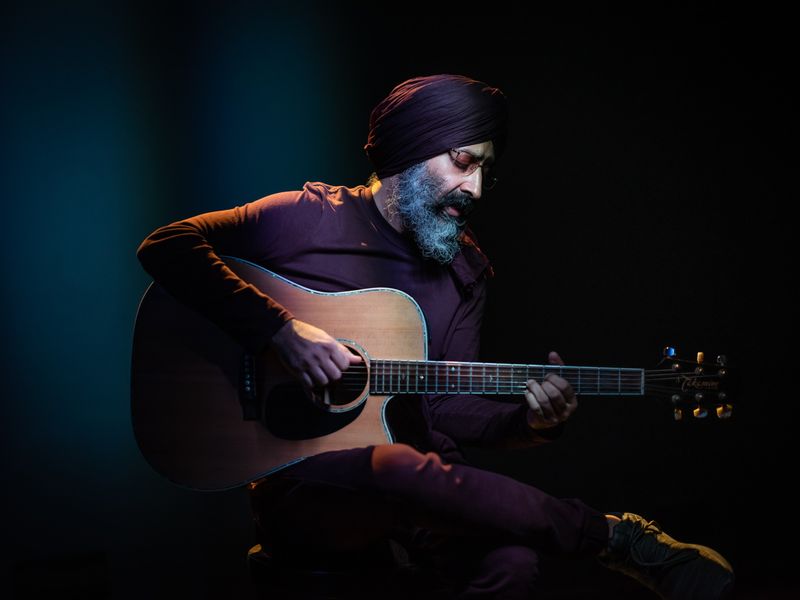

What does it take to write a song that outlives the generation it was written for?Not talent. Talent is common. Not ambition either — the music industry runs on ambition and most of it is forgotten by Friday. What it takes, if Rabbi Shergill’s life and work are any evidence, is something far simpler and far rarer. The willingness to go somewhere completely, soulfully true — and stay there long enough to write.There is a reason Tere Bin still finds you. Not merely because it is a great song, though it is. But because it does something most music only pretends to do — it meets you exactly where you are. Heartbroken at seventeen. Quietly hollow at thirty-five. Missing someone you cannot even name. It already knows. It has always known. And that is precisely why, when Rabbi performed it live at Biella Jazz Club in Italy last year, the world loved it all over again — as if hearing it for the very first time. Some songs do not age. They simply wait for the next person who needs them.Rabbi Shergill is a man who understood that human feelings are often the most universal: the fear of loss, the need for love, the ache of remembering. The emotions that remain long after the music ends. Because beyond the music, Rabbi has spent much of his life searching for the same thing his songs search for: what remains when everything else falls away.With roots in a village in Ajnala, near Amritsar, and having been raised in Delhi, he grew up among people from every corner of the country. Yet, even as the city widened his imagination, he found himself drawn back to the things that had quietly formed him: his father, Gurbani, Punjabi poetry and a language he consciously chose to hold closer.At a very young age, he realised something unsettling. “I felt my father wasn’t going to be around forever,” he says. “So, I started listening to my grandmother and my father a little more intently. I really wanted to know that language. I really wanted to call that language my own.” For Rabbi, language is not merely a means of communication. It is inheritance. Memory. Belonging.”To lose a language is to lose an entire universe,” he says. That concern with continuity runs through almost everything, he says. Ask him about Punjabi music today and the conversation quickly moves beyond charts, streams or global popularity. His question is not whether Punjabi music has travelled far. It is whether it has travelled deep enough. “It’s spread a lot,” he says thoughtfully. “But has it gone deep enough?”For Rabbi, Punjab is not merely an identity. It is the land of Baba Farid, Bulleh Shah, Shah Hussain and centuries of poetry that asked difficult questions of society and of itself. Which is perhaps why he grows uneasy when contemporary music becomes trapped in narrow ideas of status, masculinity or superiority while ignoring the deeper concerns of the land it comes from.At one point, he recalls Baba Farid:Fareeda lorai daakh bijauriyaan, kikkar beejai jatt.Handhai unn kataaida, paidha lorai patt.(Farid, one cannot plant acacias and expect sweet fruits.)The verse arrives not as criticism, but as a reminder. What we celebrate eventually shapes what we become.Yet, for all his concerns about where Punjabi music is headed, Rabbi’s faith in people remains intact. After all, he has seen what happens when something genuine finds its audience. “When something authentic becomes sensational, it really enriches the culture,” he says.The line feels almost like a summary of his own journey. He never set out to write songs that would survive decades. He simply tried to write something he felt. The fact that people continue to find themselves in those songs, years later, is proof that authenticity has a longer shelf life than any trend ever will, and that what is most honest in one’s life often becomes meaningful in countless others.For all the conversations around legacy, Rabbi himself seems remarkably uninterested in preserving one. He speaks instead about curiosity, dialogue and the importance of remaining open to conversation. Even now, with new music waiting to be released, he sounds less like someone looking back at what he has achieved and more like someone still searching.Perhaps that is why the songs endure.Not because they were written to last.But because they were written to tell the truth.-Simran Sandhu