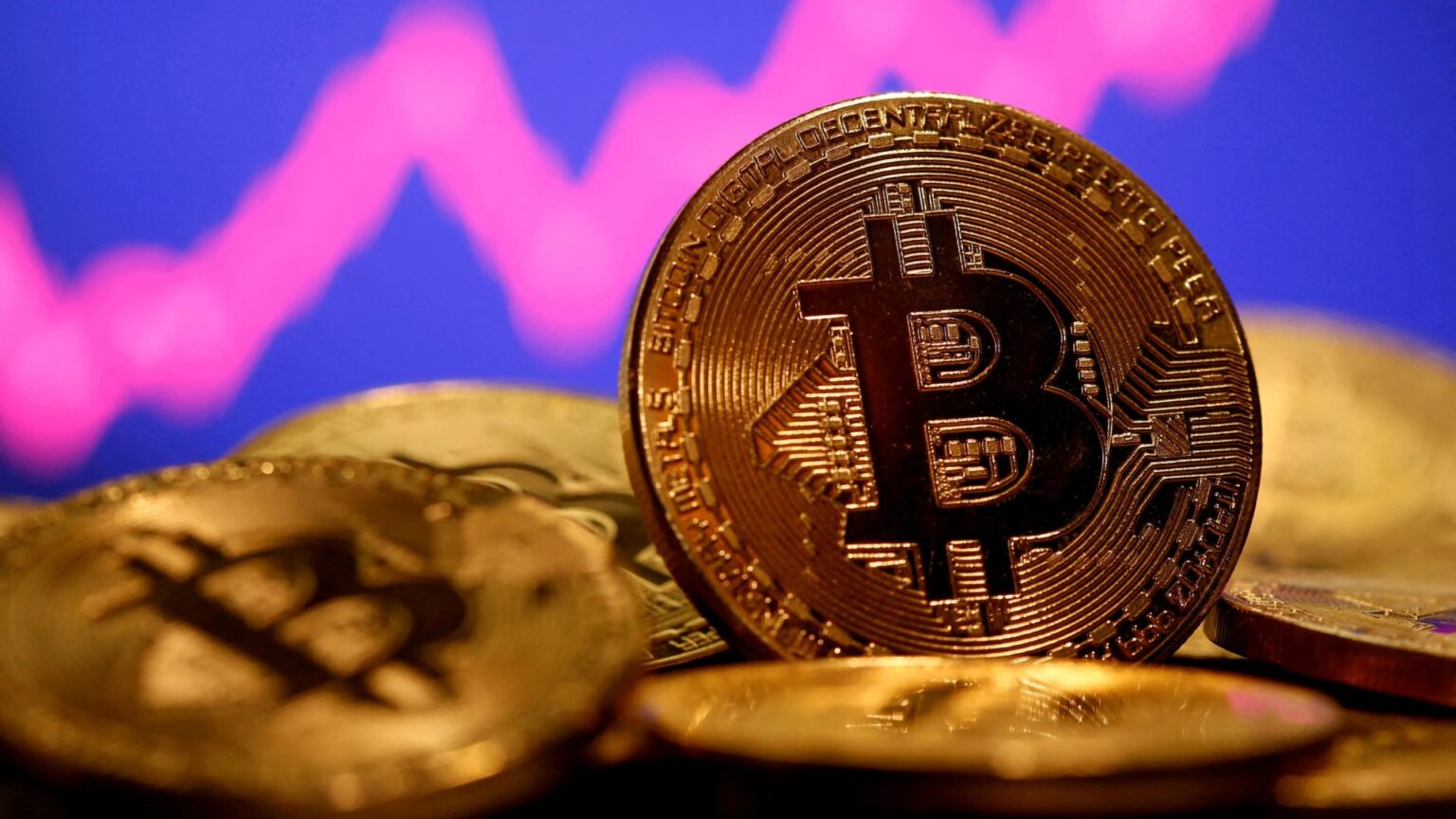


BITCOIN is on track for its worst week since the catastrophic collapse of Sam Bankman-Fried’s crypto exchange FTX.
The world’s most famous digital coin has shed 15% of its value in just seven days.
Sign up for the Money newsletter
Thank you!
The price of Bitcoin has fallen to around $62,479 (£46,370), its steepest weekly drop since November 2022 Credit: Alamy
Bitcoin is a digital currency that exists entirely online and is not controlled by any bank or government.
It can be bought, sold and traded like stocks and shares, and over the past few years millions of ordinary people have poured their savings into it hoping to make a fortune.
The price of Bitcoin has fallen to around $62,479 (£46,370), its steepest weekly drop since November 2022.
That was when the FTX scandal – one of the biggest financial frauds in history – sent shockwaves through the crypto world and ultimately landed its founder Sam Bankman-Fried behind bars.
ROOMIE RIGHTS
Millions of unmarried couples to get right to partner’s cash and house sales
BARGAIN ALERT
Exact date Aldi’s iconic £5 school uniform sale returns revealed
FTX was one of the world’s biggest cryptocurrency exchanges.
Its founder Sam Bankman-Fried had been secretly stealing billions of pounds of his customers’ money to fund risky bets and a lavish lifestyle.
When the fraud was uncovered, the whole thing collapsed overnight, wiping out the savings of millions of ordinary people.
It is a far cry from Bitcoin’s dizzying heights.
The coin smashed through the $100,000 (£74,244) barrier in late 2024 and kept climbing as President Donald Trump rolled out the red carpet for the industry.
Trump had long been a cheerleader for crypto, and his election victory sparked a wave of excitement that sent prices sky high.
But the so-called “Trump Bump” has well and truly turned into a “Crypto Slump,” with shares in companies that bet big on Bitcoin tanking hard.
Earlier in 2026, Bitcoin had already been sent into a tailspin, losing almost half its value in just three months as a brutal crypto winter froze the market.
A “crypto winter” is the term used when digital currency prices fall sharply and stay low for a prolonged period, much like a stock market crash but in the world of digital assets.
The coin had plummeted to $63,000 (£46,768) in February – a long way from its record peak of $126,000 (£89,094) reached back in October 2025.
What is crypto?
THINK of Bitcoin and other cryptocurrencies as digital cash.
Unlike the pounds in your pocket, it doesn’t exist as physical coins or notes.
There is no “Bank of Bitcoin” – it lives entirely on the internet and isn’t controlled by any government or high-street bank.
How does it work?
Normally, when you send money, a bank checks your account and “approves” the move.
With crypto, a massive global network of thousands of computers does this job instead.
They use a shared digital record book called the Blockchain.
Every time someone spends a Bitcoin, the whole network updates its copy of the book to make sure the same “digital coin” hasn’t been spent twice.
What is ‘Mining’?
This is how new Bitcoins are born. People called “miners” use incredibly powerful computers to solve complex math puzzles.
When they solve one, they get to add a new page to the digital record book (the blockchain) and are rewarded with brand-new Bitcoins.
How do I keep it?
You store your crypto in a Digital Wallet.
This isn’t a physical pouch but a piece of software.
It gives you a “Public Key” (like an email address so people can send you money) and a “Private Key” (like a super-secret PIN).
If you lose that private key, your money is gone forever – there is no “forgotten password” link in the world of crypto!
What has gone wrong?
First, there is the shock move by Strategy – formerly known as MicroStrategy – a publicly listed American company that has staked its entire business model on buying and holding Bitcoin.
Run by Bitcoin superfan Michael Saylor, it became one of the biggest corporate holders of the coin in the world.
So when the company disclosed on Monday that it had sold Bitcoin for the first time in years, it rattled confidence among loyal holders.
“Obviously people are getting spooked recently with Saylor’s selling,” said Benjamin Cowen, founder and chief of crypto analytics firm Into the Cryptoverse.
The sale may have been small in the grand scheme of things, but the symbolism has hit sentiment hard.
Then there are growing fears that a key piece of crypto legislation may not pass through Congress this year.
Many in the industry had been hoping for new laws that would give Bitcoin and other digital currencies a clearer legal status in the United States, which would make it easier and safer for big financial institutions to invest.
Without that, a major boost to the market looks unlikely any time soon.
On top of that, the upcoming SpaceX mega-IPO is pulling money away from digital assets.
An IPO – or Initial Public Offering – is when a private company sells shares to the public for the first time on the stock market.
Elon Musk‘s SpaceX is expected to be one of the biggest and most valuable floats in years, and investors are selling up crypto to free up cash so they can get a slice of it.
Christopher Beauchamp, from investing fintech IG, agrees.
“Bitcoin seems to have lost much of its charm as a driver of the future — that belongs to AI now,” he said.
“Data centres and new AIs are the big news, with cryptos struggling for attention when Alphabet, Amazon and others are throwing hundreds of billions at the AI story.
“At the same time there is a far larger pool of investors willing to consider gold in their portfolios at the moment.”
However, not everyone thinks this is the end of the road. Crypto expert Clem Chambers, boss of aNewFN, argues that Bitcoin’s drop is not a random wobble but part of a predictable four-year cycle.
He believes it has played out in broadly the same way since Bitcoin first emerged.
In this cycle, a surge in prices is eventually followed by a long and often painful slump – sometimes called a bust or crypto winter.
Chambers believes that is precisely where we are now, and that, as history has shown before, what goes down may yet come back up again.
Should you invest in crypto?
Crypto can be very risky, even if it seems cheap to buy.
Experts have warned that a lower price does not make crypto a safer investment – and recent price swings show why.
Clem Chambers said that ordinary investors should understand that trading crypto is “playing with fire” and should only do it if they can afford to lose the money.
Christopher Beauchamp at IG has previously said: “Bitcoin and other cryptocurrencies are very volatile, so it makes sense not to risk too much of your overall portfolio.”
He also suggests that existing holders “stay diversified” by spreading focus into other assets such as gold or steady stocks to balance out exposure.
If you want to invest in Bitcoin but do not want to buy the coin yourself, there are other options.
Some Exchange Traded Products, or ETPs, are listed on the London Stock Exchange, including the iShares Bitcoin ETP and the Invesco Physical Bitcoin ETP.
These products track the price of Bitcoin, so you can gain exposure through a normal investment account, a SIPP or a Stocks and Shares ISA, without having to store Bitcoin yourself.
But they are still risky. If the price of Bitcoin falls, the value of the ETP can fall too.
In the UK, crypto firms must be registered with the Financial Conduct Authority.
You can check whether a firm is registered on the FCA’s Financial Services Register.
As a general rule, experts say you should have three to six months’ worth of income in easy-access savings before investing in anything, including crypto.
The dangers of investing in crypto
HERE are five key risks to keep in mind when investing in cryptocurrencies:
Consumer protection: Many cryptocurrency investments promising high returns are not fully regulated, apart from anti-money laundering rules. This means you may have limited protection if things go wrong.
Price volatility: Cryptocurrency prices can rise and fall dramatically, making it easy to lose money. It’s also difficult to reliably determine their value.
Product complexity: Crypto products and services can be complicated, which makes it hard to understand the risks. Plus, there’s no guarantee you can convert your cryptocurrency back to cash—it depends on market demand and supply.
Charges and fees: Crypto investments often come with high fees, which can eat into your returns. These fees are often higher than those for regulated investments.
Marketing hype: Some firms exaggerate potential returns or downplay the risks involved. Be cautious of flashy promotions.
It’s essential to only invest in cryptocurrency if you fully understand how it works and the risks involved.
Remember, there’s no guarantee you can exchange it for real cash, and its value can change drastically in a short time.
If something sounds too good to be true, it probably is.
Always double-check with a trusted friend or advisor if you’re unsure.
Be wary of glowing websites or perfect reviews – fraudsters often create convincing scams.
For tips on avoiding scams, check out our guide.