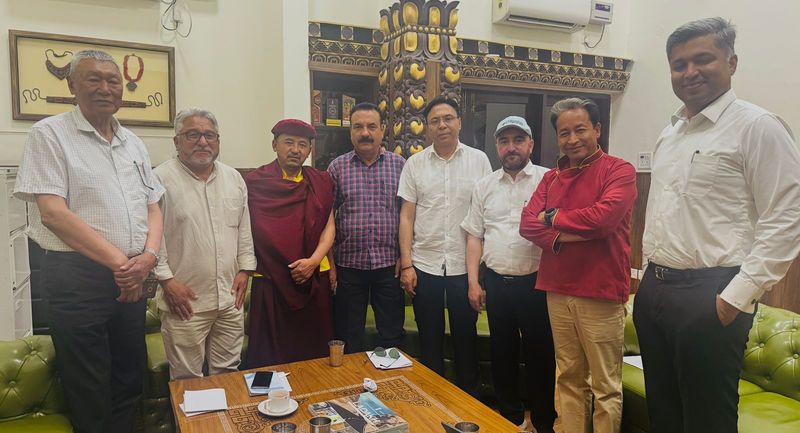

In a major breakthrough, the Leh Apex Body (LAB) and Kargil Democratic Alliance (KDA) on Friday said the bodies had reached an “in-principle” understanding with the Union Government on “restoring democracy” in Ladakh and providing “constitutional safeguards on the lines of Articles 371A, 371F and 371G,” as applicable to Nagaland, Sikkim and Mizoram.The subcommittee-level talks between the Union Ministry of Home Affairs (MHA) and Ladakh leaders were held in New Delhi on Friday.The Leh Apex Body and the Kargil Democratic Alliance have been engaged in talks with the Centre since 2021 over their four-point agenda, which includes statehood for Ladakh and constitutional safeguards under the Sixth Schedule. According to the LAB and KDA, during Friday’s meeting they reiterated the long-standing aspirations of the people of Ladakh regarding restoration of democracy, constitutional safeguards and the demand for statehood and Sixth Schedule protections.The two bodies said the understanding was reached to provide constitutional safeguards on the lines of Articles 371A, 371F and 371G, which are currently applicable in Nagaland, Sikkim and Mizoram. These constitutional provisions provide special protections and safeguards to the northeastern states.Following “detailed and constructive deliberations”, both sides arrived at an in-principle understanding on several critical points, the two bodies said in a statement. They said under the proposed model, legislative, executive and financial powers would rest with elected representatives through a Union Territory-level legislative body.“All bureaucrats of the UT, including the Chief Secretary, will come under the executive head of the UT-level elected body (proposed to be Chief Minister),” the statement said. During the meeting, MHA officials explained that the only reason why Ladakh could not be granted full statehood at present was that it “currently lacks adequate revenue generation to meet expenditure such as salaries of employees”. “However, this setup will lead Ladakh towards full statehood once it meets the revenue criteria,” the two bodies said.LAB co-chairman Chering Dorjay Lakruk told The Tribune that further meetings would be held to discuss the proposal in greater detail. “There is no date yet for the next meeting, but yes, further talks will take place,” he said.The KDA and LAB stated that they looked forward to closely working out the finer operational details with the MHA in consultation with legal and constitutional experts.Ladakh Chief Secretary Ashish Kundra told The Tribune that the talks were “constructive, positive, optimistic and free-flowing”. “The discussions were held in a democratic spirit, with the goal of deepening democracy in Ladakh,” he said.Ladakh BJP leader and former chairman of the Leh Autonomous Hill Development Council (LAHDC) Tashi Gyalson, who attended the meeting on Friday, said after a long time, a “viable solution has been proposed which is pragmatic and sustainable for Ladakh”.Veteran Ladakhi leader and former chairman of the Leh Apex Body, Thupstan Chhewang, said the agreement to secure Ladakh’s status under Article 371 of the Constitution, along with “meaningful financial and administrative empowerment of local institutions and an elected UT-level legislature with a leader having status equivalent to a CM”, represented a “historic step forward” for the people of this region. “Today has kindled genuine hope,” he said in a statement.Ladakh Lieutenant Governor Vinai Kumar Saxena had earlier announced the date of the meeting ahead of Union Home Minister Amit Shah’s visit to Ladakh on April 30. The subcommittee is chaired by senior officials from the MHA and the Ladakh administration. This was the first subcommittee-level meeting since Saxena took over as the Lieutenant Governor of Ladakh in March.The Centre had constituted a High-Powered Committee (HPC) on Ladakh under the chairmanship of Minister of State for Home Affairs Nityanand Rai to deliberate on issues concerning the UT. The last meeting of the HPC was held in New Delhi on February 4, after which no immediate follow-up meeting was convened.