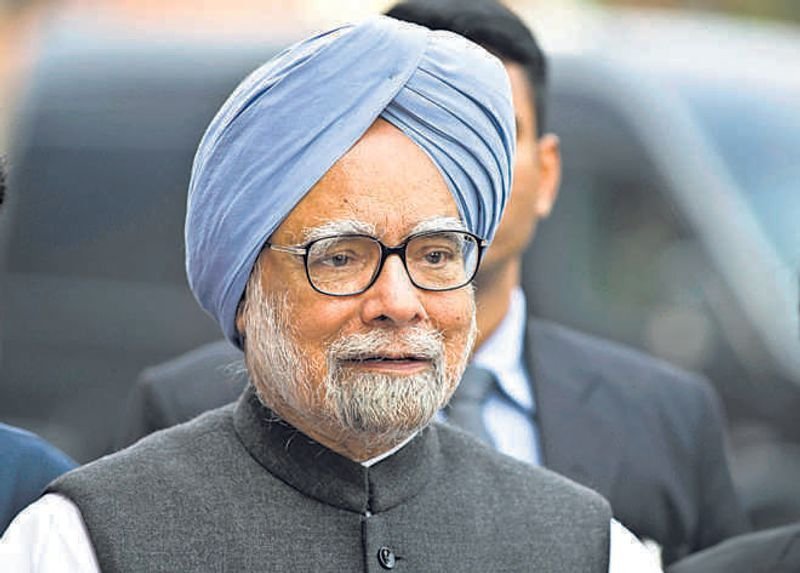

The 94th birth anniversary of Manmohan Singh on Saturday saw calls grow to confer the Bharat Ratna on the late Prime Minister. Leading the demand was Anumala Revanth Reddy, the Chief Minister of Congress ruled Telangana. Reddy said Singh was a great statesman whom the country will always remember. “I don’t understand why this government has an objection to conferring the Bharat Ratna on such a great man,” he said, after unveiling a statue of Singh in Hyderabad, a city that realised its potential, thanks to the 1991 economic reforms late PM unleashed.Though Reddy sought to politicise the issue, people close to Manmohan Singh said the late prime minister would have never wanted India’s highest civilian honour to become an object of contestation. Reason being, Singh was above entitlements.He always commanded a place in the sun on the power of merit.That said, Singh’s admirers backed the demand for Bharat Ratna to the prime minister who attained great heights despite very humble beginnings of which he never spoke.So much so, even Montek Singh Ahluwalia, his closest associate, confides that he had to refer to Daman Singh’s memoirs of her father to learn more about India’s 14th prime minister’s early life.“Manmohan Singh was brought up by his maternal grandmother in Gah village, in what is now Pakistan. His father Gurmukh Singh worked in a firm in Peshawar importing dry fruits from Afghanistan for distribution to various parts of India…They lived in a kutcha house with just two rooms, one for sleeping and another for keeping all their possessions. There was no electricity or running water…Since the school in Gah catered only for kids up to the age of eleven, Manmohan had to move to his uncle’s house in Chakwal, to continue his studies,” Ahluwalia said at a recent Prime Minister Memorial lecture on the life and legacy of Manmohan Singh.Former Union Law Minister Ashwani Kumar, also known for his proximity to Singh in the Congress-led UPA cabinet, said the late prime minister was the most deserving of the high honour.“Dr Manmohan Singh is singularly entitled to the nation’s highest civilian honour on account of his unparalleled record of public service, moral leadership and intellectual attainments of the highest order. His humility and quiet dignity make Dr Singh the most deserving of the highest award,” Kumar said, reflecting on Singh’s academic, administrative and political leadership.Another of Singh’s associates who did not want to be named said there was no match to his CV and the closest anyone came to him in terms of academic excellence was Amartya Sen.“There is hardly any individual in the country who can boast of doctorates from Oxford, Cambridge and Panjab University, Chandigarh. Dr Singh’s personal integrity remains unquestioned. He staked prime minister-ship for the Indo-US nuclear deal placing nation above self and public duty above his role. What else qualifies anyone for the Bharat Ratna?” a former cabinet colleague of Singh asked.A fascinating account of Singh’s intellectual achievements features in David Engerman’s book “The Apostles of Development”, which Ahluwalia quotes.The book outlines parallel lives of six South Asian students of economics who were at Cambridge at the same time: Amartya Sen, Jagdish Bhagwati, and Manmohan Singh from India, Mahbub ul Haq from Pakistan, Lal Jayawardene from Sri Lanka and Rehman Sobhan from what was then East Pakistan and is now Bangladesh.“It was a remarkable group by any standard. Five of the six won a first division, with Rehman Sobhan missing it narrowly. All the three Indians won the prestigious Adam Smith Prize. All of them contributed significantly to public life in their countries. Of the six, Manmohan Singh had the humblest origins. The others came from privileged backgrounds, belonging to the landed aristocracy or the professional classes,” says the book by Engerman, a scholar of twentieth-century international history.Later accounts which Singh’s associates recall reveal his leadership in the civil services.After landing the first government role as Economic Adviser in 1971, Singh had contemplated resigning because then commerce minister LN Mishra wanted him to do something that did not sit well with his ideals. That was when PN Haksar, the Principal Secretary to Prime Minister Indira Gandhi, learnt of Singh’s move and shifted him in 1972 as Chief Economic Adviser in the Finance Ministry.In fact little is known that Manmohan Singh had advocated a shift towards trade liberalisation and freedom from controls for the private sector way back in 1971.Ahluwalia throws light on this episode.“After the Bangladesh war was over, PN Haksar asked Manmohan Singh to send him a note on “What to do with the Victory.” The note itself has not been traced, but Daman Singh recalls her father telling her that he had argued strongly for a shift towards trade liberalisation and greater freedom from controls for the private sector. Haksar Saheb was a left leaning intellectual and I am not surprised that he did not follow up on this advice! But it was bold of Manmohan Singh to float the idea so soon after joining the government,” narrates Ahluwalia, the former deputy chairman of Planning Commission, whom Singh called back in 1979 from abroad to work in IndiaHad Singh’s suggestion been taken in 1971, India’s economic reforms would have started in 1971 instead of 1991. Reforms were unfortunately delayed but the Bharat Ratna to Manmohan Singh need not be.