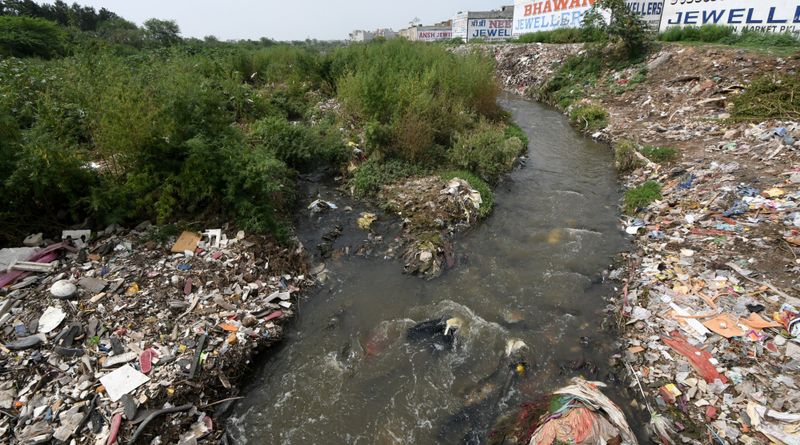

When Swiss-French architect Le Corbusier conceived Chandigarh in the early 1950s, the city’s three seasonal streams were not incidental to its design — they were structural to it. Sukhna Choe on the eastern flank, the Northern Choe cutting through the city’s centre, and Patiala Ki Rao on the western edge were integrated into the urban plan as natural stormwater channels, green belt connectors and ecological arteries that would breathe life into the planned city.Seven decades later, all three are in serious distress. What were once seasonal watercourses carrying monsoon runoff across the Tricity region have, according to Chandigarh MP Manish Tewari’s own characterisation before the Lok Sabha, degenerated to the point where “it has become difficult to even breathe around them.”This is not a local or cosmetic problem. The three choes collectively pass through — or border — multiple sectors of Chandigarh, the urban sprawl of Mohali, industrial and residential pockets of Panchkula, and eventually drain into larger regional basins, including the Ghaggar river. Their pollution has cascading consequences for groundwater quality, public health, biodiversity and the city’s identity as India’s first planned urban settlement.Who raised it — and how?The issue was formally escalated to Parliament by Chandigarh MP Manish Tewari during Zero Hour in the Lok Sabha on December 5, 2025, during the Winter Session. Tewari did not merely raise a concern — he cited the government’s own admissions against it.Drawing from a starred question he had filed earlier that week, Tewari pointed out that the Centre itself had confirmed wastewater continued to flow into the N-Choe, that monitoring was patchy, that no rejuvenation plan existed for any of the three streams, and that several sewage treatment plants had failed to transmit real-time effluent data to regulators — amounting, in his words, to “systemic environmental misgovernance.”He simultaneously flagged the Dadumajra garbage dumpsite crisis, noting the administration had committed — before the National Green Tribunal, the Punjab and Haryana High Court, and a Parliamentary Committee — to clear the site by November 2024. That deadline slipped to March 2025, then July 2025, then November 30, 2025. The mountains of waste, he told the House, “only keep growing.”Tewari urged the Parliamentary Affairs Minister, present in the House, to apprise both the Home Minister and the Environment Minister of the situation, arguing that as a Union Territory, Chandigarh’s ecological future was ultimately a Central responsibility.What is actually polluting the streams?The pollution has three primary sources, each compounding the others.Sewage discharge is the most acute. The Chandigarh Pollution Control Committee (CPCC) identified 13 direct wastewater discharge points into Sukhna Choe, 15 into the Northern Choe and 5 into Patiala Ki Rao — a combined 33 illegal or unmanaged sewage outlets draining directly into natural watercourses running through a Union Territory. The Chandigarh Municipal Corporation (MCC) has since claimed to have tapped and closed all identified outlets across all three streams.Cross-boundary contamination adds a layer that Chandigarh alone cannot resolve. Patiala Ki Rao originates in the Shivalik Hills of Punjab, enters the Union Territory of Chandigarh, passes through Mohali and re-enters Punjab — carrying untreated water from the Punjab region into Chandigarh’s jurisdiction. The CPCC has repeatedly raised this with the Punjab Government, but the problem persists.Structural drainage failure is the third dimension. Chandigarh’s drainage network was established in the 1950s and, as officially acknowledged, is particularly vulnerable to damage during heavy rainfall. Rainwater drainage outlets across the city discharge into these choes — and when the ageing infrastructure cracks or overflows during monsoon, sewage mixes with stormwater and flows directly into the streams. Periodic maintenance — cleaning of roadside drains, choes and manholes — is carried out annually by MCC and the Chandigarh Administration, but has clearly proven insufficient.What did the centre say in response?Union Minister for Environment, Forest and Climate Change Bhupender Yadav responded formally in a letter dated May 5, 2026 — five months after Tewari’s parliamentary intervention. The letter stated that the matter had been examined in consultation with the Ministry of Housing and Urban Affairs, the Ministry of Jal Shakti, CPCB and CPCC, and offered the following position:All 33 identified discharge points across the three streams have been closed. Regular monitoring is now being conducted by the NGT through the Engineering Wing of the Chandigarh Administration, MCC, CPCC and CPCB. The ministry did not, however, announce any new rejuvenation plan for any of the three streams, nor did it address the absence of real-time STP data transmission — both of which Tewari had specifically flagged.On Dadumajra, the minister’s response was partly reassuring and partly revealing. Of the legacy waste at the dumpsite, 5.10 lakh metric tonnes has been fully remediated and approximately 28 acres of land reclaimed. Of this reclaimed land, 10 acres has been earmarked for an Integrated Waste Processing Plant by IOCL for wet waste processing and 8 acres for a sanitary landfill. No new waste is being dumped at the legacy waste site.However, the annexure to the minister’s letter acknowledged that approximately 12,500 metric tonnes of legacy waste remains unprocessed. The reason cited: constraints in capping the site and the suspension, since January 2026, of bio-soil disposal in neighbouring states. No fresh deadline was given for full clearance.Who bears the burden — and how many?The populations most directly affected are the residents of Chandigarh’s eastern and western sectors abutting the choes, the resettlement colonies near Dadumajra, the villages of Raipur Khurd and Kajheri through which Sukhna Choe and N-Choe respectively exit the Union Territory, and the Mohali urban cluster through which both N-Choe and Patiala Ki Rao pass before draining further south.The Tricity region — Chandigarh, Mohali and Panchkula combined — has a resident population exceeding 25 lakh. Given that the choes run through or alongside densely inhabited and commercially active zones, and that the Dadumajra dumpsite sits in close proximity to a large resettlement colony, the public health exposure is not marginal. Groundwater contamination from untreated sewage discharge affects not just immediate residents but the broader aquifer that the region depends on.Chandigarh itself generates an average of 500 tonnes of municipal solid waste per day — a figure that underlines the scale of the ongoing waste management challenge even after legacy waste remediation is complete.What next — and what remains unresolved?The minister’s response, while acknowledging action taken, leaves several critical questions open.The closure of 33 discharge points is a remedial step, not a structural fix. Chandigarh’s drainage network remains ageing and monsoon-vulnerable. Without a formal rejuvenation plan — with timelines, funding and accountability — for each of the three streams, the risk of re-contamination after every heavy rainfall season remains real.The cross-boundary pollution from Punjab into Patiala Ki Rao is an inter-governmental problem that neither the CPCC nor the MCC can resolve unilaterally. It requires a formal intervention at the level of the Centre — the very authority that administers the Union Territory.On Dadumajra, 12,500 metric tonnes of unprocessed legacy waste, with no deadline for clearance and no alternative disposal site yet identified, means the dumpsite issue is not closed. The broader question of what happens to the 28 acres of reclaimed land — and whether the proposed IOCL plant and sanitary landfill will materialise on schedule — remains to be seen.Most significantly, neither the minister’s letter nor its annexure addresses the two systemic failures. Tewari specifically raised in Parliament: the absence of a comprehensive rejuvenation plan for any of the three choes, and the failure of several STPs to transmit real-time effluent data. Until both are addressed, monitoring will remain reactive rather than preventive.For a city that Prime Minister Jawaharlal Nehru envisioned as a symbol of independent India’s modernity — and that the world still associates with planned, green urbanism — the ecological condition of its three seasonal streams is not merely an environmental issue. It is a question of whether the city can be what it was designed to be.