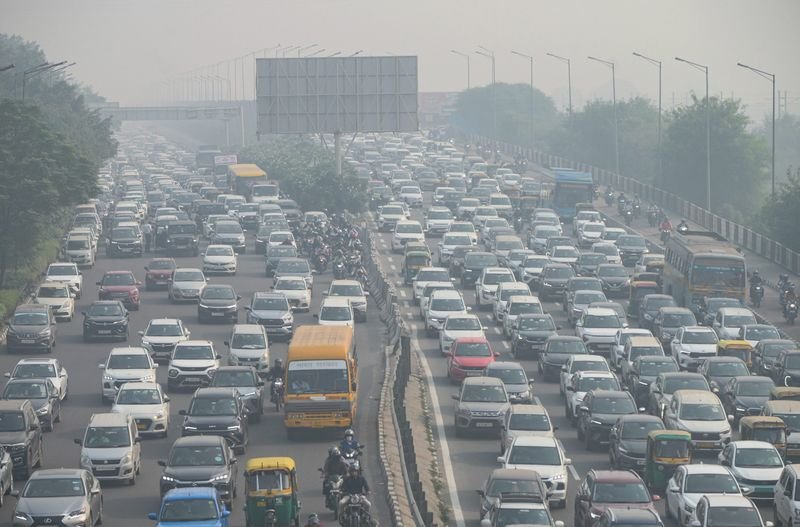

Bikers rode onto footpaths to escape long queues, motorists leaned on their horns, while commuters pleaded with traffic police to let them pass as Delhi’s enforcement of BS-VI entry restrictions turned the Ghazipur border into a bottleneck, with vehicles crawling through checks spread across a 500-metre stretch.The congestion stretched across both the flyover and the road beneath it, where vehicles crawled in fits and starts as traffic police, the Municipal Corporation of Delhi (MCD) and transport department officials stopped them for verification.A spot check by PTI showed long queues of vehicles building up at multiple checking points, with little room to manoeuvre.For those travelling from Ghaziabad and other parts of Uttar Pradesh to Delhi for work, the checks meant longer journeys, missed appointments, and uncertainty over entry into the national capital.“I left home at 10 am because I had to reach office by 11 am. It is already 11.30 am, and I am still stuck here. First, the vehicles were stopped, then their registration numbers were checked, and many people were asked to turn back. I cannot keep calling my office and explaining that I am late because of a vehicle check,” Ashok, a private-sector employee travelling from Vaishali to Preet Vihar, said.The checking exercise extended from the Uttar Pradesh side to the Ghaziabad underpass connecting Vaishali to Delhi, with three separate points manned by the three agencies.Queues at individual check points stretched between 100 and 150 metres, with the congestion worsening during peak office hours, even as the checks continued through the day.Traffic personnel said they initially rely on registration number series and stickers on vehicles to identify those that could violate the entry restrictions.“We have been conducting these checks for years and are familiar with the registration series and the corresponding years of registration. For instance, a ‘DL14’ series can help us identify vehicles registered in a particular period.“We also look at stickers displayed on vehicles, including those indicating CNG compliance and the registration year. These are initial indicators. The vehicle details are checked by the registration certificate before a final decision is taken,” a traffic officer said.At one of the checkpoints, traffic personnel said around 100 vehicles were being asked to take a U-turn daily, while approximately 80 challans were being issued for no-entry violations.For delivery agents, the congestion has brought an additional set of problems, with delays eating into working hours and affecting orders.Ankit, a delivery agent travelling from Ghaziabad to Delhi, said his motorcycle broke down amid the congestion, leaving him struggling to move it out of the crowded stretch.“I was carrying goods for delivery when my bike suddenly stopped in the middle of the traffic. I tried starting it several times, but it would not move. Now I have to push it towards the roadside and find a mechanic. There are vehicles behind me, and people are honking, with barely any space to move the bike,” he said.The disruption has also affected families dependent on a single vehicle for their daily commute.Rajesh, a Ghaziabad resident whose wife also works in Delhi, said the restrictions have made their everyday travel uncertain.“We have one car at home, and both my wife and I use it to travel to Delhi for work. We bought the car, paid the road tax and got it registered with the understanding that it could be used for its prescribed registration period.“Now we are told that it cannot enter Delhi because it does not meet the required emission standard. We are not saying pollution should not be controlled, but what are families like ours expected to do?” he said.MCD officials use mobile phones linked with the corporation’s toll application to enter vehicle registration numbers, while commercial vehicles are checked for environmental compensation charge (ECC) and radio frequency identification (RFID) tag compliance.They said vehicles that escape an initial inspection but are found to be non-compliant further ahead are also being turned back.The multiple verification and payment procedures have added to the time vehicles spend at the checkpoints, further slowing traffic movement along the stretch.Challans are also being issued to motorists who refuse to follow the directions, argue with the traffic personnel, or attempt to proceed despite being stopped, a traffic officer said.The restrictions have also disrupted commercial activity between Ghaziabad and Delhi, with traders reporting delays in deliveries and additional costs.Sanjay, a trader, said vehicles carrying orders are getting held up at the border, leaving shopkeepers waiting for their consignments.“Goods are loaded in the morning according to the day’s orders, and customers expect their deliveries within a particular time. If a vehicle is stopped at the border or asked to turn back, the goods do not reach the shops on time,” he said.The restrictions are part of Delhi’s winter pollution-control measures, under which non-BS-VI petrol and diesel vehicles registered outside Delhi are barred from entering the national capital, subject to specified exemptions.The enforcement is aimed at curbing vehicular emissions as air pollution levels rise during the winter months, from November 1 to January 31.