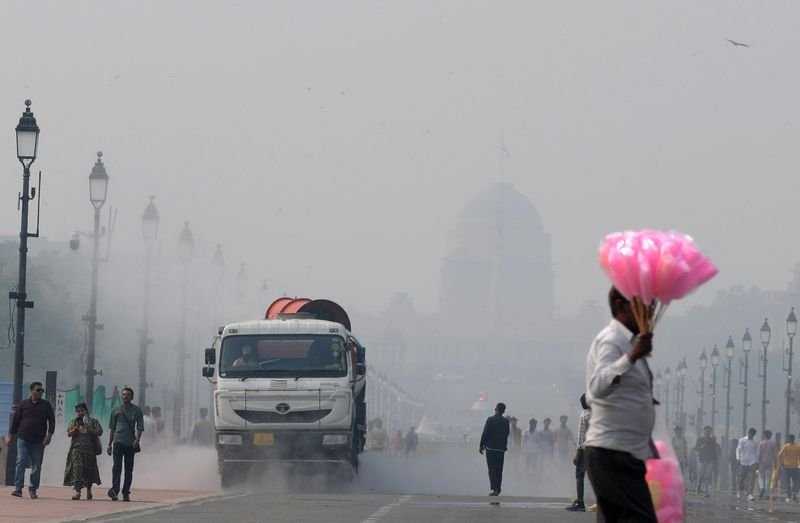

Delhi became the epicentre of North India’s air emergency as a poisonous cocktail of emissions from vehicles, farm fires and firecrackers contributed to its worst Diwali air quality in the past five years.While the Central Pollution Control Board (CPCB) data placed Delhi’s average air quality index (AQI) in the “very poor” range at 376, real-time readings on AQI.in put it in the “hazardous” category at nearly 1,500.Air quality remained poor to very poor across Punjab and Haryana. Jalandhar and Mandi Gobindgarh topped Punjab’s pollution chart with an AQI of 336 each, while Ludhiana (292), Amritsar (257) and Patiala (221) remained in the “poor” category. In Haryana, Bahadurgarh recorded the highest AQI at 400, followed by Charkhi Dadri (389) and Rohtak (378), CPCB data released on Monday showed.Stubble burning in Punjab and Haryana has contributed to the seasonal deterioration in air quality, with environmental experts cautioning against viewing farm fires as the sole driver of the winter pollution crisis. They point to a combination of vehicular emissions, industrial pollution and dust that continues to burden the atmosphere throughout the year across the Indo-Gangetic plain.A CPCB scientist said during summer, the influence of dust increases to almost 31-34 per cent, while its share during winter reduces to 6-15 per cent. “The contribution of combustion sources (vehicles, industry, biomass burning among others) increases during the winter to 85-94 per cent,” he said.Dr Gufran Beig, founder of the System of Air Quality and Weather Forecasting and Research (SAFAR) and Chair Professor at the National Institute of Advanced Studies, said changing weather patterns were increasingly determining the severity and spread of pollution. He said the response needed to move beyond episodic restrictions imposed under the Graded Response Action Plan towards a comprehensive airshed management strategy.Beig said the prevailing northwesterly winds were facilitating the movement of smoke from the major stubble-burning belts of Punjab and Haryana towards Delhi, aggravating the city’s pollution levels.“The general picture is like this, that due to the impact of El Nino, the wind speed in North India is much slower and this leads to accumulation of pollutants. In October, the climate in Indo-Gangetic plain was warm and wind speed was high so we had cleaner AQI compared to what we are witnessing now,” he said.He also attributed the delayed paddy harvest in Punjab and Haryana to uncertainty arising from rainfall deficits, which had affected the timing of agricultural operations and stubble burning.The sharp escalation in Delhi’s PM2.5 concentration on November 1 was largely attributable to stubble burning, Beig said. However, he warned that falling temperatures and sluggish wind speeds would further aggravate pollution.“Now the temperature will be low and wind speed will be slow which will accumulate the pollutants. Moreover, western disturbances will hit Delhi on November 10 and hence the winds will turn easterly, which will counter the impact of stubble burning in Delhi,” he said.Meanwhile, the latest data, covering the period till November 8, recorded 4,657 stubble-burning incidents in Punjab. Physical inspections were carried out at 2,998 locations, with evidence of burning confirmed at over 1,300 sites.Manoj Kumar, an analyst at the Centre for Research on Energy and Clean Air, said the recurring tendency to attribute Delhi’s winter pollution primarily to crop residue burning overlooked the contributions from several other emission sources. Though farm fires intensified the pollution burden in November, the NCR remained severely polluted even in late December and January, when stubble burning was no longer a significant factor, he pointed out.He said attributing the January pollution spike to farm fires was not scientifically justified, given the continued contribution of industrial emissions, biomass burning and dust.“The spike in pollution in November is recurring. The first two weeks remain choked owing to stubble burning. Industry, biomass use and dust contribute throughout the year,” he said.Kumar said Diwali was the fourth most polluted day of the year, with the daily average PM2.5 concentration reaching 257 micrograms per cubic metre. The preceding days — November 5, 6 and 7 — ranked sixth, seventh and eighth, respectively, among the year’s most polluted days.The wide gap between CPCB and AQI.in readings stems from differences in methodology. While CPCB’s AQI scale is capped at 500, some international systems allow readings to exceed that threshold when pollutant concentrations continue to rise.“It doesn’t mean that pollution has stopped increasing. The actual concentration of harmful pollutants continues to rise without a corresponding increase in the reported index. This is unfortunate that we have locked the AQI at 500,” Beig said