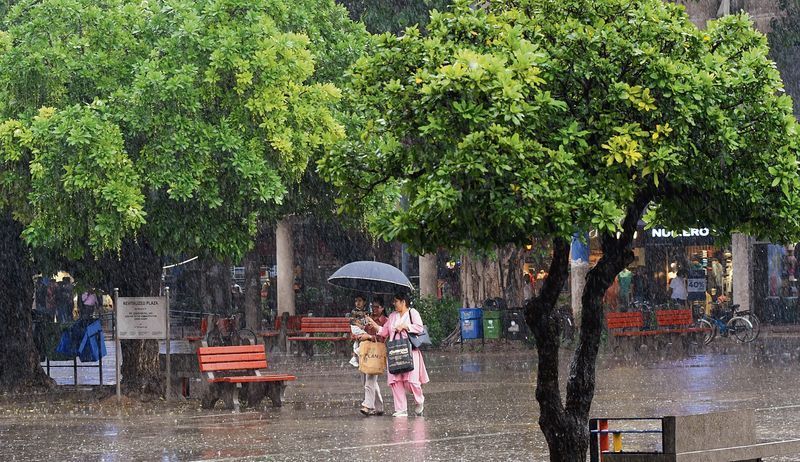

May 2026 gave Chandigarh a wild, whiplash-inducing ride. Temperatures touched 44.4°C on May 21, marking one of the hottest May days in the city’s recorded history. Nine days later, Saturday’s violent pre-monsoon storm brought the mercury crashing to 25.3°C — the coldest May day in recent memory — as heavy rain, thunderstorm, squall and hailstorm swept through the tricity. Through the month, the city received 50.1mm of rainfall against a normal of 22.8mm — a 120 per cent surplus categorised by the India Meteorological Department (IMD) as “large excess”.For residents still savouring the cool, overcast skies of a transformed weekend, the temptation to believe the worst weather news is behind them is entirely understandable. It is not. The IMD’s updated long-range forecast for the 2026 southwest monsoon season — June through September — carries a sobering message that directly touches every one of Chandigarh’s 12-plus lakh residents: the monsoon that fills the city’s taps, replenishes Sukhna Lake, irrigates Punjab’s fields, and powers Bhakra’s turbines is forecast to be below normal this year.WHAT IS IMD SAYINGIMD has forecast southwest monsoon seasonal rainfall for June-September 2026 at 90 per cent of the Long Period Average (LPA) for the country as a whole, with a model error of ±4 per cent. In plain language, India can expect somewhere between 86 and 94 per cent of the rainfall it normally receives in these four months. The most likely outcome is below normal.For Northwest India — the broad region that includes Chandigarh, Punjab and Haryana — the outlook is more specific and more concerning: seasonal rainfall is most likely to be below normal, falling below 92 per cent of LPA. For Chandigarh, Punjab and Haryana taken together, the probabilistic forecast specifically indicates normal to below normal rainfall for the full June-September season.June — the gateway month that bridges the pre-monsoon heat and the monsoon’s arrival — looks particularly challenging nationally. Below normal monthly rainfall is very likely over most of the country in June 2026, the bulletin says. Temperatures in June will compound the difficulty: above normal maximum temperatures are forecast for most of the country. Northwest India — which includes Chandigarh — falls in the category where normal to below normal maximum temperatures are very likely, offering a partial exception to the national heat trend, but above normal minimum temperatures are still very likely across most of the region, meaning the nights will remain warm even if afternoons are somewhat moderated by cloud cover.WHY SHOULD CHANDIGARH RESIDENTS CAREBecause the southwest monsoon is not merely about rain. For a planned city of over 12 lakh people with limited surface water storage of its own, the monsoon is the engine of water security — and a weak monsoon has consequences that unfold slowly but hit hard.Drinking water: Chandigarh’s water supply depends on a canal network fed by the Bhakra Nangal Dam system on the Sutlej river. Bhakra Reservoir — the lifeline of irrigation and drinking water for northern India — fills primarily through monsoon rain in the catchment area and Himalayan snowmelt in summer. A below-normal monsoon reduces inflows into the reservoir, shrinks storage levels, and puts pressure on the canal water allocations to Chandigarh, Mohali, and Panchkula — not immediately, but progressively through autumn and winter.Sukhna Lake: Chandigarh’s beloved 3-kilometre lake and the city’s most treasured recreational and ecological asset is almost entirely monsoon-dependent. Its catchment in the Shivalik foothills replenishes the lake primarily through the July and August downpours. A below-normal monsoon means a below-normal lake. In lean years, the water level drops visibly and uncomfortably — a development that affects not just boating and scenic walks but the ecological balance of the lake and the surrounding wetlands that sustain migratory birds.Power supply: Bhakra’s hydroelectric units — which feed into the northern grid and supply to Chandigarh, Punjab and Haryana — generate less electricity as reservoir levels fall. A weak monsoon translates over time into greater thermal power dependence, higher generation costs, and potential supply gaps during peak demand periods in the second half of the year.Food prices: Agriculture in the hinterland that feeds Chandigarh’s markets is the fourth pressure point. A below-normal monsoon hits kharif crops — paddy, maize, cotton, vegetables — reducing yield and gradually pushing up food prices in city markets through the second half of 2026.DON’T THE MAY RAINS HELPNot as much as the feel-good factor of a cool, wet weekend suggests. Pre-monsoon rain — even abundant pre-monsoon rain like May 2026’s 50.1mm — falls in short, intense bursts. It does little to recharge deep groundwater aquifers, which require prolonged, sustained rainfall over weeks and months. It contributes minimally to reservoir levels compared with the sustained inflows of July and August. The dramatic storms of late May are a meteorological event, not a water security dividend.To put it simply: a garden hose emptied in two hours does not water a lawn the same way as slow, steady rain over two days. May’s surplus is welcome; it is not bankable.WHAT THE 14-YEAR NUMBERS TELL USThe year-by-year May rainfall data for Chandigarh, compiled by IMD, tells a vivid story of extremes — and makes the monsoon forecast all the more significant as the only reliable indicator of the city’s annual water budget.The starkest warning sits in the 2024 column: Chandigarh received exactly zero millimetres of rain in May of that year — a 100 per cent deficit and the only completely rainless May in the 14-year data series. The same year saw temperatures peak at 46°C, the all-time highest maximum recorded for the month of May at Chandigarh, with five separate entries in the all-time top-10 list dominated by dates in May 2024 alone.The contrast with 2023 is equally striking. That year brought 106.5mm of May rainfall — a 367 per cent surplus and the highest May total in the entire 14-year series, nearly three times the amount seen in 2026. Yet 2023’s record May rain did not translate into a perpetually wet summer for the city; the monsoon remained a separate, independent variable.Looking at the full series2013 (14.8mm, -51%), 2014 (57.1mm, +150%), 2015 (17.4mm, -24%), 2016 (59.5mm, +98%), 2017 (5.7mm, -82%), 2018 (13mm, -60%), 2019 (20.4mm, -11%), 2020 (54.5mm, +139%), 2021 (60.8mm, +87%), 2022 (26.2mm, +15%), 2023 (106.5mm, +367%), 2024 (0mm, -100%), 2025 (66mm, +191%), 2026 (50.1mm, +120%).Two patterns stand out. First, May rainfall in Chandigarh is deeply volatile — the gap between the lowest (zero in 2024) and highest (106.5mm in 2023) is over 100mm in back-to-back years. Second, surplus May rain has occurred in three of the past four years (2023, 2025, 2026) — but has not guaranteed a strong monsoon in any of them. May and June-September are different climatic chapters. The pre-monsoon chapter has been generous. The monsoon chapter, IMD warns, may not be.On temperature, May 2026’s highest maximum of 44.4°C on May 21 entered the all-time top-10 list of highest May temperatures at Chandigarh, ranking eighth. The average maximum for the month was 37.4°C — above the 10-year average but below 2024’s extreme of 40.2°C. The lowest maximum of 25.3°C on May 30, triggered by Saturday’s violent storm, was the other bookend of a month that produced virtually every weather type in its 31-day run.WHAT DOES JUNE HOLDJune is the hinge month. For most of India, it brings below-normal rainfall. For Northwest India, the IMD forecast offers a narrow silver lining: parts of the northwest — a broad zone that includes Punjab and Haryana — could see normal to above-normal June rainfall, in contrast to the national below-normal trend. Whether Chandigarh benefits from this exception will become clearer only as the month progresses and the monsoon’s advance northward from Kerala unfolds.Temperatures in June, however, look uncomfortable regardless of the rainfall outcome. Above-normal maximum and minimum temperatures are forecast across most of the country in June. For Chandigarh, the five-day forecast already charts the trajectory: 36°C on Monday, climbing to 38°C on Tuesday, 40°C on Wednesday and Thursday, before easing slightly to 39°C on Friday with a hint of thunderstorm activity. The heat is returning. This time, it will not be interrupted by a dramatic pre-monsoon rescue.WHAT NEXT: WHAT RESIDENTS AND AUTHORITIES SHOULD DOA below-normal monsoon forecast is not a certainty. The ±4 per cent model error means the season could still land near normal, and the regional exception for Northwest India in June provides some grounds for measured optimism. But it is a credible, data-backed signal from India’s national weather authority that warrants action, not complacency.For residents, the time to begin conserving water is now — before the heat returns and demand spikes. Fix leaking taps, reduce garden watering, and avoid using treated piped water for washing vehicles. Rooftop rainwater harvesting, where structurally possible, captures June and July rain and reduces dependence on the supply grid.For the Chandigarh Administration and municipal authorities, the monsoon forecast is a planning document. Canal water allocations, Sukhna Lake preparedness for a potentially below-average filling season, and contingency protocols for drinking water supply need to be assessed and communicated to the public well before August when reservoir levels typically reach their annual peak. If the peak is lower this year, the drawdown through winter will be steeper.For farmers in the hinterland that supplies Chandigarh’s markets, the kharif advisory is straightforward: consider less water-intensive crop varieties where possible, ensure irrigation infrastructure is in working order before the sowing season peaks, and do not plan crop portfolios assuming a full-strength monsoon.May 2026 was one of the most meteorologically dramatic months Chandigarh has experienced in recent years — from record-approaching heat to record-approaching cold, from complete May drought in 2024 to double-normal rainfall in 2026, all within a 24-month window. The drama has been spectacular. What determines the city’s wellbeing for the rest of 2026, however, is the far quieter, slower story of how much rain falls between July 1 and September 30 — and on current evidence, that story may be shorter than anyone would like.