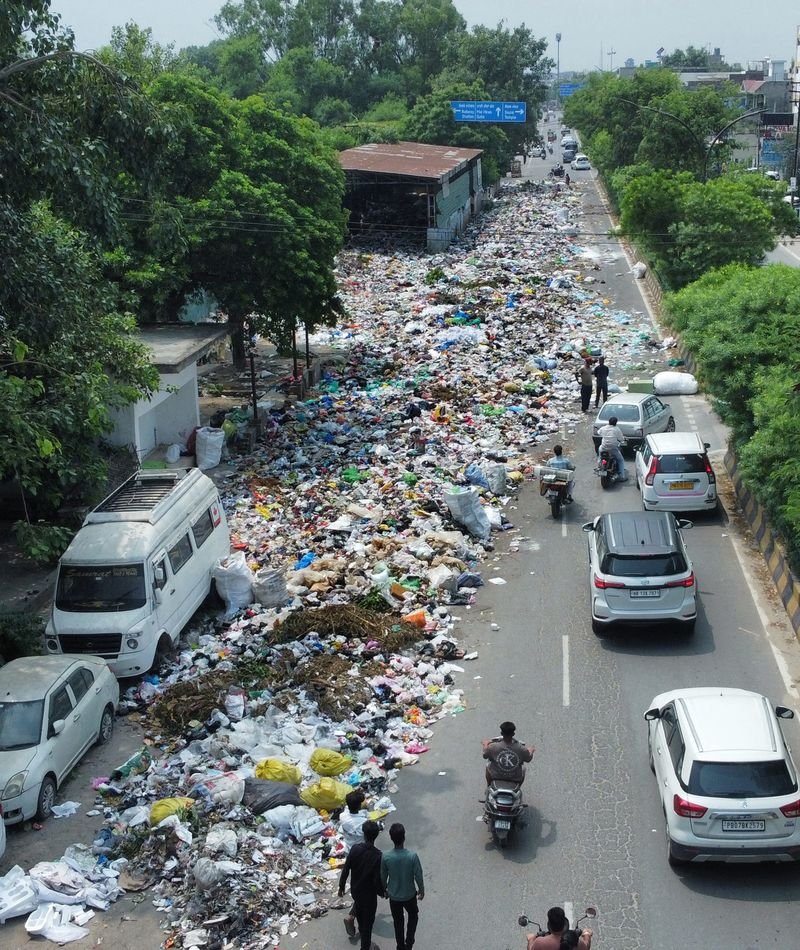

A recent strike by sanitation workers in Jalandhar to protest against the Rs 607-crore integrated solid waste management project has brought to focus the chronic lack of political will to modernise the urban waste management system across the 167 urban local bodies (ULBs) in Punjab.The National Green Tribunal (NGT) has also pulled up the Punjab Pollution Control Board (PPCB) and the Local Government Department for failing to clear legacy dump sites that violate the Solid Waste Management Rules, 2016. Only this week, the NGT reprimanded the state pollution board for failing to recover Rs 8.4 crore in environmental compensation imposed for rule violations at Jalandhar’s Wariana dump site.Not just Jalandhar, major cities like Ludhiana, Amritsar, Patiala, Sangrur, Bathinda, and Mohali are all grappling with mounting garbage piles, though the magnitude varies. The state currently faces a backlog of 47.75 lakh metric tonnes (LMT) of legacy waste.Local Government Department officials admit that the technology for disposal of solid waste has not been upgraded with time, resulting in legacy waste piling up in major cities. The recent strikes across the state exposed a delicate conflict: how to modernise an antiquated municipal framework without displacing thousands of marginalised sanitation workers.The CAG AuditA CAG audit reveals that Punjab’s solid waste management crisis is not merely a resource problem, it is fundamentally a governance issue.According to the performance audit data from the Comptroller and Auditor General (CAG) of India, Punjab generated roughly 4,222 metric tonnes (MT) of solid waste daily in 2021-22. While municipal machinery managed to collect nearly all of it (4,207 MT), it treated a dismal 1,471 MT per day — a processing rate of barely 35 per cent. Nearly two-thirds of all waste collected in the state is left untreated. More damning is the financial underutilisation. Of Rs 1,011.33 crore allocated for solid waste management infrastructure across Punjab’s ULBs between 2017 and 2022, barely 68 per cent was actually spent. In sample audits of 20 representative municipalities, fund utilisation slumped below 50 per cent.“The funds are lying in designated accounts, routed through various infrastructure boards, but project execution remains crippled,” noted a senior Local Government official, not wishing to be named. “ULBs lack internal technical audit teams, and most municipalities generate almost zero revenue from user fees — barely collecting Rs 3.7 crore across all the local bodies. They remain perpetually reliant on delayed Central and state grants.”Enforcement laxityThe regulatory roadmap has existed on paper for years. The Solid Waste Management Rules mandated source segregation into wet, dry, and hazardous streams. A directive reinforced by the framework updates introducing centralised digital tracking, strict environmental penalties, and four-stream segregation.However, on the ground across Mohali, Sangrur, or Amritsar, households rarely segregate waste. The reason is simple: civic infrastructure does not support it. Municipalities continue to operate non-compartmentalised, open vehicles. When segregated household waste is dumped into the same truck bed, public trust collapses.Public-Private Partnership (PPP) models for waste-to-energy and processing plants have also repeatedly collapsed across the state. Faulty concession contracts, unbalanced risk sharing, missing operational milestones, and a lack of independent dispute resolution have turned once-promising waste processing facilities into abandoned shell structures.The way forwardBehind the policy failure lies a human crisis. Sanitation workers, largely belonging to socio-economically marginalised communities, view corporate PPP projects and mechanised waste processing as direct threats to their livelihood. With years of political reliance on these worker unions during election cycles, the state leadership has consistently backtracked on technology upgrades the moment a strike is announced.Experts argue that breaking this impasse requires shifting from aggressive top-down mandates to an inclusive, service-led model.Punjab, they say, must adopt a phased enforcement approach. Instead of fining households and businesses for non-segregation, ULBs must first be legally audited for “segregation readiness” — ensuring dual-bin trucks and operational Material Recovery Facilities (MRFs) exist in every ward.Second, the state must integrate existing sanitation workers into formal municipal structures. Successful national models — such as Pune’s SWaCH cooperative or Ambikapur’s self-help group model — demonstrate that informal waste pickers can be organised into formal, fee-collecting cooperatives. By giving existing workers legal dignity, direct household user-fee collection rights, and access to recycling revenues, Punjab can modernise its waste systems without forcing thousands into unemployment.As judicial deadlines loom and garbage mounds grow, modernising urban sanitation will demand more than court reprimands and digital portals. It will require political courage to fix municipal finance, redesign PPP contracts, and bring the state’s frontline sanitation workers into the fold of reform.