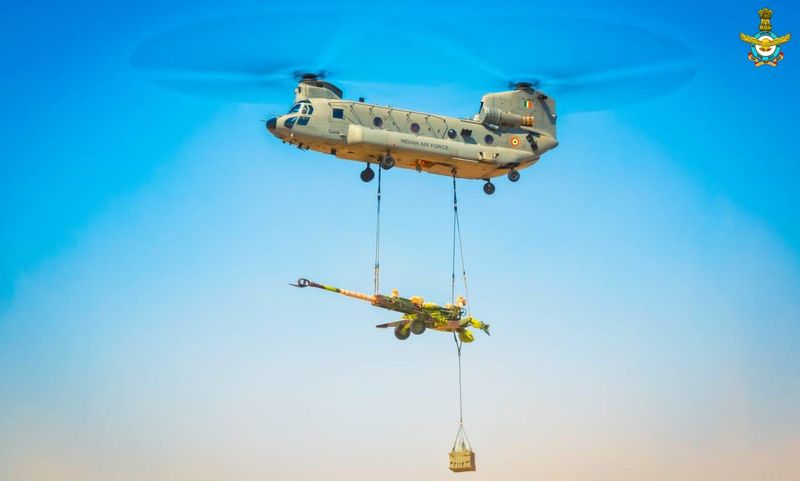

A year ago, in utmost secrecy, the Indian Army executed its first-ever air mobilisation of a specialised artillery unit that was employed to destroy terrorist camps in Pakistan during Operation Sindoor. As details of the operation unfolded a few months later, these also provided an insight into the intricate planning, professional acumen and unwavering leadership that went into the deployment of the artillery to neutralise targets across the border.While missiles and drones were extensively employed along the entire border striking targets in Pakistan’s hinterland, a lesser-known fact is that the artillery was used during the operation for offensive action along the International Border and Line of Control in Jammu and Kashmir. One such unit, 302 Medium Regiment, was tasked at short notice to undertake air mobilisation and ensure timely inter-command induction for the operation with utter secrecy. The unit was located “far away” from the intended area of deployment.Once the unit was tasked to orchestrate coordinated precision engagement of the most vital terrorist infrastructure in the Northern Command’s area of responsibility, it carried out a synchronised fire mission with absolute surprise and extremely high accuracy despite being under enemy observation and fire.The unit is equipped with the British-made M-777 155 mm ultra-light howitzers and used US-made M-982 Excalibur precision munitions that can hit targets up to 40 km with an error probability as low as two metres. The shell is also compatible with other weapons such as the Swedish Bofors FH-77 and the indigenous Dhanush and K-9 Vajra.The Army began inducting the M-777 in 2017 and the first Excalibur ordnance was procured in 2019. As many as 145 guns, with a few directly imported and the remaining assembled in India, have been inducted to form seven artillery regiments. Post Operation Sindoor, orders for additional Excalibur munitions have reportedly been placed.The M-777 howitzer itself weighs 4,200 kg. In comparison, the Bofors weighs 11,500 kg and Dhanush weighs about 13,000 kg. Mobilisation does not involve moving just the guns but also ammunition and a paraphernalia of equipment such as communication, observation and target acquisition equipment, spares, tools, camouflage and protection gear. During airlift, the guns are transported as underslung cargo by IAF CH-47 Chinook of Mi-17 V5 helicopters.The Commanding Officer of 302 Medium Regiment, Col Koshank Lamba, who hails from Haryana and is an alumnus of the National Defence Academy, was decorated with the Vir Chakra for his role in Operation Sindoor.“The officer because of his vast experience was moved at short notice and was instrumental in carrying out acquisition and analysis of one of the most difficult targets. His technical prowess on equipment, tactical knowledge and time-bound relentless mission-oriented training transformed his subunit to mission-capable within five days,” the citation for his award states.“Once the enemy retaliated with heavy bombardment, with utter disregard to personal safety, the commanding officer kept moving from gun to gun thereby motivating his troops ensuring mission accomplishment. His resolute leadership and bravery in the face of enemy fire resulted in destruction of multiple terrorist camps and neutralisation of a large number of terrorists,” the citation adds.Another artillery unit involved in intense planningAnother precision strike artillery unit, 1988 (Independent) Medium Battery, was involved in intense planning to determine precise target coordinates using the latest satellite imagery and meticulously briefing commanders-in-chain on execution methodology.Its Officer Commanding, Lt Col Sushil Bisht, decorated with the Vir Chakra, led the unit through rigorous rehearsals, focusing on achieving tactical surprise and swift extrication. Upon receiving orders to strike terrorist camps, he swiftly deployed his unit under cover of darkness and led the assault by targeting precisely, causing complete destruction of terrorist camps. Despite enemy counter-bombardment threat, he ensured safe and timely extrication of all troops under his command.He was again tasked with the destruction of a key target. Without delay he brought his unit to readiness and displaying undaunted courage under intense attack and constant enemy shelling, led his men to success.At the sub-unit level involving close support weapons, Naib Subedar Satish Kumar, Mortar Position Controller with the 4th Battalion of the Dogra Regiment, exhibited exemplary leadership, tactical acumen and unwavering courage when his post along the Line of Control came under intense enemy artillery and mortar fire.Displaying exceptional tactical proficiency and battlefield awareness, he swiftly directed accurate retaliatory fire. Under his command, mortar detachments set fire on various enemy positions, destroyed the targets, two surveillance cameras and caused substantial material loss to the enemy.In addition, his counter-bombardment and counter-mortar operations suppressed the retaliatory fire and ensured tactical dominance without any casualty or damage to own mortar platoon, for which he was awarded the Vir Chakra.